
Slab leaks
Water Line Reroute vs Repair Under the Slab
A water line reroute abandons the leaking pipe in the slab and runs a new supply line through the attic or walls, so future leaks happen where they can be seen and reached.
On this page
Key takeaways
- A reroute replaces a leaking supply line under the slab with a new line overhead or in the walls; the old pipe is capped and left in place.
- Fixr's national estimate for rerouting lines out of the slab is $4,000 to $15,000, against $1,000 to $4,000 for a single slab leak repair (May 2025); local quotes vary.
- PEX is a common reroute material; the HUD-backed PEX design guide says a home-run layout uses about 1.8 times more pipe than other layouts but the fewest fittings (HUD User PEX design guide).
- PEX should not be left in sunlight, and the same guide says to leave 1/8 inch of slack per foot so the tubing can contract.
- In New Orleans, removing or replacing water piping needs a plumbing permit from the Sewerage and Water Board (City of New Orleans).
- Attic lines in the Gulf South still need freeze protection; the January 2025 snowstorm brought record-tying lows of 22°F and 21°F at the New Orleans airport.
What is a water line reroute?
A water line reroute is a repair that bypasses a leaking supply pipe under the slab by running a new pipe along a different path, usually through the attic and down inside the walls to each fixture. The old pipe stays in the concrete, cut off and capped, and carries no water.
It applies to pressurized water supply lines, the hot and cold pipes that feed sinks, tubs, toilets and the water heater. Drain lines are a different matter: they rely on gravity and slope, so they cannot simply be lifted into the attic. If the leak is on a drain, see slab leak repair cost and foundation settlement and plumbing.
A reroute can cover one branch, such as the hot line to a single bathroom, or every supply line in the house. The second is effectively a repipe.
When is a reroute better than a slab repair?
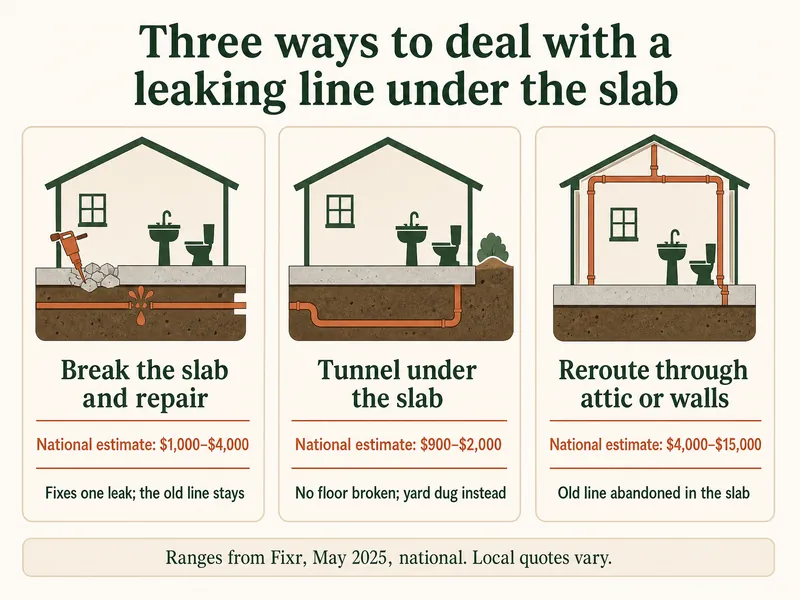
A water line reroute is often the better choice when the slab line has leaked more than once, when the pipe is old enough that more leaks are likely, or when the leak sits under flooring that would be costly to break out. Fixing one spot leaves the rest of the buried line in place; a reroute retires it.
A direct repair can make more sense when the leak is a single failure in otherwise sound pipe, when it sits near an outside wall that makes tunneling under the slab short, or when the house has no workable attic route.
| Option | What happens | What drives the price |
|---|---|---|
| Water line reroute | New supply line through attic or walls; old slab line capped | Number of fixtures served, length of run, drywall openings and patching, permit |
| Spot repair through the slab | Break the floor over the leak, repair the pipe, patch concrete | Floor covering, cabinets or tile removed, concrete patch |
| Tunneling under the slab | Dig from outside to the pipe, repair, backfill | Distance from the outside wall, soil, backfill and yard restoration |
On cost, Fixr's national estimates (updated May 1, 2025) put rerouting lines out of the slab at $4,000 to $15,000; a one-spot repair through the slab is put at $1,000–$4,000 and tunneling at $900–$2,000. These are national estimates, as of 2026, and local quotes vary. A reroute usually costs more up front, so the question is how many future repairs it avoids.
Reroute numbers worth knowing
- $4,000–$15,000National estimate for rerouting water lines out of the slab (May 2025)Fixr cost guide
- $1,000–$4,000National estimate for a single slab leak repair (May 2025)Fixr cost guide
- 1.8xPipe used by a PEX home-run layout compared with other layouts, on averageHUD User PEX design guide (2006)
- 1/8 in per ftSlack the PEX guide says to leave in installed tubingHUD User PEX design guide (2006)
Where does the new line run?
In most slab houses the new line runs from the main supply where it enters the house, up into the attic, across the ceiling framing, and down inside interior walls to each fixture. Short openings are cut in the drywall at the top and bottom of each drop and patched afterward.
Other routes exist. Some lines run inside exterior walls, behind cabinets, or through a garage ceiling. In a raised or partly raised house, part of the run may go through the crawl space. The route matters for two Gulf South reasons: attic heat in summer and the occasional hard freeze in winter.
Attics on the Gulf Coast can freeze. The National Weather Service recorded 8.0 inches of snow at New Orleans International Airport on January 21, 2025, and record-tying lows of 22°F and 21°F on the following two days (NWS New Orleans record report, via Iowa State Mesonet). Ask how attic lines will be insulated, and read how to prevent frozen pipes in the Gulf South. For freeze nights, the Sewerage and Water Board's advice, posted by NOLA Ready, is to run only the indoor faucet farthest from the meter at a trickle about as thin as a strand of spaghetti, and to open the cabinet doors where pipes run.
Which pipe materials are used for a reroute?
The materials most used for a water line reroute are PEX (cross-linked polyethylene), copper and CPVC; PEX is common because it is flexible and can be pulled through walls in long runs with few joints. Each must be approved for drinking water under the plumbing code that applies in your parish.
The PEX design guide prepared for HUD's Partnership for Advancing Technology in Housing describes its traits in detail (HUD User, 2006):
- Layout. Trunk-and-branch, home-run (a separate line to each fixture from a manifold), or remote manifold. Home-run uses about 1.8 times more pipe on average but the fewest fittings.
- Freezing. Water-filled PEX can usually freeze and thaw without splitting when it has room to expand, as in walls and ceilings; the guide notes PEX inside a slab may not be able to expand evenly.
- Sunlight. PEX should not be installed where it is exposed to sunlight unless protected, because UV degrades it.
- Disinfectants. The guide reports research finding free chlorine generally more aggressive to PEX than chloramines. New Orleans' Carrollton plant disinfects with chloramine, with a highest running annual average of 3.3 ppm in the 2025 Carrollton Water Works report (see chloramine in water).
Copper is rigid, so a copper reroute uses more fittings and joints than a flexible run. Whatever the material, fittings and solder for drinking water must be lead-free; SWBNO's 2025 water quality report notes that "lead-free" now means no more than 0.25% lead, down from 8% before January 2014 (SWBNO water quality reports).
How long does a water line reroute take?
A water line reroute can take from part of a day for one short branch to several days for a whole house, plus drywall patching and the permit inspection; no published survey gives typical durations. The schedule depends on the number of fixtures, attic access, wall construction and how quickly the inspection is booked.
Water is usually off only while the new line is tied in, not for the whole job. Ask for a written plan that covers when water will be off, which walls will be opened, who patches and paints, and when the inspection happens.
What should you ask before a reroute?
Before agreeing to a reroute, ask what exactly is being replaced, where the new line will run, and who pulls the permit. In New Orleans the city says a plumbing permit is needed to remove or replace any water piping, the application has to come from a master plumber licensed in Orleans Parish, and the Sewerage and Water Board, not Safety and Permits, issues it (City of New Orleans). Jefferson Parish permit rules were not verified for this page.
A short list to take to every quote:
- Is this one branch or the whole house, and why?
- Which material, which fittings, and what layout?
- How will attic lines be insulated against freezing and kept out of sunlight?
- How many wall openings, and is patching and painting included?
- What happens to the old line in the slab?
- Will your insurer help with any part of the cost? See does homeowners insurance cover slab leaks.
For the full picture of slab plumbing problems, start with the slab leak guide or browse all guides.
How we put this page together
This page draws on the PEX design guide prepared by the NAHB Research Center for HUD's Partnership for Advancing Technology in Housing (2006), New Orleans' permit guidelines brochure, SWBNO's 2025 water quality report, and National Weather Service records for January 2025. The cost ranges come from Fixr's national cost guide (May 2025) and are credited by name without a link. Everything was re-read in October 2026. Not included: per-foot repipe prices, brand comparisons and contractor quotes, none of which could be traced to a primary source.
Common questions
Is rerouting a water line the same as repiping?
A reroute replaces one or more supply lines; a repipe replaces all of them. A whole-house reroute out of the slab is, in practice, a repipe of the supply side.
Does a reroute fix a leaking drain under the slab?
No. Drains depend on gravity and slope, so they generally stay below the floor. A drain leak needs a repair through the slab, a tunnel, or another drain method.
What happens to the old pipe left in the slab?
It is cut and capped so it carries no water. It stays in the concrete, which avoids breaking the floor to remove it.
Is PEX safe for drinking water?
PEX sold for potable water must meet product standards for drinking-water use. Ask the plumber which certified product and fittings will be used and keep the paperwork.
Can attic water lines freeze in Louisiana?
Yes, during hard freezes. New Orleans International Airport tied record lows of 22°F and 21°F in January 2025. Insulated lines and keeping heat on help.
Will drywall have to be opened for a reroute?
Usually, in small sections where lines drop to fixtures. Ask how many openings are planned and whether patching and paint are in the price.
How does a reroute affect water pressure?
A well-sized new line should deliver normal pressure. Ask how pipe sizes were chosen, especially for long runs to distant bathrooms.
Related guides

More guides: the Below the Slab home page.