
Slab leaks
Does Homeowners Insurance Cover Slab Leaks?
Does homeowners insurance cover slab leaks in Louisiana? Often it covers sudden, accidental water damage, while gradual leaks, earth movement, flood and sewer backup are usually excluded; the exact answer is in your policy wording.

On this page
Key takeaways
- Louisiana's Broad Form homeowners coverage includes "accidental discharge of water or steam from within plumbing" (Louisiana Department of Insurance).
- The same guide lists flood, surface water, water that backs up through sewers or drains, and earth movement as not covered.
- Washington State's insurance regulator explains that most policies don't cover gradual leaks, and gives "a leaky pipe behind a wall or under the floor" as the example (Washington OIC).
- The NAIC says a homeowners policy "isn't a maintenance contract" and that sewer and drain backup is sold as an endorsement (NAIC consumer guide).
- Flood is a separate policy: FEMA says homeowners can buy NFIP coverage of up to $250,000 for the building and $100,000 for contents (FEMA), and a new policy usually has a 30-day wait.
- Whether access or "tear-out" costs are covered depends on the policy, so ask the insurer before work starts.
Does homeowners insurance cover a slab leak?
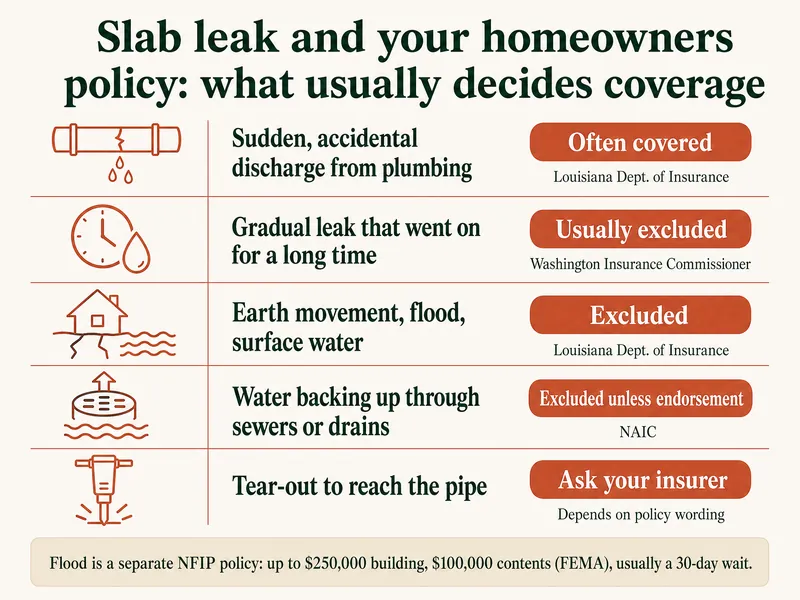
For Louisiana slab houses, homeowners insurance often covers the water damage from a slab leak when the leak is sudden and accidental, and often does not when the leak was gradual, caused by earth movement, or caused by flood or a sewer backup. Coverage depends on the policy form and its exact wording, so the same leak can be handled differently by two insurers.
The Louisiana Department of Insurance (LDI) describes the policy forms sold in the state. The Broad Form covers "freezing of or accidental discharge of water or steam from within plumbing, heating/air conditioning systems, domestic appliances," and the Special Form covers "all risks" except named exclusions such as flood (LDI Consumer's Guide to Homeowners Insurance). A slab leak is plumbing, so the question is usually not whether plumbing is a covered peril but which exclusion, if any, applies.
Soil movement is a real factor in the state: an LSU-led model of expansive soils found the coastal parts of Louisiana face the highest risk, and lists ruptured pipes among the damage uneven settling can cause (Mostafiz et al., 2021). That matters because earth movement is a standard exclusion.
Three parts of a slab leak claim are worth separating, because policies treat them differently: the damage the water caused (floors, walls, belongings), the cost of reaching the pipe (tear-out and access), and the repair of the pipe itself. Read the policy for each one, and confirm with the insurer in writing.
What is tear-out and access coverage?
Tear-out, or access, coverage pays to open the floor or dig to reach a leaking pipe and to put the floor back afterward. Some policies state this; others are silent; and some state regulators have addressed it in bulletins, so the answer is in your policy wording rather than in a general rule.
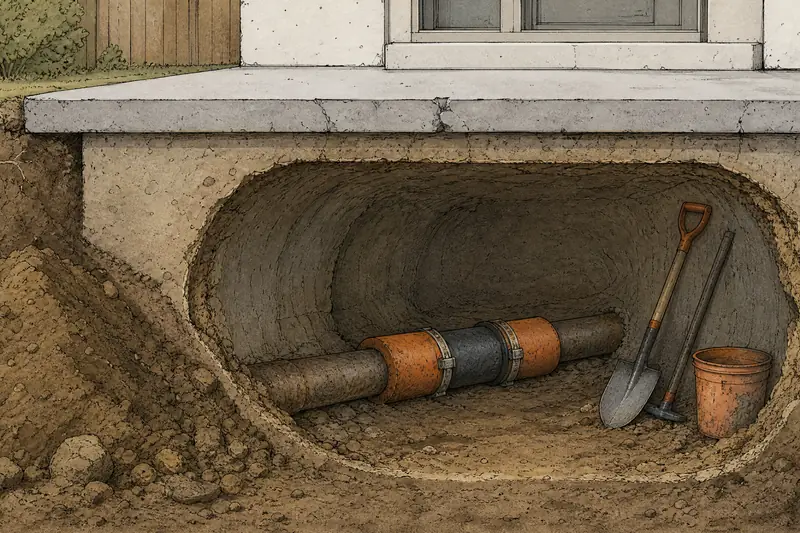
For a slab leak, access is often the expensive part. Reaching a pipe means breaking concrete from above or tunneling under the slab from outside, and then restoring floors or the yard. Fixr's national cost guide (May 2025) puts a typical slab leak repair between $1,000 and $4,000 nationally; local prices differ. See slab leak repair cost for what drives the price.
Ask the insurer three specific questions before work starts: Is the resulting water damage covered? Is tear-out to reach the leak covered, and up to what amount? Is the pipe repair covered, or treated as maintenance?
Why are gradual leaks often excluded?
Gradual leaks are often excluded because insurers treat slow, long-running damage as a maintenance problem rather than a sudden accident. Washington State's Office of the Insurance Commissioner puts it plainly: most policies "don't cover gradual leaks that have continued for long at all, even if you had no way of knowing they started" (Washington OIC). Its example is a leaky pipe "under the floor", which is where a slab leak lives.
That page is a Washington regulator's general guidance, not Louisiana law, but it explains how many policies are written. The NAIC's consumer guide makes the same point in fewer words: a homeowners policy "isn't a maintenance contract" (NAIC).
This is why early detection matters for a claim, not only for the house. A simple check is EPA WaterSense's meter test: read the meter before and after a two-hour period with no water use, and if it changes at all, a leak is probable. Learn the slab leak signs, and when one shows up, have the leak confirmed by slab leak detection and report it promptly. A dated detection report helps show when the problem was found.
| Situation | How policies usually treat it | Source |
|---|---|---|
| Sudden, accidental discharge from a supply line | Often covered for resulting water damage | LDI Consumer's Guide (Broad and Special Forms) |
| Slow leak that went on for weeks or months | Usually excluded as gradual or maintenance | Washington OIC; NAIC |
| Pipe broken by settling or soil movement | Earth movement is excluded in most policies | LDI Consumer's Guide |
| Sewage backing up through a floor drain | Excluded unless a sewer/drain backup endorsement was bought | LDI Consumer's Guide; NAIC |
| Water from outside rising into the house | Flood: not covered; needs an NFIP or private flood policy | LDI Consumer's Guide |
Insurance numbers to know
- $250,000Most NFIP building coverage a homeowner can buyFEMA
- $100,000Most NFIP contents coverage for homeowners and rentersFEMA
- 30 daysTypical wait before a new NFIP policy takes effectFEMA
- 80%Insuring below this share of the home's value can make you a co-insurer on some policiesLouisiana Department of Insurance
Does flood insurance cover a slab leak?
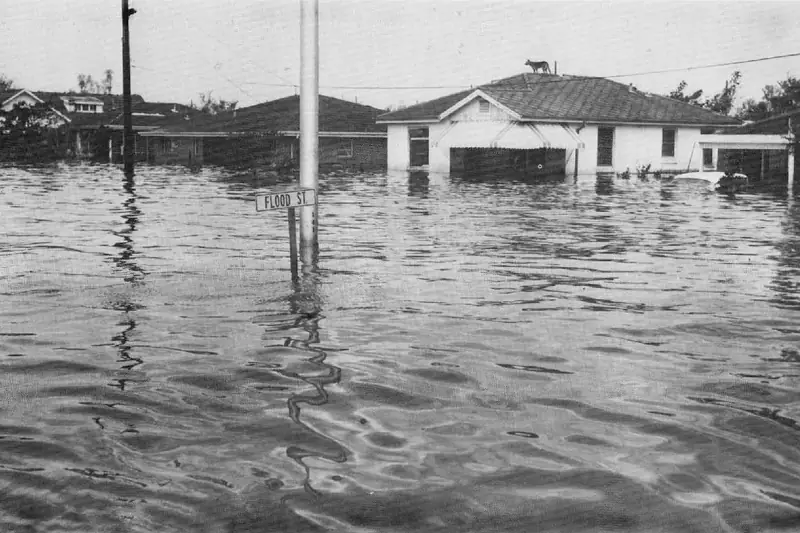
No, flood insurance generally does not cover a slab leak, because a leak from your own plumbing is not a flood. Flood policies cover water from outside rising into the house; homeowners policies, in turn, exclude flood and surface water, as LDI's guide notes.
The two policies sit side by side in Louisiana. LDI urges homeowners to look into a separate flood policy "no matter where you live" and warns that a new flood policy may take 30 days to take effect. FEMA, which runs the National Flood Insurance Program, puts the most a homeowner can buy at $250,000 for the building and $100,000 for contents, and says there is typically a 30-day waiting period before an NFIP policy starts. If a storm floods a slab house and also damages pipes, the adjusters will sort out which policy pays for which damage, so keep both policies and their declarations pages together.
Sewer backup is a third, separate item. It is excluded from standard homeowners policies but can usually be added as an endorsement, according to the NAIC. For what causes backups and how backflow valves help, see sewer backup.
How do you file a slab leak claim in Louisiana?
To file a slab leak claim, stop the water, document the damage, notify your insurer or agent promptly, and keep records of every step until the adjuster has inspected. LDI's guide gives the practical steps:
- Limit further damage. LDI says you may need to make temporary repairs to prevent further damage, keep a list of the work, and save receipts. For a slab leak, that usually means shutting off the water at the main.
- Don't sign repair contracts yet. LDI advises not to sign contracts or work orders until you have spoken with your insurance company.
- Record every call. Note the name of the person you spoke with, and the date and time. An adjuster will be assigned to the claim.
- Document the damage. Photos and video of wet floors, cracked tile, the water meter and any detection report help. LDI also recommends a home inventory with photos, kept away from the house.
- Be there for the adjuster. Ask for identification, and have your policy, your list and your photos ready.
Keep the plumber's leak-detection report and repair invoice. They show where the leak was, when it was found and what was done, which is the evidence an adjuster needs to decide between "sudden" and "gradual".
What does the Louisiana Department of Insurance advise?
LDI advises reading your policy before a loss, knowing your deductibles, and asking questions first and complaining second if a claim goes badly. Its consumer guide says that if you cannot agree with the adjuster on what needs repair, "do not accept an unfair settlement"; contact the company, then the Department (LDI guide).
The guide also flags points that matter for slab leaks. Policies may value losses at actual cash value, which subtracts depreciation, or at replacement cost. Many Louisiana policies carry a separate hurricane or named-storm deductible, which can be a percentage of the home's insured value. And insuring for less than 80% of the home's value can make you a co-insurer on some policies.
If a dispute can't be settled with the company, the guide points consumers to the Department by phone or through its website, ldi.la.gov. For the house itself, start with the slab leak guide, or see foundation settlement and plumbing if soil movement is in the picture.
How we put this page together
This page is based on the Louisiana Department of Insurance's Consumer's Guide to Homeowners Insurance, the NAIC's A Consumer's Guide to Home Insurance (2022), and the Washington Office of the Insurance Commissioner's page on leaks and water damage, used only as general context. NFIP coverage limits and the 30-day wait come from FEMA's flood insurance pages; the LDI guide's NFIP limit figures, which do not match FEMA's, are not used. The single repair price range is credited to Fixr's national cost guide by name, without a link. All documents were re-read in October 2026. Deliberately omitted: claims about what every insurer pays, insurer blog advice, Louisiana claim-handling deadlines (the statute could not be loaded), and any statement that the pipe itself is or is not covered, which varies by policy.
Common questions
Will my insurer pay to replace the leaking pipe under the slab?
It depends on the policy. Many policies focus on the damage the water caused, and some treat the failed pipe as wear and tear. Ask the insurer to say in writing how the pipe repair is handled under your form.
Does homeowners insurance cover slab leaks caused by foundation movement?
Usually not, because earth movement is listed among the exclusions in most Louisiana homeowners policies, according to LDI. Resulting water damage may be treated differently, so ask.
Is mold from a slab leak covered?
Mold coverage is often limited and usually applies only when the mold comes from a covered loss, according to Washington's insurance regulator. Check your policy's mold limit.
Is it better to get leak detection before calling the insurer?
Reporting promptly matters, and a detection report helps the claim. Many homeowners notify the insurer first, then share the detection report when it is ready.
Can my insurer cancel my policy after a slab leak claim?
LDI's guide says that once a policy has been in effect and renewed for more than three years, the insurer generally cannot cancel or refuse to renew it except under listed conditions. One of those is two or more claims within three consecutive years over a five-year period. You can ask in writing for the reason for any cancellation.
Does a home warranty cover slab leaks?
A home warranty is a service contract, not insurance, and coverage of slab leaks varies by contract. Read its plumbing section and its exclusions before relying on it.
What if my insurer denies a slab leak claim?
Ask for the reason in writing, citing the policy language. If talking to the adjuster and company does not resolve it, the Louisiana Department of Insurance can help with complaints.
Related guides
More guides: the slab house plumbing guide home page.