
New Orleans & Jefferson Parish water
Do I Need a Water Softener? A City Water Answer
Do I need a water softener on New Orleans city water? No: at 4.1 to 5.9 grains per gallon the water is moderately hard, so a softener is a comfort and appliance choice you can make, or skip.
Disclosure: SoftPro Water Systems, a store owned by the same team as this site, sells the filters and softeners we link to. Our water pages follow the utilities' 2025 water quality reports and federal and state agency guidance, checked October 2026. Store descriptions are reported as the store's own claims. Ownership disclosure
View at SoftPro Water Systems
On this page
Key takeaways
- East Bank New Orleans water measured 100.7 mg/L of hardness in 2025, which converts to 5.9 gpg (Carrollton report, LDH).
- West Bank plants were lower: Algiers 4.1 gpg, West Jefferson 4.7 gpg and Gretna 4.8 gpg.
- The USGS calls 61 to 120 mg/L "moderately hard"; hard starts at 121 and very hard above 180 (USGS).
- Hardness has no federal health limit, so softening is about spotting, scale and feel, not safety.
- A salt-free conditioner is sold to reduce scale; it does not soften water or lower the gpg reading.
- Store prices checked in October 2026 start at $229 for a salt-free unit and $967 for a 32,000-grain softener, before installation.
Do I need a water softener?
Not on New Orleans or West Jefferson city water. The 2025 reports put every local plant in the moderately hard range, from 70.7 mg/L in Algiers to 100.7 mg/L at Carrollton, and hardness carries no health-based limit. A softener is something you may want, not something the water requires.
People who choose one usually want fewer spots on glassware and shower doors, less white crust on faucets and kettles, and less scale in the water heater. Those are real comforts, and they are worth weighing against the price, the salt and the upkeep. On the West Bank, where the water is softer still, the case for a softener is weaker.
The New Orleans water hardness page has the full table by water system, including why East Jefferson's figure is not shown.
How hard is hard enough for a water softener?
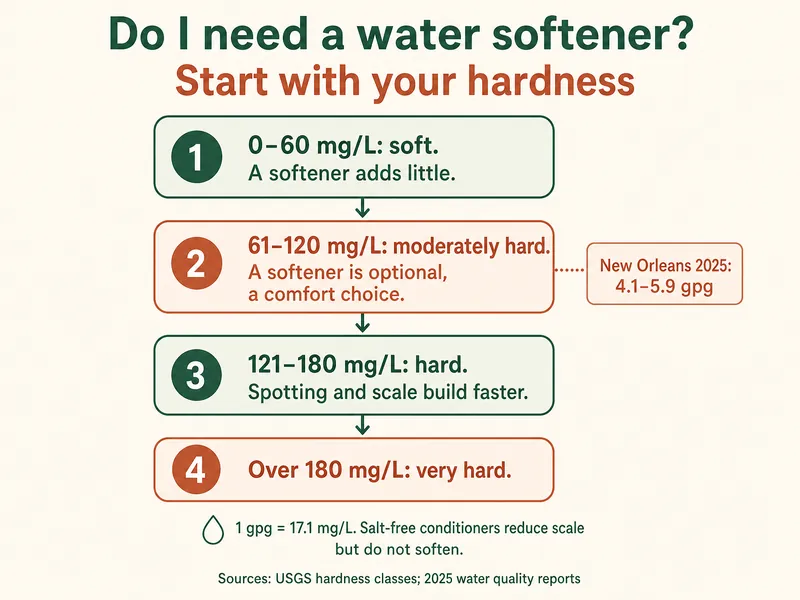
There is no official hardness level at which a softener becomes necessary. The useful yardstick is the USGS hardness scale: soft water is 0 to 60 mg/L, moderately hard 61 to 120, hard 121 to 180 and very hard above 180. Softener makers quote grains per gallon instead; Montana State University Extension gives the conversion of 17.1 mg/L to 1 gpg.
On that scale, East Bank New Orleans' 5.9 gpg sits in the upper half of the moderately hard band and the West Bank's 4.1 to 4.8 gpg in the lower half. Water in the hard and very hard classes builds scale faster, and that is where the case for softening is strongest.
| Where you live | 2025 grains per gallon | Softener verdict |
|---|---|---|
| East Bank of Orleans Parish (Carrollton plant) | 5.9 | Optional comfort choice |
| Gretna | 4.8 | Optional; weaker case |
| West Bank of Jefferson Parish | 4.7 | Optional; weaker case |
| Algiers | 4.1 | Optional; weakest case |
| Metairie and Kenner (East Jefferson) | Not verified here | Read the parish's 2025 report first |
What does a softener fix on 5.9 gpg water?
On 5.9 gpg water, a softener mainly cuts spotting, soap scum and slow scale buildup. Moderately hard water leaves some film on glass and fixtures and gradually coats heating elements and the inside of kettles; softened water does much less of that.
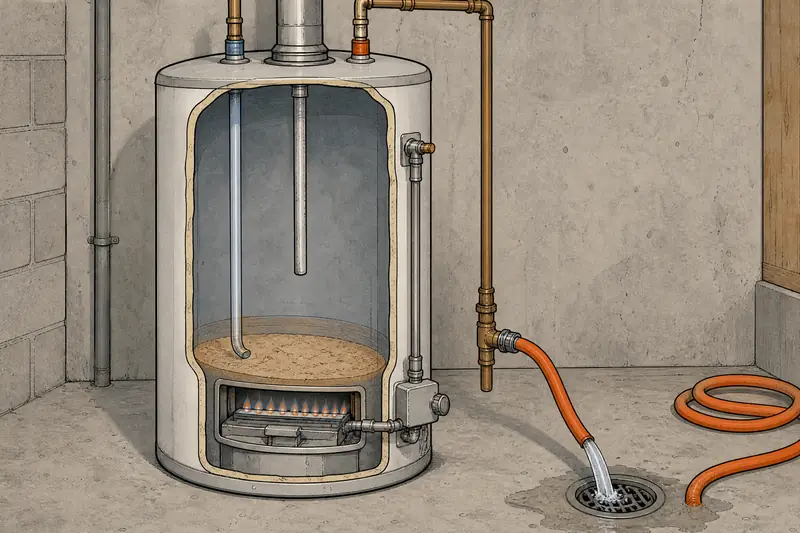
What a softener does not do matters as much. It does not change the disinfectant, so it is not a chloramine fix; the chloramine guide covers that. It is not a lead filter. And it does nothing during a boil water advisory. Water heater sediment still needs draining on the schedule in the heater's manual, which the water heater flush guide explains.
Softening also has a cost for a tank water heater. A. O. Smith's residential gas water heater manual (326940) warns that "the use of a water softener may decrease the life of the water heater tank", because softened water speeds up wear on the anode rod that protects the tank. The manual says to inspect the anode after no more than three years and then every year until it needs replacing, so a softened house should put that check on the calendar.
Salt-based softening exchanges hardness minerals for sodium. The 2025 Carrollton report lists sodium in the tap water at 22.6 mg/L before any softening; anyone on a sodium-restricted diet should ask a doctor before adding a salt-based softener.
The numbers behind the answer
- 5.9 gpgHardness at the Carrollton plant in 2025, equal to 100.7 mg/LLDH 2025 water quality report
- 4.1 gpgAlgiers Water Works hardness (70.7 mg/L), 2025LDH 2025 water quality report
- 121 mg/LWhere the USGS "hard" class beginsUSGS Water Science School
- 22.6 mg/LSodium already in East Bank tap water, January 2025 sampleLDH 2025 water quality report
Salt-based or salt-free: what's the difference?
A salt-based softener removes hardness; a salt-free conditioner does not. A salt-based softener uses resin that swaps calcium and magnesium for sodium, then regenerates with brine from a salt tank, which needs a drain and electricity. Your test strip reading drops toward zero after it.
A salt-free conditioner is sold to keep minerals from forming scale, without salt, a drain or regeneration. The minerals stay in the water, so a hardness test reads about the same after it, and you will not get the slick feel of softened water. It is the lower-cost, lower-upkeep option if scale on fixtures is your only complaint.
What does a water softener cost to own?
Owning a softener means the unit, a licensed plumber's installation, salt, and the water and power used in regeneration. In New Orleans, the city's permit guide says a permit is needed to remove or replace water piping, issued by the Sewerage and Water Board on application by a licensed master plumber. This site does not print local installation prices; ask for a written quote.
Store prices give a sense of the equipment cost. These are the store's prices on its pages in October 2026, for the softener or conditioner alone:
- The SoftPro ECO City Water Softener (sold by SoftPro Water Systems, a store we own) is listed at $967 for the 32,000-grain size, with larger sizes at $1,117 and $1,447. The store says it uses 10% less salt than traditional systems.
- The SoftPro Elite Smart HE (sold by SoftPro Water Systems, a store we own) is listed at $1,367 for 32,000 grains. The store says a typical household uses one 40 lb bag of salt every 2 to 4 months and that it regenerates about every 14 days.
- The SoftPro FORTRESS Salt-Free Conditioner (sold by SoftPro Water Systems, a store we own) is listed at $229 for the Home model (6 GPM, about 1 to 2 bathrooms, by the store's sizing) and $529 for the Pro.
Salt use and regeneration figures are the store's own claims. At 5.9 gpg any of these is an optional purchase; if you want to try softening, starting with the smallest size that fits your household's daily water use keeps the cost down.
Optional on city water
SoftPro ECO City Water Softener
New Orleans East Bank tap water measured about 5.9 grains per gallon in the 2025 Carrollton report: moderately hard, so a softener is a choice, not a need. If scale on fixtures and spotting bother you, try a city-water softener sized to your household; check sizes and current prices at SoftPro Water Systems. See what 5.9 gpg means.
View at SoftPro Water SystemsSoftPro Water Systems, a store owned by the same team as this site, sells the filters and softeners we link to. Ownership disclosure
When can you skip a softener?
You can skip a softener whenever the spotting and scale do not bother you, and on New Orleans water that is a perfectly sound choice. It makes even more sense if you are on the West Bank (4.1 to 4.8 gpg), if you rent or expect to move soon, if a sodium-restricted diet rules out salt-based softening, or if there is no good spot near the main line with a drain.
Cheaper habits cover a lot of the difference: wiping glass shower doors, cleaning faucet aerators, and draining the water heater as its manual directs. If tap water taste is your real concern, that is a filter question, not a softener one; see the whole house water filter guide and the tap water safety page.
How we put this page together
Sources for this page: hardness and sodium results in four 2025 utility reports (Carrollton, Algiers, West Jefferson, Gretna) from the state health department's archive, the USGS hardness classes, a Montana State University Extension unit conversion, New Orleans permit guidance, and SoftPro's listings, all checked in October 2026. Store prices and salt-use figures are the store's own. Installation quotes, zip-code hardness maps and appliance-lifespan claims were left out because no primary source supports a local figure.
Common questions
Is 5.9 grains per gallon considered hard water?
By the USGS classes, 5.9 gpg (about 100 mg/L) is moderately hard, not hard. The hard class starts at 121 mg/L, about 7.1 gpg.
Does a water softener help with dry skin and hair?
Some people find softened water feels different on skin and hair, and the store markets its softeners for that. There is no health limit for hardness, and the sources on this page do not measure skin effects, so treat it as personal preference.
Can a water softener damage plumbing?
A properly sized and installed softener is a common household appliance, but it can shorten a tank water heater's life. A. O. Smith's gas heater manual (326940) warns that softened water wears out the tank's protective anode faster and can shorten the tank's life, and it calls for a yearly anode check after the first three years (A. O. Smith). Have a licensed plumber connect the softener to the main line and drain, following the maker's installation manual.
Is softened water safe to drink?
It adds some sodium, on top of the 22.6 mg/L already in East Bank water in 2025. Most households drink it; people on low-sodium diets should ask a doctor, or keep one unsoftened tap for drinking.
How long does a water softener take to pay for itself?
No sourced figure supports a payback period on 5.9 gpg water, so this site does not give one. The benefits are comfort and less scale cleaning rather than a measured saving.
Do salt-free conditioners actually work?
They are sold to reduce scale formation, not to soften, so a hardness test will not change. Judge one by whether it reduces scale on fixtures, and check the maker's own claims and any certification for the specific model.
Should renters buy a water softener?
A whole-house softener needs a plumbing connection, a drain and usually the owner's permission. On moderately hard water, renters lose little by skipping it.
Related guides
More guides: the Below the Slab home page.