
New Orleans & Jefferson Parish water
Lead in Drinking Water and Lead Service Lines
Lead in drinking water comes from pipes and fixtures, not the river: New Orleans' 2025 report shows 6 ppb at the 90th percentile, so check your service line, flush, test, and use a filter certified for lead if needed.
On this page
Key takeaways
- The EPA says lead service lines are typically the most significant source of lead in tap water, and brass or chrome-plated brass faucets the most common fixture problem (EPA).
- East Bank New Orleans sampling for 2023–2025 found 6 ppb at the 90th percentile, a range of 0 to 23 ppb, and 2 of 85 samples above the 15 ppb action level.
- West Jefferson's 90th-percentile result was about 2.4 ppb, with no sites over the action level.
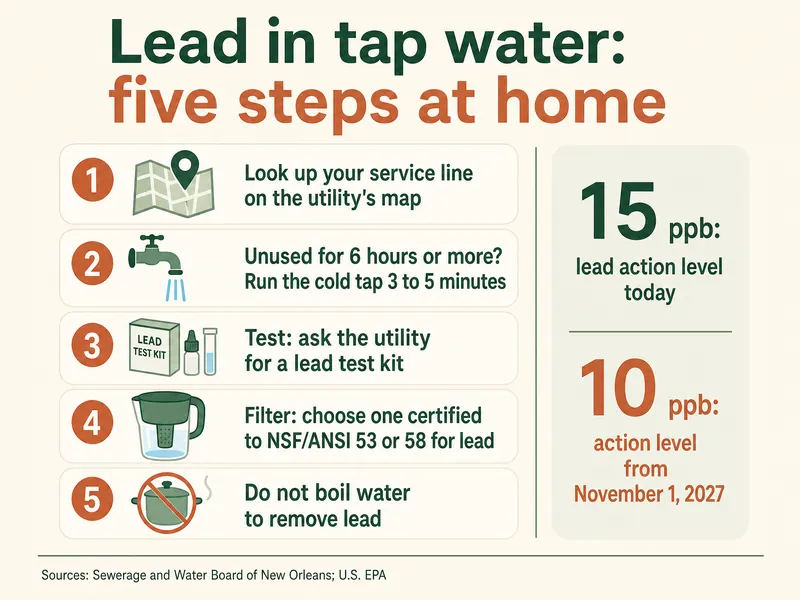
- The federal action level drops to 10 ppb from November 1, 2027, under the EPA's Lead and Copper Rule Improvements (EPA).
- The Sewerage and Water Board has a service-line map, a test kit request and a lead-filtering pitcher on request (SWBNO).
- Boiling does not remove lead; a filter needs an NSF/ANSI 53 or 58 listing that names lead.
How does lead get into drinking water?
Lead gets into drinking water from the plumbing between the main and your glass, not from the river or the treatment plant. The EPA's basic lead information page says lead enters water "when plumbing materials that contain lead corrode", and that lead service lines are typically the most significant source.
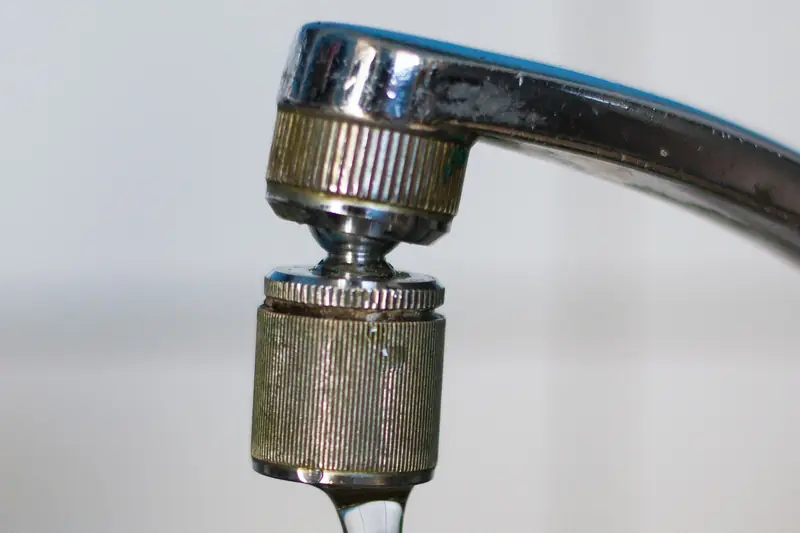
Inside the house, the EPA says the most common problem is brass or chrome-plated brass faucets, along with lead solder on older copper pipe. It adds that lead pipes are more likely in older cities and in homes built before 1986. Today's "lead-free" rules cap the weighted average lead content of pipes, fittings and fixtures at 0.25%; the Sewerage and Water Board's 2025 report notes that fixtures sold before January 2014 could carry the label with up to 8%.
Water that sits still in the pipes picks up more metal, which is why the first water out of a tap in the morning is the one to flush. Utilities add corrosion control to slow this; the Sewerage and Water Board uses lime, and a zinc orthophosphate pilot on the West Bank.
What do New Orleans lead results show?
New Orleans lead results were under the action level at the 90th percentile, with a small number of homes above it. The 90th percentile is the figure compared with the action level, which is why reports lead with it.
| Water system | 90th percentile | Range | Samples over 15 ppb | Source |
|---|---|---|---|---|
| Carrollton (East Bank New Orleans), 2023–2025 | 6 ppb | 0–23 ppb | 2 of 85 | LDH and SWBNO 2025 reports |
| Algiers (West Bank New Orleans) | 6 ppb | 0–100 ppb | 2 of 52 | SWBNO 2025 report |
| West Jefferson Water Works District 2, 2023–2025 | about 2.4 ppb | 0–7.2 ppb | 0 | LDH 2025 report |
| East Jefferson (Metairie, Kenner) | Not listed on this site | – | – | Parish 2025 report |
The ranges matter more for a household than the 90th percentile. The East Bank's highest result was 23 ppb and Algiers' was 100 ppb, which shows that a single home can differ sharply from the citywide figure. The Carrollton report, the West Jefferson report and the Sewerage and Water Board's annual water quality report give the full rows. The tap water safety page puts lead alongside the other 2025 results.
The EPA's position is that no level of lead in children's blood is known to be safe, and the CDC says no safe blood lead level in children has been identified. That is the reason to test your own tap rather than rely on an average.
Lead by the numbers
- 6 ppbLead at the 90th percentile, East Bank New Orleans, 2023–2025 samplingLDH 2025 water quality report
- 15 ppbFederal lead action level in force todayEPA
- 10 ppbAction level from November 1, 2027 under the Lead and Copper Rule ImprovementsEPA
- $6,930EPA's mean cost estimate for one full lead service line replacement (2020 dollars)EPA LCRI economic analysis
How do you know if you have a lead service line?
Look up your address on the Sewerage and Water Board's map, then check the pipe where it enters the house. The SWBNO lead awareness page has a map where you "search your address" to see the status of your water service line. Utilities had to file an initial service line inventory by October 16, 2024 under the EPA's rules, so many lines are now listed, though some are still marked unknown.
You can also look at the pipe yourself, usually near the meter or where the line comes up into the house. The EPA's Protect Your Tap guide walks through checking the pipe with nothing more than a key or penny and a magnet. A licensed plumber can confirm the material if you are unsure. On a slab house the line may run under the slab, which the slab leak guide explains.
How do you test your water for lead?
Test with a kit from the utility or a certified lab, and follow the sampling instructions exactly. The Sewerage and Water Board says that, depending on availability, a test kit with instructions will be mailed to your address, and its 2025 report describes the kit as free.
Until you have results, use the habits both the EPA and the utility recommend. When water has not been used for six hours or longer, the Sewerage and Water Board says to run the faucet for three to five minutes before drinking or cooking. The EPA says to use only cold water for drinking, cooking and baby formula. Do not boil water to remove lead; the EPA says "boiling water does not remove lead".
Which filters are certified to reduce lead?
A filter reduces lead only if its certification says so. NSF's guidance is direct: a product "must say NSF/ANSI 53 or NSF/ANSI 58 to be sure it reduces lead", and its lead reduction listing shows certified pitchers, faucet mounts, under-sink units and reverse osmosis systems. The Sewerage and Water Board also recommends a filter that meets NSF Standard 53 and offers a lead-filtering pitcher on request.
Watch for NSF/ANSI 372 on product pages. It certifies that the product's own parts are lead-free; it is not a lead reduction claim.
Reverse osmosis is one option for drinking water at a single tap, but certification is model-specific: a system only counts for lead if its listing names lead reduction under NSF/ANSI 58 or 53, so check the certifier's listing for the exact model before you buy. An NSF/ANSI 53 pitcher or faucet filter that names lead is a lower-cost way to cover lead if that is the only concern.
Who replaces a lead service line?
Replacement is split between the utility and the property owner. The Sewerage and Water Board says it is responsible for replacing the public side of a lead line, and that property owners are typically responsible for the portion on their property. Its 2025 report says regulations require all lead water lines to be removed by December 31, 2037, and that it has secured $86 million from the State Revolving Fund and applied for $66 million more.
The EPA's Lead and Copper Rule Improvements require most systems to replace lead service lines within 10 years. For a sense of scale, the EPA's economic analysis estimates a mean of $6,930 for a full replacement and $3,803 for a partial one, in 2020 dollars; that is a national estimate, not a local quote. Work on the private side in New Orleans needs a plumbing permit from the Sewerage and Water Board, applied for by a licensed master plumber, as the Louisiana plumbing code page explains. Testing again after any work on the line confirms where you stand.
How we put this page together
This page draws on the EPA's lead information page, Lead and Copper Rule Improvements page and economic analysis, CDC lead guidance, NSF's lead reduction listing, the Sewerage and Water Board's lead awareness page and 2025 annual water quality report, and the 2025 Carrollton and West Jefferson reports on the Louisiana Department of Health site, all checked in October 2026. No store or maker pages for a reverse osmosis unit were used, and the page links to no store. East Jefferson's lead results are not included: the parish's report blocked every attempt to open it. Medical advice is left to doctors and pediatricians.
Common questions
What level of lead in tap water is considered dangerous?
No level of lead in a child's blood is known to be safe, according to the EPA. The 15 ppb action level is a trigger for utility action, not a safe threshold, and it drops to 10 ppb in November 2027.
Can a home have lead when the city's results are low?
Yes. Lead comes from service lines and plumbing at each address, and 2025 East Bank results ranged from 0 to 23 ppb even though the 90th percentile was 6 ppb. Testing your own tap is the only way to know.
Does a water softener or whole house filter remove lead?
Only when that product's NSF/ANSI 53 or 58 certification lists lead. Softeners are sold for hardness, and many whole-house filters are sold for taste and chloramine; see the whole house water filter guide.
Is it safe to shower in water with lead?
The EPA's advice focuses on water you drink and cook with: use cold water for drinking, cooking and baby formula, and flush before use. Ask a doctor about any specific health concern.
Do pitcher filters remove lead?
Only models certified to NSF/ANSI 53 for lead. Certification is model by model, so check the exact pitcher or cartridge on NSF's lead reduction listing.
How long does lead service line replacement take in New Orleans?
The Sewerage and Water Board describes a 10-year replacement timeline starting in 2027, and its report cites a December 31, 2037 deadline. Ask the utility when your street is scheduled.
Who pays to replace the private side of a lead line?
The Sewerage and Water Board says property owners are typically responsible for the portion on their property. Ask the utility whether any funding applies to your address before hiring a plumber.
Related guides
More guides: the Below the Slab home page.