
Sewer & drains
Orangeburg Pipe: Spot It and Plan the Replacement
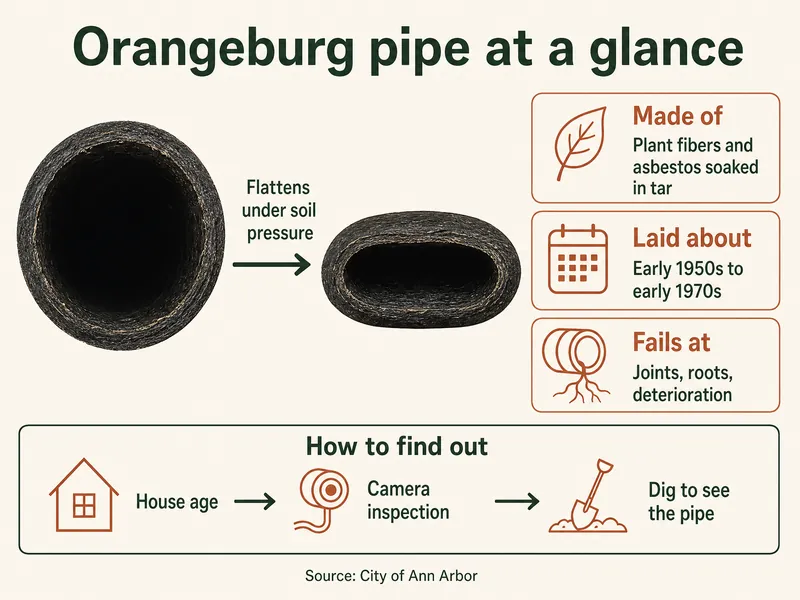
Orangeburg pipe is a tar-soaked fiber sewer pipe that the City of Ann Arbor dates to roughly the early 1950s through the early 1970s; it flattens as it deteriorates, so the realistic plan is replacement.
On this page
Key takeaways
- The City of Ann Arbor describes Orangeburg as bituminous fiber pipe: plant fibers and asbestos soaked in a tar-like substance.
- Ann Arbor's working range for installation is the early 1950s to the early 1970s, and it says the pipe was likely not used after the early 1970s.
- The same page says failures are usually at the joints, from shifting bedding, root intrusion and deterioration that flattens the pipe; solvents and paint thinner speed the damage.
- The City of Morro Bay, California lists Orangeburg as one of four key defects to flag in private sewer video (Morro Bay video standard).
- Ann Arbor calls trenching the standard replacement method and pipe bursting an emerging alternative; Fixr's national range for sewer line replacement is $1,000 to $20,000 (January 2025).
- Louisiana's homeowners insurance guide says most policies exclude earth movement and water that backs up through sewers or drains (LDI).
Orangeburg pipe in brief
- Early 1950s–early 1970sInstallation window the City of Ann Arbor treats as a reasonable assumptionCity of Ann Arbor
- 4Key defect types in Morro Bay's private sewer video standard, Orangeburg among themCity of Morro Bay
- $1,000–$20,000National range for replacing a sewer line, January 2025Fixr
- $300–$600National range for the camera inspection that identifies the pipe, January 2025Fixr
What is Orangeburg pipe?
Orangeburg pipe is a sewer pipe made of fiber and tar rather than clay, iron or plastic. The City of Ann Arbor's building department explains that Orangeburg is a brand name and that the material is generally called bituminous fiber pipe, made from plant-based fibers and asbestos soaked in a tar-like substance. Morro Bay's video standard describes it more simply as asphalt-impregnated paper. The name often turns up in home inspection reports for houses of that era, which is why buyers ask about it.
The trouble is the material itself. Fiber and tar do not hold their shape the way fired clay or iron does, and Ann Arbor says the pipe flattens as it deteriorates. A round pipe slowly squeezed into an oval leaves less room for waste, catches paper and grease, and eventually closes.
How long does Orangeburg pipe last?
No reliable lifespan in years has been published by an agency, so this guide does not give one; what is documented is how it fails. Ann Arbor says failures usually occur at the joints, caused by shifting bedding, tree root intrusion and deterioration of the material that flattens the pipe. It adds that solvents, paint thinner, mineral spirits or adhesive cleaner poured into the drains will speed that deterioration.
Age is still a fair warning sign. If Ann Arbor's window of the early 1950s to the early 1970s is right for a given house, any original Orangeburg line in it is now more than 50 years old. Whether a particular line is still round enough to work can only be answered by looking inside it.
How do you know if you have Orangeburg pipe?
The surest way short of digging is a camera inspection of the sewer line from a cleanout. Ann Arbor says a television or video scan of the pipe may be possible if the line can be accessed, and that digging down to the pipe gives positive identification but is very disruptive. On video, Orangeburg usually shows a dark fiber wall, and a pipe pressed out of round is a strong hint; the sewer camera inspection guide explains what else to look for in the footage.
Paper records help narrow it down. Ann Arbor notes there is no consistent pattern of which houses got Orangeburg, and that city replacement records and microfilm files may give clues. In New Orleans the Sewerage and Water Board's plumbing department issues the permits, so ask the board or a seller whether the sewer was ever replaced and when. A house built in the 1950s to 1970s with an untouched original sewer is the case to check first.
What does a failing Orangeburg line look like?
A failing Orangeburg line usually shows up as slow drains and backups in the lowest fixtures, often getting worse over months. Ann Arbor's page says a sewer with problems may run very slowly or back up through a fixture or floor drain. In a slab house the lowest openings are usually a shower, a tub or a first-floor toilet, so gurgling or a slow shower drain after laundry or several flushes is a common first sign.
On a camera video, the warning signs are an oval or flattened cross-section, separated or root-filled joints, and places where the wall has lifted or split. Repeated clogs right after a cleaning are another tell, because the narrowed pipe catches debris again quickly. Roots at the joints are covered in the tree roots in sewer line guide, and a low stretch that holds water in the sewer line belly guide.
| Pipe material | What it is | Typical weak point | Common fix when it fails |
|---|---|---|---|
| Orangeburg (bituminous fiber) | Plant fibers and asbestos soaked in tar | Flattening and joint failure (Ann Arbor) | Replacement by trench or bursting |
| Vitrified clay | Fired clay in short jointed sections | Root entry at joints | Spot repair, lining or replacement |
| Cast iron | Iron pipe with hub joints | Corrosion and scale inside the pipe | Descaling, lining or replacement |
| Plastic (PVC or ABS) | Solvent-welded plastic pipe | Poor bedding or settling soil | Spot repair at the failed section |
What replaces Orangeburg sewer pipe?
Orangeburg is usually replaced outright with new plastic pipe, either by digging a trench or by pipe bursting. Ann Arbor says the standard method involves digging a large and probably deep trench, and lists pipe bursting as an emerging alternative that pulls a new pipe through the path of the old one. The city adds that it does not recommend any particular method, and that the choice should fit the owner's needs and budget.
Lining is harder with Orangeburg than with clay or iron. A cured-in-place liner needs a pipe open enough to pull or push it through; the City of Columbus lining brochure notes that a lateral too damaged for the liner has to be dug up and replaced. Because Ann Arbor lists asbestos in the pipe, ask each contractor how the old pipe will be handled and disposed of. Bids should also name who files the New Orleans plumbing permit; the sewer line replacement cost guide breaks down what sets the price.
Does home insurance cover Orangeburg replacement?
Replacing a pipe because it has worn out is generally treated as maintenance rather than a covered loss, though the policy wording decides. Louisiana's consumer guide to homeowners insurance says most policies exclude earth movement and water that backs up through sewers or drains, and that coverage for some excluded items can be bought separately. The NAIC's consumer guide says a homeowners policy "isn't a maintenance contract" and lists sewer and drain backup as an endorsement.
A backup endorsement may help with the water damage from a backup, not necessarily the pipe. Read the policy, ask the insurer in writing before the work starts, and keep the camera video as a record. The sewer backup guide covers endorsements and backwater valves, and the slab leak insurance guide explains sudden versus gradual damage.
How we put this page together
Built from the City of Ann Arbor building department's page on Orangeburg sewer piping, Morro Bay's private lateral video requirements, Columbus' lateral lining brochure, the New Orleans water board's plumbing information page, Louisiana's and the NAIC's homeowners insurance guides, and Fixr's national ranges (named, without links). Read in October 2026. Left out on purpose: any lifespan in years and any earlier start date for Orangeburg (neither could be verified), estimates of how many local houses have it, asbestos handling rules (not checked for Louisiana), contractor quotes and forum anecdotes.
Common questions
Why is it called Orangeburg pipe?
Orangeburg is a brand name, according to the City of Ann Arbor; the generic name is bituminous fiber pipe. The brand name stuck as the common name for the whole material.
Is Orangeburg pipe still sold?
Ann Arbor says it was likely not used after the early 1970s. New house sewers are typically plastic, laid under the plumbing code adopted in the state.
Can roots get into Orangeburg pipe?
Yes. Ann Arbor lists tree root intrusion among the usual causes of failure at the joints, along with shifting bedding and deterioration of the material.
Is it safe to snake or jet an Orangeburg line?
Ask for a camera run first. The pipe flattens as it ages, so a contractor should see its condition before choosing a cleaning tool; the hydro jetting guide covers when jetting is the wrong call.
Does a house with Orangeburg pipe fail inspection?
It depends on the inspection. Morro Bay, California treats Orangeburg as a key defect in sewer videos it requires for certain permits; New Orleans rules on this point were not found, so ask the buyer's inspector and the Sewerage and Water Board.
Should Orangeburg be replaced before it fails?
Many owners replace it when it is found, because a flattening pipe rarely improves and a planned job avoids an emergency backup. A camera video showing an oval cross-section or failed joints makes the case stronger.
Can part of an Orangeburg line be replaced?
A spot repair can fix one failed joint, but the rest of the line is the same material and age. Ask the contractor to price a spot repair and a full replacement side by side.
Related guides


More guides: the Below the Slab home page.