
Home & code
Louisiana Plumbing Code: What Applies Now and Who to Ask
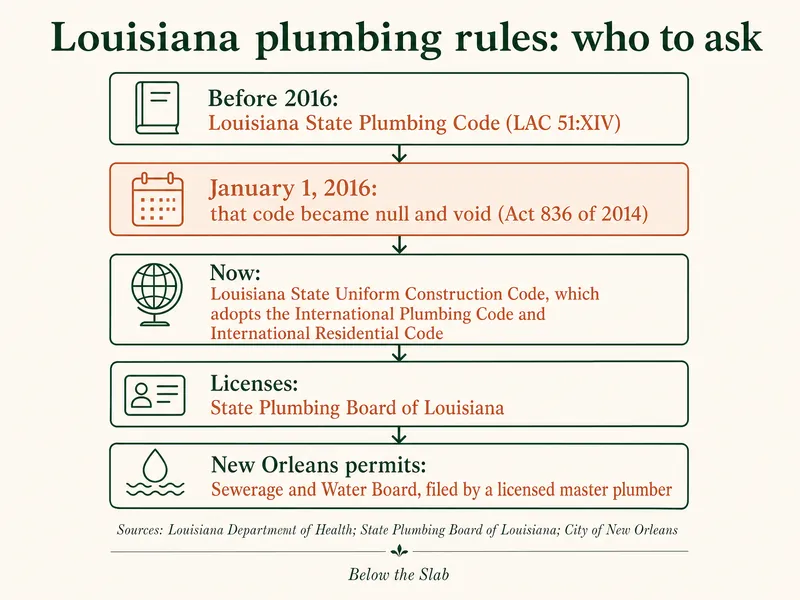
The Louisiana plumbing code that many guides still quote, the State Plumbing Code in LAC 51:XIV, has been void since January 1, 2016; plumbing now falls under the State Uniform Construction Code, which adopts the International Plumbing Code.
On this page
- What happened to the Louisiana plumbing code?
- What plumbing code applies in Louisiana now?
- Why do some sources still cite the old plumbing code?
- Who licenses plumbers in Louisiana?
- Can a homeowner do plumbing work in Louisiana?
- When do you need a plumbing permit?
- How do permits work in Orleans and Jefferson parishes?
- Common questions
Key takeaways
- Act 836 of the 2014 regular session made Part XIV of the State Sanitary Code, the Louisiana State Plumbing Code, null and void on January 1, 2016, as the Louisiana Department of Health records.
- Plumbing rules now come from the Louisiana State Uniform Construction Code (LSUCCC), which adopts the International Plumbing Code and International Residential Code with state amendments.
- The edition in force can change; ask your parish or city building official, rather than relying on a year printed in an old guide.
- Plumbers are licensed by the State Plumbing Board of Louisiana: registered apprentice, Residential Plumber Limited, journeyman and master, plus the Water Supply Protection Specialist endorsement.
- In New Orleans, plumbing permits come from the Sewerage and Water Board, not the city's permits department, and only an Orleans Parish licensed master plumber may apply, per the City's permit brochure.
Search for the Louisiana plumbing code and much of what comes back describes a rulebook that no longer exists. That matters if you are reading a contractor's estimate, checking whether a repair needs a permit, or trying to understand a utility notice. This page explains what changed, what applies now, and which office answers which question.
What happened to the Louisiana plumbing code?
The Louisiana State Plumbing Code, Part XIV of the State Sanitary Code (LAC 51:XIV), became null and void on January 1, 2016, as required by Act 836 of the 2014 regular legislative session. The Louisiana Department of Health set this out in its February 2016 emergency rule on protection of water supply, which it issued to fill gaps the change left behind.
For decades the State Plumbing Code was a public-health rule, written and kept by the state health department. Act 836 moved plumbing into the building code system. The health department's rule says the State Uniform Construction Code Council issued new state plumbing regulations through an emergency rule under the State Uniform Construction Code, found in Title 17 of the Louisiana Administrative Code.
The change left one gap that the health department filled itself. The construction code council did not adopt rules on who may install, repair and test backflow preventers, so the department adopted its own, nearly identical to the old Part XIV language, effective February 23, 2016. The backflow prevention guide covers those qualifications.
What plumbing code applies in Louisiana now?
Plumbing in Louisiana now falls under the Louisiana State Uniform Construction Code, which adopts the International Plumbing Code and the International Residential Code, with state amendments. The International Plumbing Code is published by the International Code Council, and the International Residential Code covers one- and two-family houses.
This page does not name an edition year. Model codes are revised every few years, and the state adopts new editions on its own schedule, sometimes with amendments that change specific sections. A year that was right when a guide was written may be out of date when you read it. The office that will inspect the work can tell you which edition and which amendments it enforces, and that is the answer that counts.
Local rules sit on top of the state code. New Orleans is the clearest example: the Sewerage and Water Board's plumbing information page refers to its own S&WB Plumbing Code for permits, inspections and service connections.
| Question | Who to ask | What they handle |
|---|---|---|
| Which code edition and amendments apply to my job? | Your parish or city building official | Local adoption, plan review and inspection |
| Is this plumber licensed? | State Plumbing Board of Louisiana | Licenses, endorsements, complaints |
| Do I need a plumbing permit in New Orleans? | Sewerage and Water Board plumbing department | Permits, inspections, SWBNO Plumbing Code |
| Who can test a backflow device? | Louisiana Department of Health rule; your water utility | Tester and installer qualifications, annual tests |
| Does my insurance cover the work? | Your insurer or agent | Policy wording; see the insurance guides |
Why do some sources still cite the old plumbing code?
Some sources still cite LAC 51:XIV because they were written before 2016, or because a page was never updated. Even official pages lag: the Sewerage and Water Board's backflow program page still lists "LAC Title 51:XIV" as the source of customer responsibilities, years after that part was voided.
That does not make the underlying requirement wrong. Annual backflow testing, for example, is still required; the legal basis moved. When a document cites LAC 51:XIV, read it as a sign to check the current rule with the agency, not as proof the rule is gone.
The same caution applies to contractor estimates. If a quote says work is required "by the Louisiana State Plumbing Code", ask which current code section the contractor means. A licensed plumber should be able to name it.
Who licenses plumbers in Louisiana?
Plumbers in Louisiana are licensed by the State Plumbing Board of Louisiana (SPBLA), which issues several license levels. Its license page says anyone performing plumbing or gas fitting who is unlicensed must register as an apprentice, work for a master plumbing company, and work under the direct, on-the-job supervision of a journeyman or master.
The levels a homeowner is most likely to meet:
- Registered apprentice: works only under a licensed plumber's supervision.
- Residential Plumber Limited: may independently perform repairs to existing plumbing in one- and two-family homes, under the employment and direction of a licensed master plumber.
- Journeyman plumber: a licensed plumber who has passed the journeyman exam.
- Master plumber: the license that runs a plumbing company and, in New Orleans, the one that can pull a plumbing permit.
- Water Supply Protection Specialist (WSPS): an endorsement for journeyman or master plumbers who complete a 40-hour tester certification, needed to test backflow devices.
SPBLA keeps a public roster of license holders. Checking a name there before work starts takes a minute and is the simplest protection against unlicensed work.
Can a homeowner do plumbing work in Louisiana?
This guide could not confirm what Louisiana law allows a homeowner to do on their own house, so it gives no answer either way. The state licensing statute is the place it would be settled, and SPBLA is the agency to ask. Answers found on forums and contractor sites are not a substitute.
What is clear is the permit rule in New Orleans. The City's permit brochure says a plumbing permit is needed to remove or replace any water piping or plumbing fixture, and that only an Orleans Parish licensed master plumber may apply for it. Permitted plumbing work in the city therefore runs through a licensed master plumber.
Outside New Orleans, ask the parish or city permit office before starting. Unpermitted work can surface later, during a sale, an insurance claim or a slab leak repair that opens the floor.
When do you need a plumbing permit?
In New Orleans you need a plumbing permit to remove or replace any water piping or plumbing fixture, according to the City's permit brochure. That covers more than many owners expect: a water heater swap, a water line reroute and a sewer repair under the slab all involve piping or fixtures.
The Sewerage and Water Board's plumbing information page adds how the process works. A licensed master plumber registered with the Board files the permit through the City's One Stop portal. Inspections are required for all new work and for parts of existing systems the work affects. Work that is covered before inspection must be uncovered, and failure to comply can lead to water service interruption.
For a slab house, that last point matters. If a plumber repairs a pipe under the slab and pours concrete back before the inspection, the inspector can require it opened again. Ask the plumber when the inspection is scheduled, and keep the permit number with the job paperwork. The water heater replacement cost guide lists permits among the items to look for on a quote.
The change in numbers
- Jan 1, 2016Date the Louisiana State Plumbing Code (LAC 51:XIV) became null and voidLouisiana Department of Health
- Act 8362014 regular-session law that moved plumbing rules into the State Uniform Construction CodeLouisiana Department of Health
- 1- and 2-familyHomes where a Residential Plumber Limited may repair existing plumbing, under a master plumberState Plumbing Board of Louisiana
How do permits work in Orleans and Jefferson parishes?
In Orleans Parish, plumbing permits are issued by the Sewerage and Water Board, while the City's Department of Safety and Permits handles building permits; the City's brochure says so directly and notes that the Board charges its own plumbing permit fee. A remodel can therefore need two permits from two offices: a building permit from the City and a plumbing permit from the Board.
For Jefferson Parish, this guide could not load the parish's permit pages and does not describe its rules. Ask the parish permit office which work needs a plumbing permit, who may apply, and how inspections are booked. The same goes for other parishes and for cities with their own building departments.
Whatever the parish, three questions cover most jobs: does this work need a permit, who will pull it, and when will it be inspected. A licensed plumber should answer all three before work starts. The guides index links the repair pages where permits come up.
How we put this page together
Sources: the health department's February 2016 emergency rule on water supply protection, which records the end of the state plumbing code and sets backflow tester rules; the plumbing board's licensing pages; New Orleans' building permit guidelines; and two Sewerage and Water Board pages, on plumbing permits and on backflow. Each was reread in October 2026. Deliberately not stated: which International Plumbing Code edition Louisiana enforces today (the construction code council and legislature sites would not load to confirm it), whether owners may legally do their own plumbing (the statute would not load), Jefferson Parish permit rules, and any permit fee amounts.
Common questions
Is LAC 51:XIV still in effect?
No. Part XIV of the State Sanitary Code, the Louisiana State Plumbing Code, became null and void on January 1, 2016, under Act 836 of 2014. Some pages still cite it because they were never updated.
Does Louisiana use the International Plumbing Code?
Yes, through the Louisiana State Uniform Construction Code, which adopts the International Plumbing Code and International Residential Code with state amendments. Ask your local building official which edition is in force.
How do you check whether a plumber is licensed in Louisiana?
Use the State Plumbing Board of Louisiana's online roster of license holders. Check the license type too: a Residential Plumber Limited, for example, works under a master plumber.
Who pulls a plumbing permit in New Orleans?
An Orleans Parish licensed master plumber, registered with the Sewerage and Water Board. The Board, not the City's permits department, issues plumbing permits.
Does replacing a water heater need a permit in New Orleans?
The City's brochure says a permit is needed to remove or replace any water piping or plumbing fixture, and a water heater swap involves both. Confirm with the Sewerage and Water Board for the specific job.
What happens if plumbing work is covered before it is inspected?
SWBNO's plumbing page says covered work must be uncovered for inspection, and that failure to comply can lead to water service interruption. Under a slab, that can mean reopening the floor.
Where are backflow rules found now that the state plumbing code is gone?
Plumbing backflow requirements moved into the State Uniform Construction Code, and the health department's rule at LAC 51:XII sets who may install and test devices. Water utilities run the testing programs.
Related guides
More guides: the slab house plumbing guide home page.