
Home & code
Backflow Prevention and Backflow Testing Explained
Backflow prevention keeps used or dirty water from flowing backward into drinking water lines; most homes need only an air gap at the hose, while irrigation, pools on auto-fill and fire sprinklers need a tested device.
On this page
Key takeaways
- The Sewerage and Water Board defines backflow as contaminated water flowing backward into clean drinking water lines, usually due to a change in water pressure.
- SWBNO says the most common residential cross-connection is a garden hose submerged in non-drinkable water, such as a pool; filling through an air gap avoids it.
- SWBNO's table matches devices to hazards: a Pressure Vacuum Breaker for irrigation, a Reduced Pressure assembly for pools or fountains on auto-fill, and a Double Check Assembly for fire sprinklers.
- Backflow preventers must be tested at least once a year, and the owner pays for tests, repairs and replacements, per SWBNO.
- In Louisiana, testers must be State Plumbing Board-licensed plumbers with a Water Supply Protection Specialist endorsement, or ASSE 5110 testers, under the Louisiana Department of Health rule effective February 23, 2016.
- SWBNO is surveying all 140,000 water connections in its service area for cross-connections.
Backflow prevention sounds like a commercial-building concern, and much of it is. But the most common cross-connection in a home is something everyone owns: a garden hose. This page explains how backflow happens, which devices a house might need, why utilities require yearly tests, and who in Louisiana is allowed to do them.
What is backflow prevention?
Backflow prevention is any method or device that stops water from flowing backward out of a building's plumbing and into the public water supply. Water systems are built for one-way flow, from the treatment plant to the tap. The Sewerage and Water Board of New Orleans explains on its backflow program page that when that flow reverses, contaminants can be pulled into the drinking water through unprotected cross-connections.
A cross-connection, in SWBNO's words, is a physical connection between the drinking water system and an outside source, meaning anything other than freshly treated utility water. A hose lying in a pool, a lawn sprinkler line, a boiler and a fire sprinkler loop are all examples.
Prevention takes two forms. The simplest is an air gap: open space between the end of a pipe or hose and the water it fills, so nothing can be drawn back. Where an air gap is not practical, a mechanical backflow preventer is fitted in the line to block reverse flow.
How does backflow contaminate drinking water?
Backflow contaminates drinking water when pressure in the supply drops or pressure on the customer side rises, so water moves the wrong way through a cross-connection. SWBNO describes the two ways it happens:
- Backsiphonage: water is pulled back into the system when supply pressure drops, for example during a water main break, maintenance or heavy demand such as firefighting.
- Backpressure: pressure in the customer's piping exceeds pressure in the main and pushes water backward. Pumps, piping at a higher elevation and thermal expansion from a heat source can cause it.
EPA's distribution system resources page puts the mechanism in one line: when cross-connections are present and pressure in the drinking water system is lower than in the non-potable source, contamination can enter the distribution system.
Backsiphonage is the one a homeowner can most easily prevent. When pressure falls during a main break, a hose left in a bucket of soapy water, a pool or a fertilizer sprayer becomes a straw. That is one reason pressure-loss events lead to the advisories covered in the boil-water advisory guide; NOLA Ready's boil water page says SWBNO issues a precautionary advisory when water is potentially unsafe, and that one usually lasts at least 24 hours while the water is tested. SWBNO's table lists the risks plainly: chlorinated pool water, and mud, microbes and E. coli from irrigation heads, siphoned back into drinking water.
Which backflow preventer does a home need?
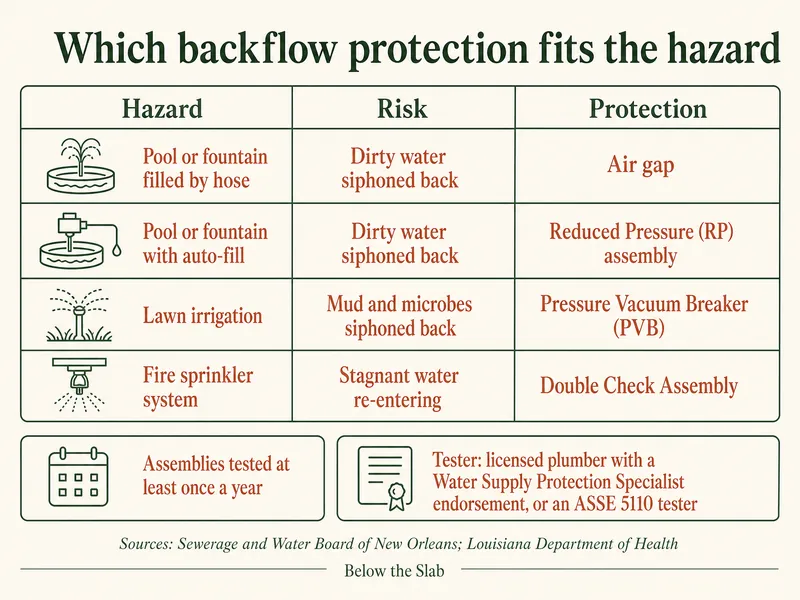
Most homes need no mechanical backflow preventer at all, only good hose habits; a device is needed when the house has irrigation, a pool or fountain with an auto-fill, or a fire sprinkler system. SWBNO's table of common cross-connections sets out the match between hazard and protection.
| Hazard | Cross-connection | Risk | Protection |
|---|---|---|---|
| Swimming pool | Filling with a submerged hose | Chlorinated pool water siphoned back | Air gap |
| Swimming pool or fountain | Auto-fill device | Dirty water siphoned back | Reduced Pressure (RP) principle assembly, tested yearly |
| Irrigation system | Sprinkler heads open to the air | Mud and microbes siphoned back | Pressure Vacuum Breaker (PVB), tested yearly |
| Fire sprinkler system | Water pipes | Stagnant sprinkler water re-entering the supply | Double Check Assembly, tested yearly |
The air gap is free. Fill pools, tubs, buckets and fountains with the hose end held above the water line, never lying in it. SWBNO also asks pool owners to tell it whether they have a pool and how they fill it, so it can update the account.
If an irrigation system is still connected to the city's water line, SWBNO says the device on it must be tested. The type of device depends on the hazard, so the choice belongs to a licensed plumber who knows the local rules. Don't confuse any of these with a sewer backwater valve, which keeps sewage out of the house; that device is covered in the sewer backup guide.
Why do utilities require backflow testing?
Utilities require backflow testing because the state requires them to protect their systems from contamination on customers' premises, and a mechanical device can fail without anyone noticing. SWBNO says laws and regulations require at least annual testing of backflow preventers, and that the Louisiana Department of Health and the U.S. EPA mandate backflow prevention.
The state rule is specific. Under the Louisiana Department of Health's 2016 rule on protection of water supply (LAC 51:XII.344), each water supplier must write and carry out a backflow prevention plan, and must disconnect or refuse to connect customers who fail to comply with required containment practices or won't confirm compliance. The same document notes that the old state plumbing code was repealed on January 1, 2016, and that the backflow rules for plumbing now sit in the State Uniform Construction Code; the Louisiana plumbing code guide explains that change.
In New Orleans, the owner of the device is responsible for the yearly test, and SWBNO tracks due dates through its Aqua Resource customer portal. It sends "Test Due" and "Test Overdue" notices, and its page notes that a tester may not have entered results before a notice went out, so check the portal before assuming a test was missed.
Backflow figures
- 1 a yearMinimum testing frequency for backflow preventersSewerage and Water Board of New Orleans
- 140,000Water connections SWBNO is surveying for cross-connectionsSewerage and Water Board of New Orleans
- Feb 23, 2016Effective date of LDH's rule on backflow tester and installer qualificationsLouisiana Department of Health
- 40 hrTester certification course required for the Water Supply Protection Specialist endorsementState Plumbing Board of Louisiana
Who can test a backflow device in Louisiana?
In Louisiana, a backflow device can be tested by a State Plumbing Board-licensed plumber who holds a Water Supply Protection Specialist (WSPS) endorsement, or by a tester certified to the ASSE 5110 standard. That is the rule in LAC 51:XII.346 in the Louisiana Department of Health's 2016 rule. The same section allows state-licensed landscape irrigation contractors (licensed through the Louisiana Department of Agriculture and Forestry), with a special WSPS endorsement from the plumbing board, to test devices on irrigation systems.
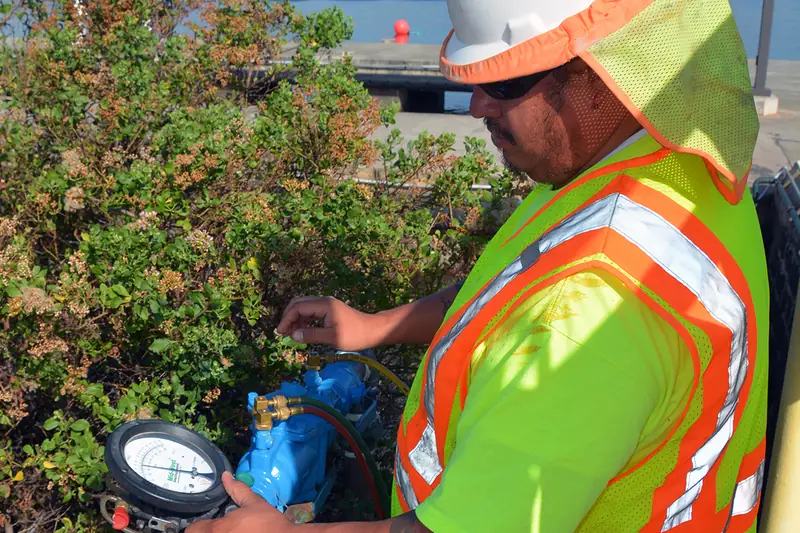
Installation and repair are narrower. The rule says backflow preventers are to be installed, repaired and maintained by a plumbing board-licensed plumber with the WSPS endorsement, again with an irrigation-contractor exception for irrigation systems.
To earn the endorsement, the State Plumbing Board of Louisiana says an applicant must be a licensed journeyman or master plumber, or a licensed landscape irrigator, and complete a 40-hour tester certification. In New Orleans, SWBNO adds its own list: a General Tester or plumber from its Approved Plumbers list must perform the test.
What does a backflow test cost?
There is no published standard price for a backflow test in Louisiana, and SWBNO itself says testing costs can vary and recommends collecting several quotes. This guide found no primary source for typical prices, so it gives none.
What drives the price is easier to describe: the type and size of the assembly (an RP assembly has more parts to check than a PVB), how easy it is to reach, whether the tester has to file the result with the utility, and whether the device fails and needs repair. SWBNO states that all tests, repairs, overhauls and replacements are at the owner's expense.
When getting quotes, ask whether the price includes filing the result with SWBNO, what happens if the device fails, and whether a retest after repair costs extra. Ask to see the tester's WSPS endorsement or ASSE certificate, and confirm the tester is on SWBNO's approved list. The guides index links the other home and code pages.
How we put this page together
This page is based on the Sewerage and Water Board of New Orleans' Backflow Prevention Program page, the Louisiana Department of Health's Declaration of Emergency on Protection of Water Supply (LAC 51:XII.344 and 346, effective February 23, 2016), and the State Plumbing Board of Louisiana's license pages, all checked in October 2026. SWBNO's page still cites the repealed state plumbing code (LAC 51:XIV), so this page relies on the LDH rule for the legal requirements. Left out: test prices, plumbing code edition numbers and device brand comparisons, none of which had a primary source this guide could confirm.
Common questions
Does a house with no sprinklers or pool need a backflow test?
Usually not, because there is no testable device. The garden hose is still a cross-connection, so keep the hose end out of pools, buckets and sprayer tanks and fill through an air gap.
What is an air gap in plumbing?
SWBNO defines it as the physical distance between the discharge of a garden hose and the receiving vessel. Because the outlet never touches the water, nothing can be drawn back into the line.
What happens if an annual backflow test is overdue?
SWBNO sends "Test Due" and "Test Overdue" notices, and its backflow department can grant a reasonable extension on request. Under the state rule, a water supplier must disconnect or refuse service to customers who do not comply with required containment practices.
Is a backflow preventer the same as a backwater valve?
No. A backflow preventer protects the drinking water supply from the building. A backwater valve sits on the sewer line and keeps sewage from backing up into the building.
Can a landscaper test my irrigation backflow device?
Only a state-licensed landscape irrigation contractor with a special WSPS endorsement from the plumbing board, under the LDH rule. In New Orleans, the tester must also be on SWBNO's approved list.
Why does SWBNO ask homeowners about pools?
Pools are a common cross-connection. SWBNO asks owners to say whether they have one and how they fill it, so it can update the account and help the owner stay in compliance.
Related guides
More guides: the slab house plumbing guide home page.