
Slab leaks
Slab Leak Signs and How to Confirm Them
Slab leak signs start with a water meter that keeps moving while every tap is off, then a warm floor patch, a higher bill or damp flooring; a two-hour meter test confirms it.
On this page
Key takeaways
- The most reliable sign is the meter: EPA WaterSense says to read it before and after a two-hour period with no water use; any change means a leak is probable.
- Closing the house shutoff isolates the service line: if the meter's flow indicator still moves, the leak is between the meter and the valve, per the City of Dayton's water department.
- A warm spot on a slab floor usually means a hot-water supply line, because heated water keeps flowing into the soil under the concrete.
- Toilets are the most common false alarm; EPA's dye test shows a leaking flapper if color reaches the bowl within 10 minutes.
- Drain-line leaks never move the meter; their signs are odors, slow drains and dampness near bathrooms and kitchens.
- Leak detection runs $100 to $400 in Fixr's national estimate (May 2025), far less than opening the wrong part of a floor.
What are the first signs of a slab leak?
The first sign of a slab leak is usually a number, not a puddle. A supply line under a slab can leak for weeks into the soil before anything shows on the floor, but the water meter and the bill register it from the first day.
Signs that point to a leak under the slab, roughly in the order owners tend to notice them:
- A bigger water bill while household use stays the same. Compare it with the same month last year, not just last month.
- The sound of running water when every fixture is off, often heard best at night near a wall or floor.
- A warm or hot patch of floor, especially on tile, felt with bare feet.
- Damp carpet, lifting vinyl, cupped wood or loose tile away from any bathroom or appliance.
- A musty smell or mildew at baseboards along an interior wall.
- A water heater that runs more often, or hot water that runs out sooner than it used to.
- Lower water pressure at several fixtures at once.
- Cracks in flooring or walls that appear along with any of the signs above.
None of these alone proves a slab leak. A high bill can be a running toilet; damp flooring can come from a window or a dishwasher. That is why the meter test comes first.
How do you use the water meter to check for a leak?
The water meter is the only free test that confirms water is leaving the system with nothing turned on, and it takes two readings and a little patience.
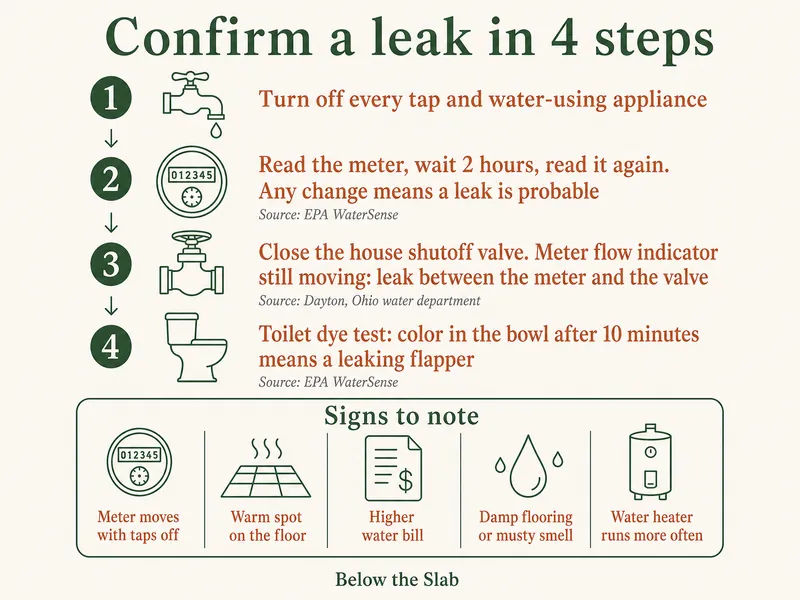
EPA WaterSense gives the simplest version: read the meter, use no water for two hours, then read it again. Its Fix a Leak Week guidance says that if the reading changes at all, there is probably a leak. Before starting, turn off ice makers, irrigation, pool fill valves and any water treatment equipment that might regenerate.
Most meters also have a small flow indicator, a triangle, star or dial that turns with even a slow trickle. The City of Dayton's water department describes the red triangle as one that "will move whenever water is passing through it." Watching it for a few minutes is a quick first check; the two-hour reading catches slower leaks.
The second step separates the yard from the house. Close the main shutoff valve where the line enters the house, turn on an indoor faucet to make sure the water is really off, then check the meter again. Dayton's page puts it plainly: if the indicator is still moving, "the leak is between the shutoff valve and the water meter." If it stops, the leak is inside the house, as the City of Hemet's leak-check steps also note, and that includes the pipes under the slab.
Why is one spot on the floor warm?
A warm spot on a slab floor is the classic sign of a leaking hot-water line. The water heater keeps replacing the water that escapes, so a steady stream of heated water flows into the soil and warms the concrete directly above it.
The spot is easiest to feel on tile or bare concrete, and in winter. Carpet and pads hide it. Walk the floor barefoot along the route from the water heater to the kitchen and bathrooms; warmth that follows a line, or a patch that stays warm overnight, is worth noting and photographing.
Rule out other heat sources first. A refrigerator or freezer exhausts warm air at floor level, sunlight through a door warms tile for hours, and radiant floor heating or ducts in the slab will feel the same as a leak. A second check is to shut off the cold-water supply to the water heater for a few hours: if the warm spot cools, the hot side is the likely suspect. A leak on the cold side gives no warmth at all, so a cold floor does not rule out a slab leak.
A licensed plumber with a thermal camera can map the warm area more precisely, as described on the slab leak detection page.
Which signs point to a drain leak instead of a supply leak?
A drain leak does not move the water meter, so a house can pass the two-hour meter test and still have a leak under the slab. Drain lines only carry water when a fixture empties, and that water has already been metered.
Signs that point to a drain or sewer line instead:
- Sewer odor inside the house, often near a tub, shower or floor drain.
- Damp flooring or baseboards that get worse after showers, laundry or a dishwasher cycle, then dry out.
- Slow drains or gurgling in several fixtures, which can mean a broken or sagging line rather than a simple clog.
- Insects or small flies near floor drains or slab penetrations.
Drain problems under a slab are usually found with a camera, not a meter. The sewer camera inspection page covers what a camera shows, and the sewer line belly page explains sags that hold water.
| Sign | Supply-line leak | Drain-line leak |
|---|---|---|
| Water meter with every tap off | Moves | Does not move |
| Water bill | Rises steadily | Usually unchanged |
| Warm floor patch | Possible, on the hot side | No |
| Timing of dampness | Constant | After fixtures drain |
| Odor | Musty, from wet materials | Sewer smell is common |
| Usual confirming test | Meter test, then pressure test | Camera inspection |
What else looks like a slab leak?
Several common problems produce the same clues, and ruling them out first can save a detection fee.
Toilets. A worn flapper leaks silently into the bowl and moves the meter all day. EPA WaterSense suggests a few drops of food coloring in the tank: if color shows up in the bowl after 10 minutes, the toilet is leaking. By EPA's count, leaks in a typical home add up to more than 9,300 gallons in a year (EPA WaterSense), so a toilet is the first thing to test.
Outdoor lines. Irrigation systems, hose bibs and the service line from the meter all sit outside the slab. The shutoff test above sorts out the service line.
Water heater relief valves. A temperature-and-pressure relief valve that drips into a drain line can move the meter without any visible water.
Rain and grading. Water that comes in at the slab edge after storms, then dries, is a drainage problem, not a plumbing one. It does not move the meter.
Slab cracks alone. Hairline cracks are common in concrete and do not by themselves mean a leak. Wider cracks that keep growing may point to settlement, covered on the foundation settlement and plumbing page. Ground movement is part of life here: a 2016 NASA JPL study measured parts of the New Orleans area sinking up to 2 inches a year.
When is it time for professional leak detection?
Call for professional leak detection once the meter moves with the house shutoff open and stops with it closed, and the toilets, water heater and outdoor fixtures have been ruled out. At that point the leak is inside the house, and the next question is where.
Pinpointing the leak before anything is opened matters, because the location decides the fix: a spot repair through the floor, a tunnel from outside, or a reroute that abandons the buried line. Fixr's national cost guide (May 2025) puts leak detection at $100 to $400, while slab leak repair itself runs $1,000 to $4,000, though prices in any one city can differ. The slab leak repair cost page explains each option.
The repair itself needs paperwork in New Orleans: the city's building permit brochure says removing or replacing any water piping needs a plumbing permit, and only an Orleans Parish licensed master plumber may apply for it.
Ask whoever does the detection to write down which line is leaking (hot, cold or main), the method used and the marked location. That report helps when comparing repair quotes and when talking to an insurer. The Louisiana Department of Insurance homeowners guide places sudden leaks from inside the plumbing among the risks a broad-form policy covers, and the page on homeowners insurance and slab leaks covers what to ask.
If water is surfacing through the floor or the meter is spinning fast, close the main shutoff now and keep it closed between uses. The slab leak overview explains what makes a leak urgent.
Numbers behind the leak checks
- 2 hoursNo-water-use window for the meter testEPA WaterSense
- 10 minutesWait time for the toilet dye testEPA WaterSense
- 9%Homes losing at least 50 gallons daily to leaksEPA WaterSense
- $100-$400National estimate for a leak detection visit, May 2025Fixr cost guide
How we put this page together
This page is based on EPA WaterSense's Fix a Leak Week guidance (updated March 13, 2026), the City of Dayton water department's leak-check steps, the NASA JPL subsidence study (2016) and the Louisiana Department of Insurance homeowners guide, checked in October 2026. The detection price is Fixr's national estimate, named and unlinked. Left out: contractor checklists, forum stories and any claim about how often slab leaks happen, because no primary source gives a rate.
Common questions
Can a slab leak cause a high water bill with no visible water?
Yes. A supply-line leak under a slab can drain into the soil for weeks before any dampness reaches the floor. A steady rise in usage with no change in habits is often the first sign, which is why comparing bills year over year is useful.
Does a moving meter always mean a slab leak?
No. Toilets, irrigation, a dripping relief valve and the service line in the yard all move the meter. Closing the house shutoff and testing toilets with dye rule out the most common ones before anyone looks under the floor.
How can you tell a hot-water slab leak from a cold-water one?
A hot-water leak often warms the floor and makes the water heater run more. Closing the cold supply valve on top of the water heater for a few hours and rechecking the meter can also help: if the meter stops, the leak is likely on the hot side.
Can a slab leak smell like sewage?
A supply-line leak smells musty at most, from wet flooring and drywall. A sewage smell points to a drain or vent problem, which may also be under the slab and is checked with a camera.
Do cracks in tile mean there is a slab leak?
Not by themselves. Tile cracks often come from slab movement or installation. Cracks that appear together with dampness, warmth or a moving meter are worth a closer look.
How fast should a meter's flow indicator move with a slab leak?
There is no standard speed. A pinhole may turn the indicator very slowly, while a split pipe spins it visibly. Any movement with everything off and the house valve open is worth following up.
Should flooring be pulled up to look for the leak?
No. Pulling flooring rarely shows where a pipe under the concrete is leaking. A detection visit can mark the spot first, so only the area that needs opening is disturbed.
Related guides

More guides: the Below the Slab home page.