
New Orleans & Jefferson Parish water
Chloramine in Water: Safety, Taste and Filters
Chloramine in water is a regulated disinfectant, chlorine combined with ammonia, that the EPA calls safe to drink at up to 4 mg/L; removing it matters for fish tanks and dialysis, and is otherwise a taste choice.
Disclosure: SoftPro Water Systems, a store owned by the same team as this site, sells the filters and softeners we link to. Our water pages follow the utilities' 2025 water quality reports and federal and state agency guidance, checked October 2026. Store descriptions are reported as the store's own claims. Ownership disclosure
View at SoftPro Water Systems
On this page
Key takeaways
- The EPA caps chloramine at a maximum residual disinfectant level of 4 mg/L, measured as a running annual average (EPA).
- East Bank New Orleans water carried a highest yearly average of 3.3 ppm in 2025; Algiers 3.1 ppm; West Jefferson 1.9 ppm (2025 reports via LDH).
- The EPA says chloraminated water that meets its standards is safe for drinking, cooking and bathing (EPA).
- It must be removed before kidney dialysis machines and neutralized for aquariums, because it harms fish through their gills.
- Boiling, letting water stand and reverse osmosis do not remove monochloramine, according to the EPA.
- For a filter, look for an NSF/ANSI 42 listing that names chloramine reduction, not just a logo (NSF).
What is chloramine in water?
Chloramine is a disinfectant made by adding ammonia to chlorine, and water utilities use it to keep treated water free of germs on its way through the pipes. The form used in drinking water is monochloramine. It is the reason city water can smell faintly of a swimming pool even when it has no free chlorine in it.
The East Bank of New Orleans uses it. The 2025 Carrollton Water Works report lists chloramine as the disinfectant, with a highest running annual average of 3.3 ppm and individual readings from 0.0 to 4.8 ppm. The Sewerage and Water Board names chloramine first among its treatment chemicals, alongside lime, fluoride and, on the West Bank, a zinc orthophosphate pilot.
| Water system | Highest running annual average | Range of readings | Limit (running annual average) |
|---|---|---|---|
| Carrollton Water Works (East Bank New Orleans) | 3.3 ppm | 0.0–4.8 ppm | 4 mg/L |
| Algiers Water Works (West Bank New Orleans) | 3.1 ppm | 0.56–4.6 ppm | 4 mg/L |
| West Jefferson Water Works District 2 | 1.9 ppm | 0.02–7.17 ppm | 4 mg/L |
The limit applies to the running annual average, so a single reading above 4, like West Jefferson's 7.17 ppm high, is not a violation by itself. East Jefferson's figures are in the parish's own 2025 report, which this site could not open, so they are not shown.
Why do utilities use chloramine instead of chlorine?
Utilities use chloramine mainly because it lasts longer in the pipes. The EPA's chloramines page says chloramines "provide longer-lasting disinfection as the water moves through pipes to consumers", which matters in a long, old network like New Orleans'.
The second reason is disinfection byproducts. The same EPA page says some systems switched their secondary disinfectant to chloramines to meet the byproduct rules. The 2025 Carrollton report lists total trihalomethanes at a highest average of 28 ppb against a limit of 80, and haloacetic acids at 34 ppb against 60.
Is chloramine in tap water safe?
Yes. The EPA states that water containing chloramines that meets its standards is safe for drinking, cooking, bathing and other household uses. The federal limit is a maximum residual disinfectant level of 4 mg/L, and the 2025 averages for Carrollton, Algiers and West Jefferson were all under it.
In a 2009 question-and-answer sheet, the EPA adds that its standard "provides a wide margin of safety" and that monochloramine at regulated levels does not need to be removed. Taste and smell are a separate matter: some people notice chloramine and prefer filtered water, which is a reasonable personal choice rather than a safety step.
Chloramine by the numbers
- 4 mg/LEPA maximum residual disinfectant level for chloramine (running annual average)EPA
- 3.3 ppmHighest running annual average, Carrollton Water Works (East Bank New Orleans), 2025LDH 2025 water quality report
- 3.1 ppmHighest running annual average, Algiers Water Works, 2025LDH 2025 water quality report
- 1.9 ppmHighest running annual average, West Jefferson Water Works District 2, 2025LDH 2025 water quality report
Who needs to remove chloramine?
Two groups need chloramine out of the water: dialysis patients' machines and fish. The EPA's dialysis and aquarium answer says chlorine and monochloramine must be removed before use in kidney dialysis machines, because that water touches blood directly. It also says dialysis patients can safely drink chloraminated water, and should talk to their physicians about any concerns.
For aquariums and ponds, the EPA says chlorine and monochloramine can harm fish because they enter the bloodstream through the gills, and can also stop the growth of helpful bacteria in the tank. Its advice is to use conditioners sold by aquarium supply stores. A whole-house filter is not needed just to keep fish; a bottle of dechlorinator that names chloramine does that job.
Everyone else can treat chloramine removal as a preference for taste, smell or the feel of shower water.
Which filters remove chloramine?
The filters that reduce chloramine are carbon-based units with a certified claim for it, and the claim is what to check. The EPA notes that monochloramine "can be more difficult to remove from drinking water than chlorine" and that it does not test or certify home filters, pointing buyers instead to NSF/ANSI 42 listings. NSF keeps a searchable list of products certified for chloramine reduction; a product that only shows logos, without a standard number and a named claim, has not shown you that.
Many whole-house units sold for city water use catalytic carbon. If you want to try one, the SoftPro Chlorine+ Carbon Whole House Filter (sold by SoftPro Water Systems, a store we own) is listed at $1,097 on the store's page (October 2026). SoftPro lists chloramine among what it is designed to reduce; that is the store's own claim, and the listing names no NSF/ANSI standard number. It is optional, and the whole house water filter guide explains sizing and upkeep before you decide.
Try it on city water
SoftPro Chlorine+ Carbon Whole House Filter
Tap water that meets federal limits is safe to drink without a filter; a catalytic carbon whole house filter is a taste, odor and chloramine choice for the whole house. Check the size, current price and the maker's performance claims at SoftPro Water Systems.
View at SoftPro Water SystemsSoftPro Water Systems, a store owned by the same team as this site, sells the filters and softeners we link to. Ownership disclosure
Does boiling or standing remove chloramine?
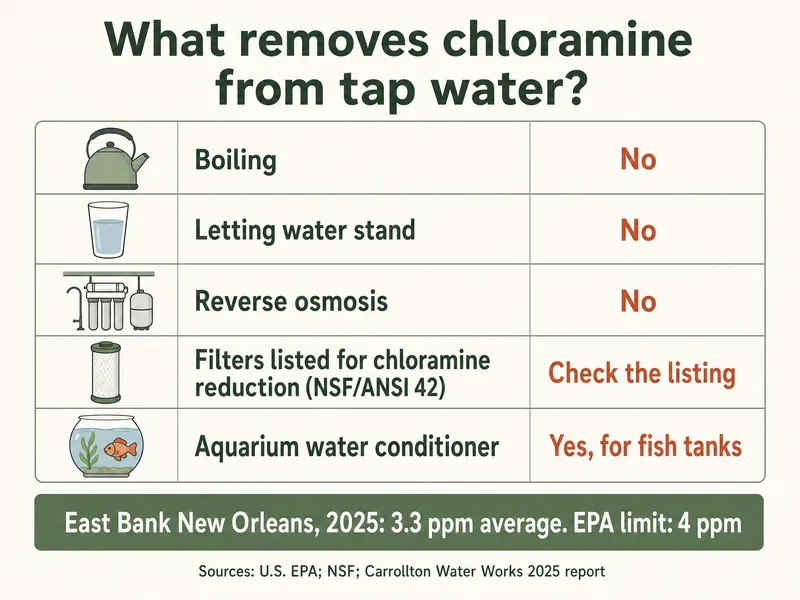
No. In the EPA's monochloramine removal answer, the agency states plainly that boiling water does not remove monochloramine and that letting water sit at room temperature does not remove it either. That is the main practical difference from chlorine, which many people are used to leaving out overnight.
The same sheet says reverse osmosis filters do not remove monochloramine. An under-sink RO unit can still be a good choice for other reasons, such as a lead-certified model at the kitchen tap, which the lead in drinking water guide covers, but it is not the tool for chloramine. Boiling during a boil water advisory is still right, because that boiling is about germs, not the disinfectant; see the boil water advisory guide.
How we put this page together
This page is based on the EPA's chloramines page, its national primary drinking water regulations and its 2009 monochloramine question sheets, NSF's chloramine-reduction listing, and the 2025 water quality reports for Carrollton, Algiers and West Jefferson posted by the Louisiana Department of Health (dates checked: October 2026). The store's product claims are reported as the store's own. Medical advice for dialysis patients is left to their physicians; no home tests or product trials were used.
Common questions
How do you know if your water has chloramine or chlorine?
Your utility's annual report names the disinfectant. New Orleans' 2025 reports list chloramine for both the East Bank and Algiers, and West Jefferson's report lists it too.
Is chloramine bad for skin or hair?
The EPA says chloraminated water that meets its standards is safe for bathing. Some people still prefer a filter for how shower water feels or smells, which is a comfort choice.
Is New Orleans tap water fine for a fish tank?
Yes, after treating it with an aquarium conditioner that neutralizes chloramine. The EPA notes that monochloramine harms fish through the gills and can stop the beneficial bacteria a tank needs.
Does a refrigerator filter remove chloramine?
Only if it is certified for that claim. Check the exact model on NSF's chloramine-reduction listing. A certification for chlorine taste and odor is a separate claim and does not cover chloramine.
Does a water softener remove chloramine?
A softener is built to exchange hardness minerals, and none of the sources on this page lists softening as a way to remove chloramine. For chloramine, look for a filter with a certified chloramine-reduction claim.
Why did my water start smelling stronger?
Chloramine readings vary through the year; Carrollton's 2025 readings ranged from 0.0 to 4.8 ppm. If the smell changes sharply or the water looks or tastes off in a new way, report it to the Sewerage and Water Board.
Is chloramine the same as chlorine dioxide?
No. Chloramine is chlorine combined with ammonia; chlorine dioxide is a different disinfectant. The New Orleans reports list chloramine.
Related guides


More guides: the slab house plumbing guide home page.