
Water heaters
How Long Do Water Heaters Last?
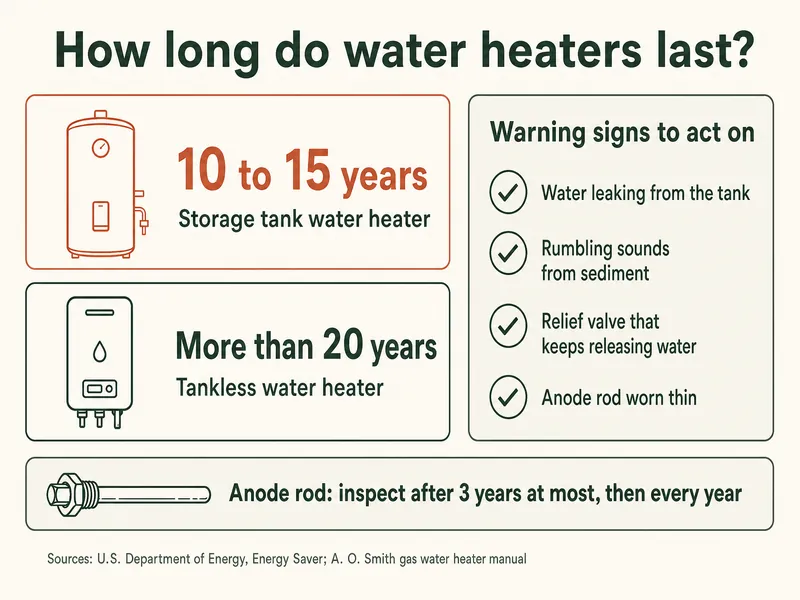
How long do water heaters last? About 10 to 15 years for a storage tank and more than 20 years for a tankless unit, per the U.S. Department of Energy, with water quality and upkeep moving each heater along that range.
On this page
Key takeaways
- The U.S. Department of Energy's Energy Saver guide gives storage tank heaters 10 to 15 years and tankless heaters more than 20 years.
- A. O. Smith's installation manual for gas tanks says heater life "depends upon water quality, water pressure and the environment" where it is installed.
- A. O. Smith says to inspect the anode rod after 3 years at most, then every year; once the rod is used up, "the tank will start to corrode."
- Thermal expansion in a closed system can cause early tank leaks that the A. O. Smith warranty does not cover.
- Tap water on the East Bank of New Orleans counts as moderately hard: 100.7 mg/L, about 5.9 gpg (Carrollton Water Works, 2025 report). That calls for routine flushing, not alarm.
- For Bradford White heaters, the maker says the first two characters of the serial number give the year and month it was made.
How long do water heaters last?
A storage tank water heater lasts about 10 to 15 years, according to DOE's Energy Saver advice. That range covers both gas and electric tanks. Where a particular heater lands depends on the water it heats, the pressure in the house, how hard it works and whether anyone ever maintains it.
The maker's manual for A. O. Smith gas tanks puts it plainly: "Water heater life depends upon water quality, water pressure and the environment in which the water heater is installed." The same manual warns that "all water heaters eventually leak," which is why it calls for a metal drain pan piped to a drain under every installation.
Water heater lifespan figures
- 10–15 yearsTypical service life of a storage tank water heaterU.S. Department of Energy, Energy Saver
- 20+ yearsTypical service life of a tankless water heaterU.S. Department of Energy, Energy Saver
- 3 yearsLongest gap before the first anode rod inspection, then yearlyA. O. Smith gas water heater manual
- 5.9 gpgTotal hardness of East Bank New Orleans tap water (100.7 mg/L), moderately hardLDH, Carrollton Water Works 2025 report
How long does a tankless water heater last?
A tankless water heater lasts more than 20 years, by the Department of Energy's Energy Saver estimate, roughly twice a storage tank. There is no tank of standing water to corrode; the part that wears is the heat exchanger. Its enemy is scale, the mineral crust that hard water leaves on hot surfaces.
Rheem's tankless use and care manual sets water-quality limits for its warranty, including total hardness up to 200 mg/L, and excludes failures "caused by lime, mineral build-up, or scale." The 2025 reports put East Bank New Orleans at 100.7 mg/L and Algiers at 70.7 mg/L, both inside that hardness limit. The tankless water heater cost guide covers the descaling that keeps one running.
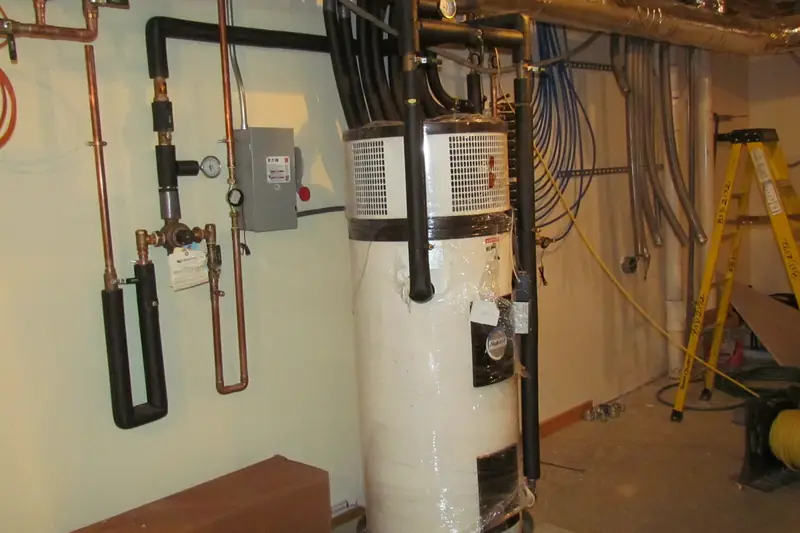
No verified lifespan figure for heat pump (hybrid) water heaters was found in the DOE or maker documents checked, so this page gives none. They are storage tanks with a heat pump on top, so the tank-care advice below applies to them too.
| Type | Typical life | Main wear point | Key upkeep |
|---|---|---|---|
| Gas storage tank | 10–15 years (DOE) | Tank corrosion once the anode is spent; sediment over the burner | Anode check, flushing, T&P valve test |
| Electric storage tank | 10–15 years (DOE) | Tank corrosion; scale on heating elements | Anode check, flushing, element replacement |
| Tankless (gas) | More than 20 years (DOE) | Scale in the heat exchanger | Descaling flush, inlet filter cleaning |
| Heat pump (hybrid) | No verified figure | Tank corrosion; clogged air filter or condensate drain | Anode check, filter cleaning, condensate drain |
What shortens a water heater's life?
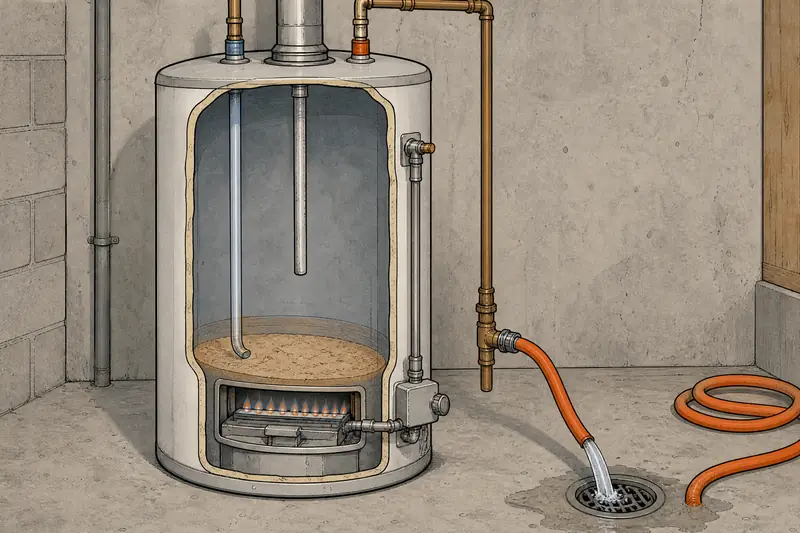
Three things shorten a heater's life most: a spent anode rod, high pressure from thermal expansion, and sediment. The anode is a metal rod that corrodes so the steel tank does not. The A. O. Smith manual says hotter water, heavy use, poor water quality and water softening all speed up anode loss, and that once the anode is gone, the tank corrodes and eventually leaks.
Pressure is the quieter culprit. In a closed water system, one with a check valve, backflow preventer or pressure-reducing valve on the supply, heated water has nowhere to expand. A. O. Smith says the resulting thermal expansion "can cause premature tank failure" and that this failure is not covered under its limited warranty. A properly sized expansion tank is the fix; the backflow prevention guide explains why many homes have a closed system.
Sediment settles at the bottom of a tank, insulating the water from a gas burner and making the heater work harder. Carrollton's East Bank supply sits in the moderately hard class at about 5.9 gpg (Carrollton Water Works, 2025 report), and the New Orleans water hardness guide compares the utilities. That is reason enough for routine flushing, but not evidence that local water ruins heaters early; no source gives a shortened lifespan figure for the area.
How do you find a water heater's age?
The age is coded into the serial number on the rating plate, the label on the side of the heater. Each maker uses its own code. Bradford White says "the first two characters of the serial number represent the year and month of manufacture," and its My Water Heater page returns the date when the serial is entered.
Other brands use other patterns, so look up the decoding chart on the maker's own site rather than guessing from a pattern meant for a different brand. The install date can also appear on the permit record or on a sticker the installer left. A heater made 11 years ago may have sat in a warehouse before it was installed, so the manufacturing date is an upper bound on how long it has been working.
What are the signs a water heater is failing?
The clearest sign is water leaking from the tank itself, which cannot be repaired. Before treating a puddle as a dead heater, check the fittings, the drain valve and the T&P valve discharge pipe, because those parts can be replaced. A leak from the steel shell or the bottom seam means the tank has corroded through.
The A. O. Smith manual describes other warning signs. Rumbling or "percolating" sounds come from sediment in the bottom of the tank. A temperature and pressure relief valve that releases water again and again often points to excessive pressure from thermal expansion, which the manual calls "the most common cause" of T&P valve leakage. A "rotten egg smell" in the hot water comes from a reaction between the anode rod and certain water conditions; it is a nuisance worth fixing but not by itself a sign the tank is failing.
How can you make a water heater last longer?
Flush the tank, check the anode, test the relief valve and control pressure. The Department of Energy's Energy Saver guidance suggests draining a quart of water from the tank every three months and inspecting the anode rod every three to four years. A. O. Smith's manual goes further for its gas heaters: a full drain and flush every 6 months, the anode checked after no more than 3 years and then every year, and the T&P valve operated at least once a year.
Where the two differ, follow the manual for the heater you own; the water heater flush guide walks through the steps. Keeping the thermostat at 120°F, which DOE says is enough for most households, also helps, since A. O. Smith lists hotter water among the things that speed up anode wear. Ask a licensed plumber to fit an expansion tank if the house has a closed system and the heater has none. When the time comes, the water heater replacement cost guide explains what a new one involves.
How we put this page together
This page is based on the archived DOE Energy Saver pages on storage and tankless water heaters (read via an archived copy, January 2026), A. O. Smith's manual 326940-001 for residential gas heaters, Rheem's tankless use and care manual, Bradford White's serial number help pages, and the Louisiana Department of Health copy of the 2025 Carrollton Water Works and Algiers Water Works water quality reports. Each was opened and read in October 2026. Deliberately not used: lifespan figures from contractor blogs, any claim that New Orleans water shortens heater life by a set number of years (no source gives one), and heat pump lifespan figures, which could not be verified.
Common questions
Does a gas or electric tank last longer?
DOE gives the same 10 to 15 year range for storage tanks in general. Which lasts longer in a given house depends more on water quality, pressure and upkeep than on fuel.
Is a 15-year-old water heater living on borrowed time?
It is at the top of DOE's range for storage tanks. If it still works and does not leak, many owners start budgeting for a replacement rather than replacing it at once.
Does a water softener shorten a water heater's life?
A. O. Smith says artificially softened water speeds up anode rod depletion and that softener use "may decrease the life of the water heater tank." It asks for yearly anode inspection on softened water.
Can replacing the anode rod extend a tank's life?
The anode protects the tank from corrosion, so replacing a worn one before the tank corrodes is the main way to extend tank life. A. O. Smith lists a rod thinner than 3/8 inch, or one with about a third of its support wire exposed, as depleted.
Does a water heater in a garage wear out faster?
No source checked gives a figure. The maker manuals do stress clearances, combustion air and protection from freezing, so an exposed location deserves more frequent checks.
Why does a water heater make popping or rumbling noises?
A. O. Smith attributes rumbling or percolating sounds to sediment collecting in the bottom of the tank. Flushing the tank is the first step it recommends.
Does the warranty length tell you how long a heater will last?
Not exactly. A warranty is the maker's coverage period, and tanks often outlast it, but warranties also exclude failures from thermal expansion or scale, so upkeep matters.
Related reading

More guides: the Below the Slab home page.