
Sewer & drains
Cast Iron Drain Pipe: Lifespan, Failure and Replacement
Cast iron drain pipe has no verified lifespan in years; its condition depends on corrosion from sewer gas, which EPA says turns into sulfuric acid that attacks iron, so a camera check tells more than the house's age.
On this page
Key takeaways
- No agency publishes a verified lifespan in years for cast iron house drains, so this guide gives none; condition is judged by camera, not by age.
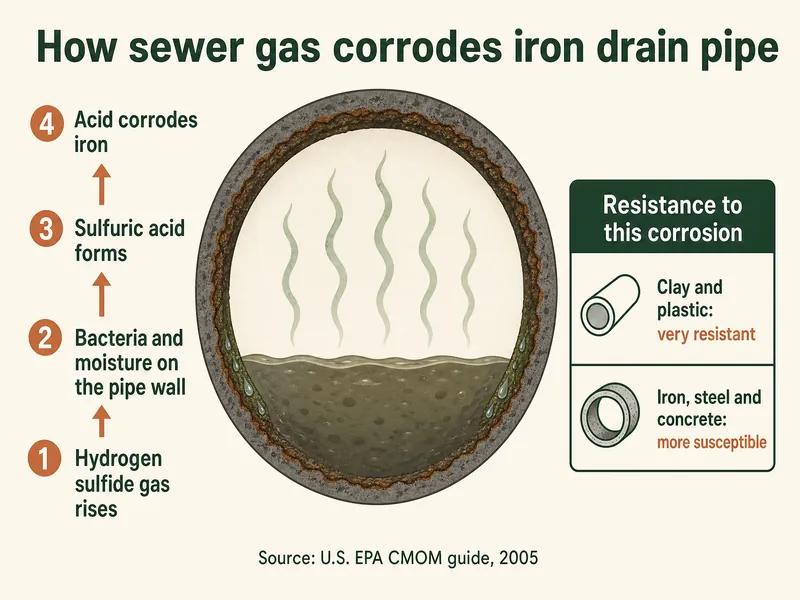
- EPA's 2005 sewer-maintenance guide explains that hydrogen sulfide rises into the air space of a pipe and, with bacteria and moisture, forms sulfuric acid that corrodes ferrous metals (EPA CMOM guide).
- The same guide says clay and plastic pipe are very resistant to that corrosion, while iron, steel and concrete are more susceptible.
- EPA links more hydrogen sulfide to slow flow and long detention times, and less to pipes where wastewater moves faster.
- The City of Columbus gives a newly lined lateral a life expectancy of 50 years, one benchmark for lining as an alternative to digging.
- In New Orleans, drain work needs a Sewerage and Water Board permit filed by a registered licensed master plumber (SWBNO).
Cast iron drain facts
- <4 pHReading at a pipe crown that EPA's guide says warrants a closer look for hydrogen sulfide corrosionU.S. EPA, CMOM guide (2005)
- 50 yearsLife expectancy Columbus, Ohio states for a newly lined sewer lateralCity of Columbus
- $300–$600National range for a sewer camera inspection, January 2025Fixr
- $1,000–$20,000National range for sewer line replacement, January 2025 (not specific to cast iron)Fixr
How long does cast iron drain pipe last?
Cast iron drain pipe has no verified lifespan in years, and figures quoted online are not backed by an agency or standard this guide could find. What is documented is how it wears out. EPA's guide to sewer-system maintenance explains that when flow drops, hydrogen sulfide gas rises into the air space of the pipe and reacts with bacteria and moisture on the walls to form sulfuric acid, and that sulfuric acid corrodes ferrous metals and concrete. Iron drain pipe is ferrous metal.
How fast that happens depends on the house. EPA lists low velocity, long detention times and solids deposition among the conditions that generate hydrogen sulfide, and notes that wastewater moving faster down a steeper pipe carries less of it. A well-sloped drain that is used every day can stay sound far longer than a flat run in a house that sits empty, which is why two cast iron systems of the same age can be in very different shape.
What does cast iron failure look like?
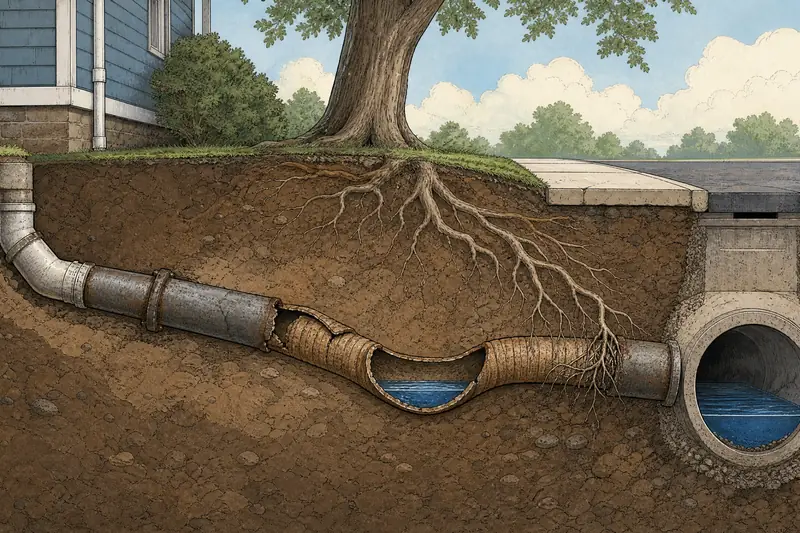
Cast iron failure usually shows as slow drains, repeat clogs, sewer odor, rust-colored stains or weeping at joints, and on camera as heavy scale, cracks and thin or missing wall. Scale is the rough, flaky crust of corrosion product that builds inside the pipe and narrows it, so paper and grease catch on it. Cracks can run along the length of the pipe, and the hub joints, where one length slips into the next, can open or let roots in where the pipe runs outside. Roots are a big part of the picture: a U.S. Forest Service-hosted review notes they are reported to cause more than half of all sewer blockages, with old jointed pipe among the risk factors.
In a slab house the main drain runs through the soil beneath the floor, so leaks there are hidden. A drain leak under a slab can show up as a damp or musty spot, a sewer smell indoors, or soil washing out below the floor; the slab leak signs guide covers what to watch for, and the foundation settlement guide explains how moving soil and pipes affect each other. A camera run from a cleanout is the way to see the pipe itself, and some cities set rules for the footage: Morro Bay, California requires the camera to travel no faster than 30 feet per minute and to stop for at least 5 seconds at broken sections, root intrusion and misaligned joints; the sewer camera inspection guide explains how to read the video.
What is channeling in a cast iron pipe?
Channeling is the word contractors use for a groove worn or corroded along the bottom of a horizontal cast iron drain, where wastewater always runs. Over time the floor of the pipe thins into a trough, and in bad cases it opens into the soil below while the top of the pipe still looks intact. This guide found no agency definition of the term, so treat it as trade language, and ask to see the trough on the video rather than taking a report's word for it.
Channeling matters for the repair choice. A pipe with a deep channel or a hole in its floor may not hold a liner well, and cleaning tools can break through a thin floor. EPA's guide places acid formation in the air space at the top of the pipe; a channel along the floor is a different pattern, one more reason to see the whole circumference on video. Both kinds of damage show on a good camera run, especially after the line has been cleaned.
Can cast iron drain pipe be lined instead of replaced?
Often yes, if the pipe still has enough structure to act as a host. In a cured-in-place job, a resin-filled liner is pushed or pulled through the old pipe and hardened into a new pipe inside it; the City of Columbus describes filling the liner with hot water so it cures in place, and states a life expectancy of 50 years for a newly lined lateral. Lining avoids cutting a slab or digging a trench, which is its main appeal in a slab house.
Lining has limits. Columbus notes that a line too damaged for the liner to pass has to be dug up and replaced, and EPA's guide ties the choice of rehabilitation method to the pipe's size, type, location and condition. Branch lines with many fittings are harder to line than a straight main. Ask the contractor to show, on video, that the pipe was cleaned to bare wall before lining, how branch connections will be reopened, and what warranty comes with the work.
| Option | What it involves | Works best when | Watch out for |
|---|---|---|---|
| Spot repair | Cut out and replace one bad section | Damage is limited to one place | Older pipe on either side of the repair |
| Cured-in-place lining | Resin liner hardened inside the cleaned pipe | Pipe is round and continuous enough to host a liner | Deep channels, holes, many branches |
| Pipe bursting | New pipe pulled through as the old one is broken outward | Long straight outdoor runs | Pits at each end, nearby utilities |
| Full replacement | Old pipe removed and new plastic laid | Damage is widespread or under easy access | Slab cutting or tunneling under the house |
What does cast iron pipe replacement cost?
No verified cost figure exists for replacing cast iron drains specifically, so this guide gives none; the price depends on where the pipe runs and how it is reached. For the buried line outside the house, Fixr's national range for sewer line replacement is $1,000 to $20,000 (January 2025), which covers every pipe material. Under a slab, the bill adds the cost of reaching the pipe, by cutting the floor or by tunneling, plus restoring floors and fixtures.
The main cost drivers are the length of pipe being replaced, whether it is under the slab or the yard, the number of branch lines and fixtures that must be reconnected, the method, the permit and restoration. In New Orleans the permit is filed with the Sewerage and Water Board by a licensed master plumber registered with the board, and work covered before inspection must be uncovered. The sewer line replacement cost guide and the tunneling under a slab guide go further into bids for each part of the job.
Should you replace cast iron before selling?
Not automatically; what matters is knowing the pipe's condition before a buyer's inspector finds it for you. A camera inspection costs $300 to $600 nationally according to Fixr (January 2025), and the video gives a seller something concrete to show, price or fix. If the pipe is sound, the video helps the sale; if it is failing, the owner can choose between a repair, a price adjustment or a credit with real numbers in hand.
Insurance rarely changes the math. Louisiana's insurance department, in its consumer's guide to homeowners insurance, lists sewer and drain backups and earth movement among the usual homeowners exclusions, and the NAIC reminds owners that a homeowners policy "isn't a maintenance contract". Louisiana's seller-disclosure rules were not checked for this guide, so ask a real estate attorney or agent what must be disclosed once a defect is known.
How we put this page together
This page relies on EPA's 2005 guide to evaluating CMOM programs (document 305-B-05-002), mainly its hydrogen sulfide and rehabilitation sections, the City of Columbus homeowner brochure on lateral lining, the Sewerage and Water Board's page on plumbing permits, the Louisiana insurance department's and NAIC's homeowners guides, and Fixr's national cost ranges, named and unlinked. All were checked in October 2026. Left out: any cast iron lifespan in years and any cast iron replacement price (neither could be verified), per-foot lining prices, Louisiana seller-disclosure rules, insurer lawsuits from other states and forum anecdotes.
Common questions
How can you tell if a house has cast iron drains?
Look at exposed drain pipe at a cleanout, a water heater closet or under a sink: cast iron is heavy, dark gray or black, and a magnet sticks to it. A camera run confirms what the buried lines are made of.
Is cast iron drain pipe still used?
Yes, cast iron soil pipe is still made and sold, though plastic is far more common in house drains. The International Plumbing Code edition adopted in Louisiana sets which materials are approved.
Does cast iron pipe make a house noisy?
Cast iron is heavier than plastic, so drain noise through walls is usually lower. That is a comfort point, not a reason to keep a failing pipe.
Can rust from a cast iron drain get into drinking water?
No. Drain pipes carry waste out of the house and are separate from the supply lines that carry drinking water in. Rust-colored tap water has other causes covered in the New Orleans tap water guide.
Will chemical drain cleaners hurt cast iron?
They do nothing for scale or a cracked wall, and this guide found no maker or agency data on their effect on old iron. A camera and mechanical cleaning are the better first step for a repeat clog.
Is descaling the same as lining?
No. Descaling removes the corrosion crust to restore the pipe's opening; lining adds a new pipe inside the old one. Descaling often comes first, because a liner needs a clean wall.
Can only the pipe under the slab be lined?
Yes, lining can be limited to one run, such as the main drain under the slab, while outdoor pipe is replaced or left alone. Ask for the camera footage of every section so the bid matches the damage.
Related guides

More guides: the slab house plumbing guide home page.