
Water heaters
Water Heater Flush: How to Drain the Tank
A water heater flush runs water out through the tank's drain valve until it comes out clean, carrying sediment with it; makers such as A. O. Smith call for one every 6 months.
On this page
Key takeaways
- The A. O. Smith gas tank manual recommends that the tank "be drained and flushed every 6 months to remove sediment."
- The U.S. Department of Energy's Energy Saver advice is lighter: drain about a quart every three months. Where advice differs, follow your own heater's manual.
- Rheem's electric heater manual suggests draining "a few quarts" every month and warns the tank "must be full of water before heater is turned on."
- For tankless units, Rheem's maintenance guidance says to flush or descale about every six months in hard-water areas.
- East Bank New Orleans water is drawn from the Mississippi and measured 100.7 mg/L hardness, about 5.9 gpg (Carrollton Water Works, 2025 report): moderately hard.
- A. O. Smith says to inspect the anode rod after 3 years at most, then yearly.
Why flush a water heater?
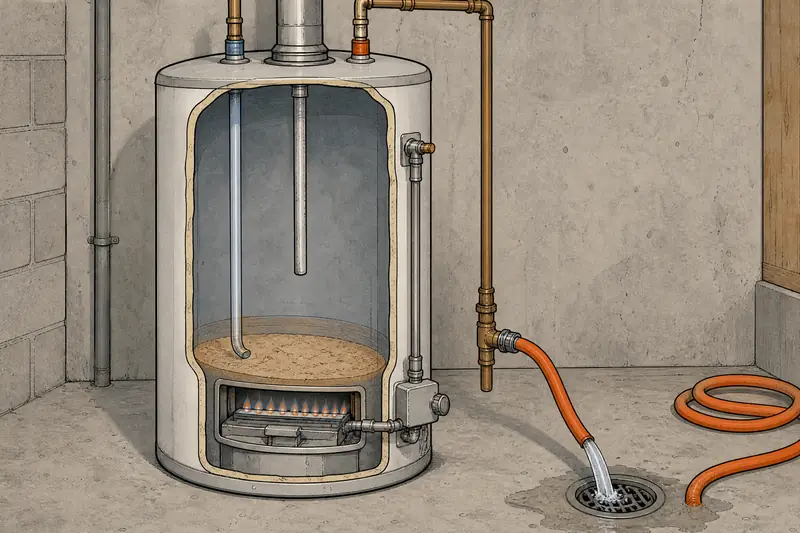
Flushing removes the sediment that settles in the bottom of a tank. Rheem's electric manual describes the tank as "a setting basin for solids suspended in the water," where hard water deposits collect. On a gas heater that layer sits between the burner and the water; on an electric heater it can bury the lower element.
The A. O. Smith manual links sediment to "rumbling" or "percolating" sounds and sends owners to its draining and flushing section. Mississippi River water feeds the New Orleans and Jefferson Parish plants, and the 2025 Carrollton Water Works report lists East Bank tap water at 100.7 mg/L total hardness, or about 5.9 grains per gallon. That is moderately hard on the USGS scale, so some scale and sediment are normal; the New Orleans water hardness guide has the figures for each utility.
Flushing intervals from makers and DOE
- 6 monthsFull drain and flush interval in A. O. Smith's gas tank manualA. O. Smith gas water heater manual
- 3 monthsDOE suggestion for draining about a quart from a storage tankU.S. Department of Energy, Energy Saver
- MonthlyRheem's suggestion to drain a few quarts from its electric tanksRheem electric water heater manual
- 100.7 mg/LTotal hardness of East Bank New Orleans tap water (about 5.9 gpg)LDH, Carrollton Water Works 2025 report
How often should you flush a water heater?
Follow the manual for your heater, because the makers and DOE give different intervals. A. O. Smith's gas tank manual says every 6 months for a full drain and flush. DOE's Energy Saver advice suggests draining a quart every three months, and Rheem's electric manual suggests a few quarts every month.
These are not in conflict so much as different habits: a small drain often, or a full flush twice a year. On moderately hard river water, either keeps sediment from building up for years. If the heater has never been flushed, read the section below on old tanks before opening the valve.
| Heater | Flush or drain | Other routine checks | Source |
|---|---|---|---|
| A. O. Smith gas tank | Drain and flush every 6 months | T&P valve at least once a year; anode after 3 years, then yearly | A. O. Smith manual 326940-001 |
| Rheem electric tank | A few quarts every month | T&P valve at least once a year; anode yearly | Rheem electric manual AP21980 |
| Any storage tank (DOE) | About a quart every 3 months | T&P valve every 6 months; anode every 3 to 4 years | DOE Energy Saver |
| Rheem tankless | Flush or descale about every 6 months in hard water | Clean the inlet water filter; inspect the vent | Rheem guidance and tankless manual |
How do you flush a water heater step by step?
For a gas tank, the A. O. Smith manual flushes under normal water pressure without draining the tank first. Its steps, in short:
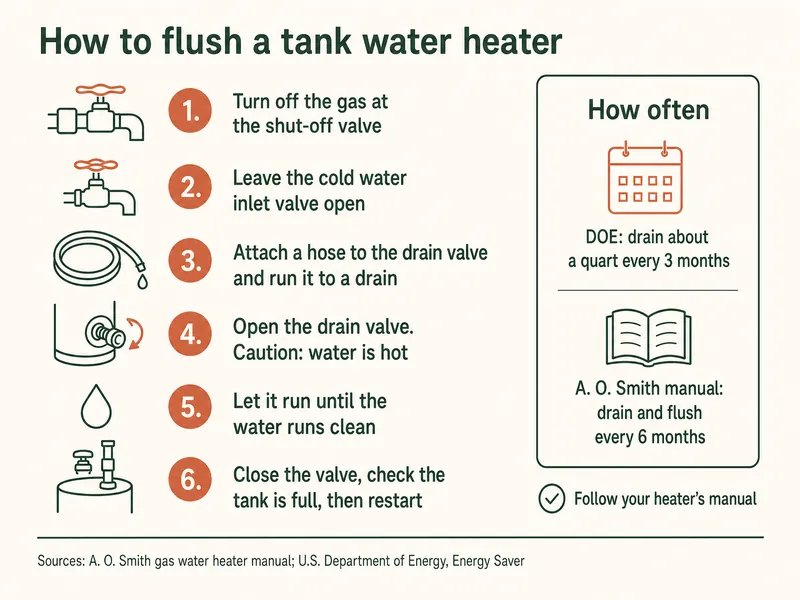
- Turn off the gas at the manual gas shut-off valve.
- Make sure the cold water inlet valve is open.
- Connect a hose to the drain valve and run it to an adequate drain, securing the hose for the whole flush.
- Open the drain valve. The manual warns: "Water will be hot."
- Let the water flow "until it runs clean."
- Close the drain valve, remove the hose and make sure the tank is full.
- Turn the gas back on and follow the lighting instructions on the label, then let the heater run several heating cycles.
On an electric tank, Rheem's manual says to shut off power to the heater before draining, turn off the cold supply, open a hot faucet or the relief valve lever to let air in, and drain through a hose to a drain. Refill the tank completely, until hot faucets run with a steady flow, before turning the power back on. Rheem's control lists "dry fire" (heating without water) as a fault, and its warranty does not cover damage from running with an empty or partly filled tank.
A slab house often has the heater in a closet or garage with no floor drain nearby, so plan where the hose will go before opening the valve. The water comes out hot, so the hose needs to end somewhere it cannot scald anyone or back up.
How do you flush a tankless water heater?
A tankless unit is flushed by pumping a descaling solution through its heat exchanger, not by draining a tank. Rheem's maintenance guidance says "a vinegar or descaling solution flush helps dissolve deposits" and suggests about every six months in hard-water areas, with yearly maintenance otherwise. The maker sells a flush kit and isolation valves for the job.
Rheem's tankless use and care manual strongly recommends isolation valve kits on the inlet and outlet lines because they make flushing easier, and it calls for cleaning the cold-water inlet filter. Some models show a maintenance reminder code when a flush is due. Many owners have a licensed plumber do the first descale, then follow the manual themselves; the tankless water heater cost guide covers this upkeep in context.
What is an anode rod and when should you check it?
An anode rod is a sacrificial metal rod hung inside the tank to take the corrosion in place of the steel. A. O. Smith writes that it it "will slowly deplete" and that once it is gone, "the tank will start to corrode, eventually developing a leak." It asks for an inspection after a maximum of three years and every year after that.
A. O. Smith counts a rod as depleted when most of it is thinner than 3/8 inch or about a third of its support wire shows. Rheem's electric manual asks for a yearly check and replacement when more than 6 inches of core wire is exposed. DOE's Energy Saver advice gives every three to four years. Softened water speeds up anode wear, by A. O. Smith's account, so homes with a softener should check yearly; the water softener guide covers whether one is worth having on city water at all.
When should you not flush an old tank?
Do not bother flushing a tank that already leaks from its shell; a flush cannot fix corrosion, and the water heater lifespan guide explains what a shell leak means. No maker manual reviewed forbids flushing an older tank. The caution is practical: a drain valve that has sat closed for many years may drip once it has been opened.
A. O. Smith's manual includes a drain valve washer replacement procedure for that situation. If the heater is near the end of the DOE's 10 to 15 year range and has never been flushed, weigh a first flush against the chance of a dripping valve, and have a replacement valve on hand or a licensed plumber present. The water heater replacement cost guide helps with the repair-or-replace decision.
How we put this page together
This page is based on A. O. Smith's residential gas water heater manual (326940-001, "Draining, Refilling And Flushing" and "Anode Rod Maintenance"), Rheem's electric residential manual (AP21980), Rheem's tankless use and care manual and maintenance article, the archived DOE Energy Saver page on storage water heaters, and the 2025 Carrollton Water Works report as posted by LDH. All were read in October 2026. Excluded: video tutorials, forum tips and any claim that river water ruins water heaters in a set number of years, which no source supports.
Common questions
How long does it take to flush a tank water heater?
It depends on how much sediment comes out. The A. O. Smith procedure runs water until it is clear, then asks for several heating cycles to confirm the heater works before walking away.
Should the water heater be turned off to flush it?
Yes. A. O. Smith says to turn the gas off at the shut-off valve, and Rheem says to shut off power to an electric heater before draining.
Do you have to drain the whole tank to flush it?
Not with A. O. Smith's method, which flushes under supply pressure with the cold inlet open. A full drain is a separate procedure in the same manual.
Is it safe to use vinegar in a tank water heater?
The vinegar or descaling advice in Rheem's guidance is for tankless heat exchangers. For a tank, follow the flushing steps in its manual.
What should the flushed water look like?
It may come out cloudy or carry grit at first. The A. O. Smith manual says to continue until the water runs clean.
Can a flush stop a water heater from rumbling?
A. O. Smith links rumbling to sediment and points owners to its flushing section, so a flush is the first thing to try. Heavy, hardened scale may not all come out.
Does the relief valve need testing when flushing?
It is a separate yearly task. Both A. O. Smith and Rheem ask owners to operate the T&P valve at least once a year, with the discharge pipe running to a safe drain.
Keep reading


More guides: the slab house plumbing guide home page.