
New Orleans & Jefferson Parish water
Is New Orleans Tap Water Safe to Drink?
Is New Orleans tap water safe to drink? By the federal yardstick, yes: the 2025 Carrollton report shows disinfectant and byproducts inside EPA limits and lead under the 15 ppb action level, with one freeze-related turbidity violation and old lead pipes left to replace.
Disclosure: SoftPro Water Systems, a store owned by the same team as this site, sells the filters and softeners we link to. Our water pages follow the utilities' 2025 water quality reports and federal and state agency guidance, checked October 2026. Store descriptions are reported as the store's own claims. Ownership disclosure
View at SoftPro Water Systems
On this page
Key takeaways
- East Bank tap water comes from the Mississippi River through Carrollton Water Works, which draws at the Dakin/Industrial and Oak St intakes (LDH 2025 report).
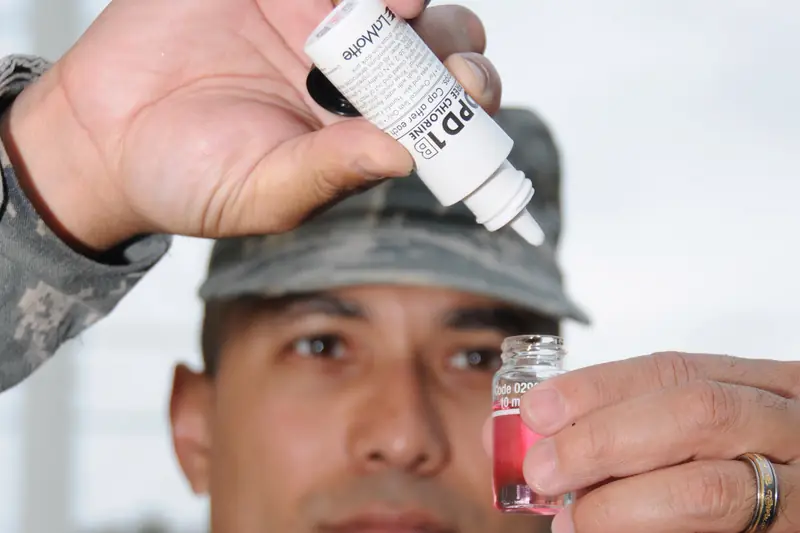
- Chloramine, the disinfectant, ran at a highest yearly average of 3.3 ppm in 2025, under the EPA limit of 4 mg/L.
- Lead at the 90th percentile was 6 ppb for 2023–2025, under the 15 ppb action level, which triggers utility action rather than marking a safe level; the EPA's health goal for lead is zero.
- The one 2025 violation was turbidity in January, tied to freeze-related demand; the Sewerage and Water Board said boiling was not needed.
- Hardness was 100.7 mg/L, about 5.9 grains per gallon: moderately hard, a comfort issue rather than a health one.
- No home filter fixes a boil water advisory; follow NOLA Ready and the utility.
Is New Orleans tap water safe to drink?
New Orleans tap water met the federal health limits that the 2025 water quality report measures, with one treatment-technique violation noted below, and lead stayed under its action level, which is a trigger rather than a safety limit. The Louisiana Department of Health copy of the Carrollton Water Works report lists each regulated contaminant beside its limit, and the East Bank figures sit under those limits.
"Safe" here means what the Safe Drinking Water Act means: results within the EPA's national primary drinking water regulations. It does not mean every home tap is identical. Old service lines, old faucets and water that sits in the pipes overnight can change what comes out at your sink, which is why lead gets its own section below.
The report is also a snapshot. Many of its numbers come from one annual sample or a few samples spread through the year, so read them as the 2025 picture, not a permanent promise for every week.
Where does New Orleans get its drinking water?
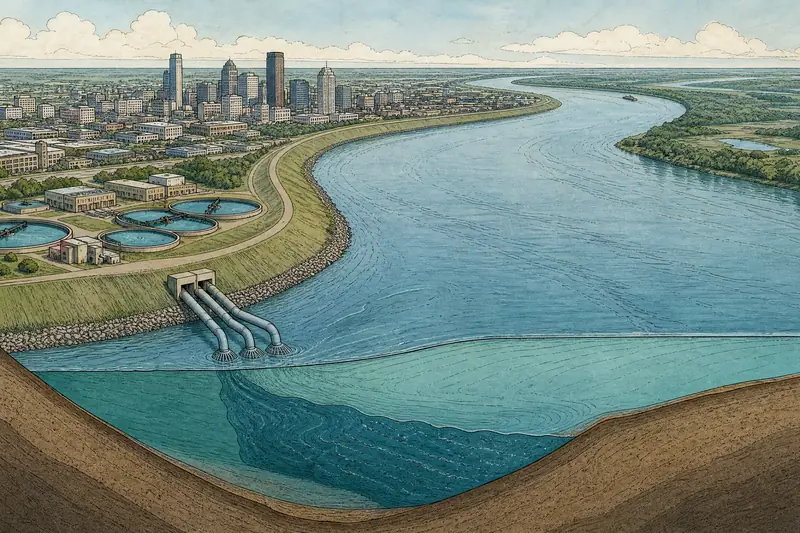
New Orleans drinks treated Mississippi River water. The East Bank system, Carrollton Water Works, takes river water at two surface intakes, and the LDH report rates the source's susceptibility to contamination as "HIGH", which is normal for a big river that drains much of the country.
The West Bank of Orleans Parish has its own plant, Algiers Water Works, with its own 2025 report. Jefferson Parish runs separate systems on each bank; the West Jefferson plant also draws from the river. East Jefferson (Metairie and Kenner) publishes its own 2025 report, and its figures are not repeated on this site because the document could not be opened for checking.
River water raises one more question in dry years: salt. The Sewerage and Water Board's own 2023 updates say salt water did not reach Orleans Parish, and the saltwater intrusion guide explains how the Corps of Engineers' underwater sill held the wedge downstream.
What does the 2025 water quality report show?
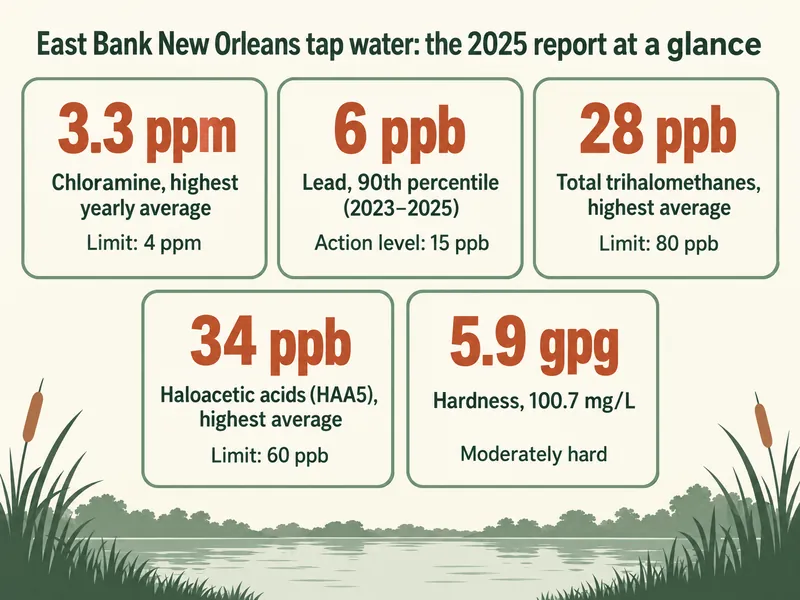
The 2025 Carrollton report shows every listed health-based result inside its federal limit or under its action level, plus one turbidity violation. The table compares the main East Bank numbers with those limits and triggers.
| Measure | 2025 result | Federal limit or trigger |
|---|---|---|
| Chloramine (disinfectant) | 3.3 ppm highest running annual average; range 0.0–4.8 | 4 mg/L running annual average (MRDL) |
| Lead (2023–2025) | 6 ppb at the 90th percentile; range 0–23; 2 sites over | 15 ppb action level (a trigger for utility action; EPA health goal is zero) |
| Copper (2023–2025) | 0.1 ppm at the 90th percentile; 0 sites over | 1.3 ppm action level (trigger) |
| Total trihalomethanes | 28 ppb highest locational average | 80 ppb |
| Haloacetic acids (HAA5) | 34 ppb highest locational average | 60 ppb |
| Hardness | 100.7 mg/L, roughly 5.9 grains per gallon | No health limit |
The violation was turbidity, a measure of cloudiness, in January 2025. The Sewerage and Water Board's 2025 annual water quality report says the plant exceeded 0.349 NTU in 6.5% of January measurements because of "higher-than-normal water treatment rates due to freeze related water usage", that consumers did not need to boil their water, and that tests did not show bacteria. That was the month of the record January 2025 snow, covered in the frozen pipes guide.
The same SWBNO report lists PFAS results: PFOA from not detected to 2.8 parts per trillion and PFOS from not detected to 2.6 ppt. The EPA's 2024 rule set a limit of 4.0 ppt for each, and the agency's May 2026 changes are still proposals, not final rules.
What the 2025 East Bank report lists
- 3.3 ppmChloramine, highest running annual average, Carrollton Water Works 2025LDH 2025 water quality report
- 4 mg/LEPA maximum residual disinfectant level for chloramineEPA
- 6 ppbLead at the 90th percentile, East Bank, 2023–2025 samplingLDH 2025 water quality report
- 28 ppbHighest total trihalomethane average (limit 80 ppb)LDH 2025 water quality report
- 100.7 mg/LTotal hardness, about 5.9 grains per gallonLDH 2025 water quality report
What about lead in New Orleans water?
Lead is the one result worth acting on at home, because it comes from pipes and fixtures rather than the river. The East Bank's 90th-percentile result was 6 ppb, with a range of 0 to 23 ppb and 2 of 85 samples above the 15 ppb action level, according to the SWBNO report. The West Bank (Algiers) figure was also 6 ppb, but its samples ranged from 0 to 100 ppb, with 2 of 52 above the action level.
The action level is not a safety line. The EPA says that if more than 10 percent of tap samples exceed 15 ppb, the water system must take extra steps such as corrosion control and public education, and it sets the health goal for lead at zero.
The EPA says there is no known safe level of lead in a child's blood, so the useful steps are simple: find out whether your service line is lead, run the cold tap after water has sat for hours, and test. The Sewerage and Water Board's lead awareness page has a service-line map, a test kit request and a lead-filtering pitcher on request. The full walk-through is on the lead in drinking water page.
Why does New Orleans issue boil water advisories?
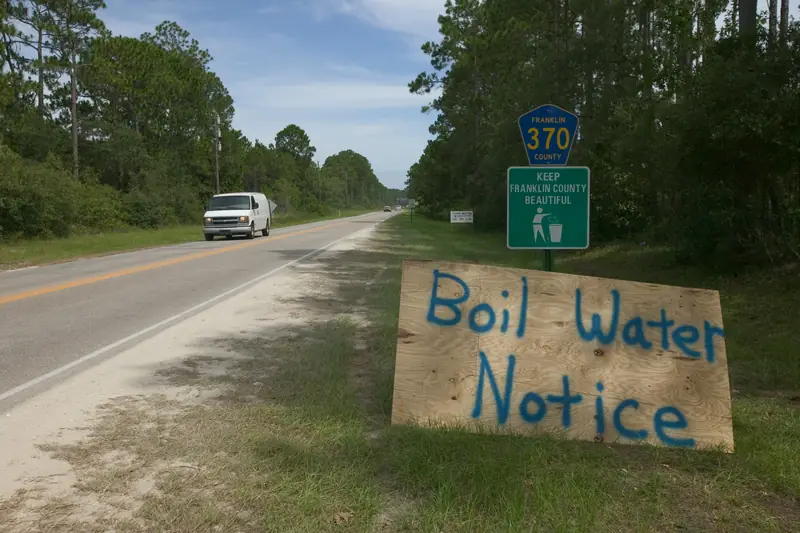
Boil water advisories follow drops in water pressure or other problems in the pipe network, when untreated water could get into the mains. They are about the delivery system, not the river or the treatment plant's chemistry, and no home filter or softener is a fix for one.
The city's boil water factsheet says most advisories last about 24 hours. When one is lifted, run cold taps for at least 5 minutes and throw out 3 batches of ice. The CDC's advice is to boil water for 1 minute (3 minutes above 6,500 feet). The boil water advisory guide covers the whole checklist, and NOLA Ready posts live status.
Which home filters help, and which don't?
A filter is a choice for taste, odor or one specific concern, not a requirement for New Orleans water. Match the filter to the job:
- Taste and smell of chloramine. A catalytic carbon filter is the usual tool. The chloramine guide explains why boiling and letting water stand do not remove it, and why fish tanks and dialysis machines are the cases where removal matters.
- Lead at the kitchen tap. Look for a filter certified to NSF/ANSI 53 or 58 for lead. NSF's lead listing is the place to check a model.
- Hardness. At 5.9 gpg a softener is optional; see the water softener guide.
If you want to try a whole-house carbon unit, the SoftPro Chlorine+ Carbon Whole House Filter (sold by SoftPro Water Systems, a store we own) lists chloramine among what it is designed to reduce; that is the store's claim, and the listing names no NSF/ANSI standard number. It is listed at $1,097 on the store's page (October 2026). For drinking water at one tap, the Waterdrop G3P600 (sold by SoftPro Water Systems, a store we own) reverse osmosis unit is listed at $429; the maker states IAPMO certification to NSF/ANSI 58 for TDS reduction. This site has not seen a certification for lead on that model, so check its performance data sheet before relying on it for lead. The EPA also notes that reverse osmosis filters do not remove monochloramine, so RO is not a chloramine tool. Both are optional, and the whole house filter guide helps decide whether either fits.
Try it on city water
SoftPro Chlorine+ Carbon Whole House Filter
Tap water that meets federal limits is safe to drink without a filter; a catalytic carbon whole house filter is a taste, odor and chloramine choice for the whole house. Check the size, current price and the maker's performance claims at SoftPro Water Systems. See who needs chloramine removed.
View at SoftPro Water SystemsSoftPro Water Systems, a store owned by the same team as this site, sells the filters and softeners we link to. Ownership disclosure
How we put this page together
This page draws on the 2025 consumer confidence reports for Carrollton Water Works and Algiers Water Works as posted by the state health department, the Sewerage and Water Board's 2025 annual water quality report, EPA and CDC guidance, the city's NOLA Ready boil water factsheet, NSF's lead-reduction listing and the store's product pages (dates checked: October 2026). East Jefferson figures were left out because the parish report could not be opened. No home water tests, news coverage or advocacy-group databases were used.
Common questions
Is it safe to drink New Orleans tap water straight from the faucet?
The 2025 East Bank report shows results within federal limits, apart from a January turbidity violation the utility said did not require boiling; lead from home plumbing is the exception the report cannot vouch for, since its 15 ppb action level is a trigger, not a safe level. The part you control is your own plumbing: if water has sat for six hours or more, run the cold tap for a few minutes before drinking, as the Sewerage and Water Board advises.
Does New Orleans tap water have fluoride?
Yes. The 2025 Carrollton report lists fluoride at 0.7 ppm, and the Sewerage and Water Board names fluoride among its treatment steps.
Why does New Orleans water sometimes smell like a pool?
That smell is usually the disinfectant. The East Bank uses chloramine, which averaged 3.3 ppm in 2025, and some people notice its taste or odor. A carbon filter can be a taste choice, but it is not needed for safety.
Is Algiers water different from East Bank water?
Yes, it comes from a separate plant. Algiers Water Works reported hardness of 70.7 mg/L in 2025, softer than the East Bank's 100.7 mg/L, and a chloramine yearly average of 3.1 ppm.
Did the 2023 saltwater wedge reach New Orleans taps?
No. The Sewerage and Water Board says salt water did not reach Orleans Parish. Its peak chloride reading at the Carrollton tap in November 2023 was 78 ppm, well under the 250 ppm advisory threshold.
Should pregnant people or babies drink New Orleans tap water?
The main home-level concern for infants and pregnancy is lead, because there is no known safe blood lead level in children. Flushing, testing and a filter certified for lead are reasonable steps; ask a pediatrician or doctor for advice specific to your family.
Where is the full New Orleans water report posted?
The Sewerage and Water Board posts its annual report on its water quality reports page, and the Louisiana Department of Health keeps a copy for each water system.
Related guides
More guides: the slab house plumbing guide home page.