
Slab House Plumbing FAQ: Short, Sourced Answers
This slab house plumbing FAQ gives ten short answers, each tied to a named source, on slab leaks, sewer sags, water heaters, New Orleans tap water and boil water advisories.
On this page
- What is the most common sign of a slab leak?
- Does homeowners insurance pay for slab leak repair?
- How can you tell if a sewer line has a belly?
- Is Orangeburg pipe still found in Gulf South houses?
- How long does a water heater last?
- How often should a water heater be flushed?
- Is New Orleans tap water safe to drink?
- How hard is New Orleans water?
- Does a home filter remove chloramine?
- What should you do after a boil water advisory ends?
Key takeaways
- A meter dial still spinning while nothing in the house runs is the plainest home check for a hidden supply leak; slab leak detection covers what comes next.
- Under the Louisiana Department of Insurance guide, standard policies leave out flood, sewer backup and earth movement, so slab leak coverage turns on policy wording.
- The U.S. Department of Energy gives storage water heaters a life of 10 to 15 years.
- The 2025 Carrollton Water Works report lists East Bank New Orleans hardness at 100.7 mg/L, about 5.9 grains per gallon.
- The CDC says to bring water to a rolling boil for 1 minute during a boil water advisory.
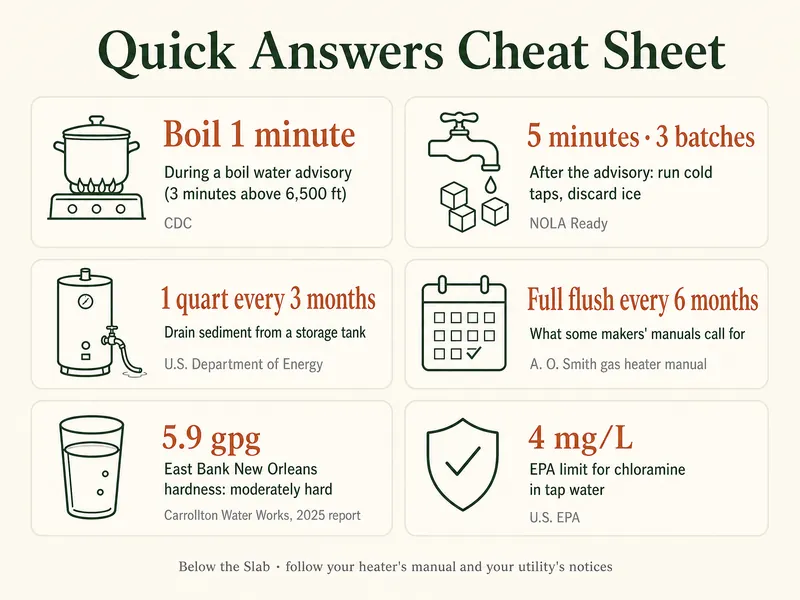
| Topic | Key figure | Source | Who to ask |
|---|---|---|---|
| Water heater flushing | Drain a quart every 3 months (DOE); full drain and flush every 6 months (A. O. Smith gas manual) | U.S. Department of Energy; A. O. Smith | The heater's own manual, then a licensed plumber |
| East Bank hardness | 100.7 mg/L, about 5.9 gpg (moderately hard) | Carrollton Water Works, 2025 report | Sewerage and Water Board |
| Chloramine | 3.3 ppm highest running annual average; EPA limit 4 mg/L | Carrollton 2025 report; EPA | Sewerage and Water Board |
| Lead at the tap | 90th percentile 6 ppb (2023-2025); action level 15 ppb | Carrollton 2025 report | SWBNO lead awareness program (free test kit) |
| Boil water advisory | Boil at least 1 minute; most advisories last 24 hours | NOLA Ready | Sewerage and Water Board and NOLA Ready |
| Slab leak claim | Flood, sewer backup and earth movement excluded in standard policies | Louisiana Department of Insurance | Your insurer, then the Department of Insurance |
Figures behind the answers
- 100.7 mg/LTotal hardness, Carrollton Water Works (East Bank New Orleans), 2025 report, about 5.9 gpgLDH 2025 water quality report
- 4 mg/LEPA maximum residual disinfectant level for chloraminesU.S. EPA
- 6 ppbLead, 90th percentile, Carrollton Water Works, 2023-2025 samplingLDH 2025 water quality report
- $250,000Most NFIP flood building coverage a homeowner can buy, separate from a homeowners policy ($100,000 for contents)FEMA
- 5 minutesRun cold taps at least this long after a boil water advisory endsNOLA Ready
What is the most common sign of a slab leak?
The most common signs of a slab leak are a higher water bill with no change in household use, a warm or damp patch of floor, and the sound of running water when nothing is on. To confirm it, close every tap and appliance and watch the meter's leak indicator for several minutes. If it moves, water is escaping somewhere between the meter and the fixtures.
That test does not show where the leak is. A licensed plumber narrows the location with pressure tests on each line and acoustic or thermal tools before deciding whether to open the floor. Slab leak signs lists the clues in order of how reliable they are.
Does homeowners insurance pay for slab leak repair?
Homeowners insurance pays for slab leak damage only when the policy wording covers it, and the repair of the pipe is a separate question. The Louisiana Department of Insurance consumer guide says broad-form policies include "accidental discharge of water or steam from within plumbing", while policies exclude flood, surface water, sewer backup and earth movement.
The NAIC's consumer guide to home insurance adds that a homeowners policy is not a maintenance contract, so slow leaks and wear are usually excluded. Before any concrete is cut, ask the insurer in writing whether the cost of reaching the pipe (tear-out and access) is covered. The full breakdown is in does homeowners insurance cover slab leaks.
How can you tell if a sewer line has a belly?
A sewer camera inspection is the only reliable way to see a belly: the footage shows a stretch of pipe where water stands instead of draining away. From inside the house the hints are repeat clogs in the same branch, slow drains that come back weeks after cleaning, and gurgling toilets.
On soft Gulf South ground, a belly usually forms when the soil under one section settles more than the soil on either side. Cleaning clears the blockage but does not lift the pipe, so the choice is between regular maintenance and re-laying that section. Sewer line belly explains how plumbers judge whether a sag is bad enough to dig.
Is Orangeburg pipe still found in Gulf South houses?
Yes, Orangeburg pipe can still turn up in houses built during its era, which the City of Ann Arbor puts at roughly the early 1950s to the early 1970s. Ann Arbor's Orangeburg guidance describes it as fiber soaked in tar that deforms and flattens under earth pressure as it breaks down.
A camera can identify it by the oval, blistered look of the pipe wall. Because it fails by losing its shape rather than by a single crack, the usual discussion once it is found is about replacement, not cleaning. See Orangeburg pipe for how it compares with cast iron and clay.
How long does a water heater last?
Expect roughly 10 to 15 years from a storage tank heater; that is the range in the federal Energy Saver guidance. Age is the main factor, followed by maintenance, water quality and how hard the unit works.
Warning signs near the end include rumbling from sediment, rusty hot water and moisture around the base. How long do water heaters last covers the signs, and national price ranges for a new unit are in water heater replacement cost.
How often should a water heater be flushed?
The right interval is the one in your heater's manual. Federal Energy Saver advice is to drain roughly a quart each quarter, while A. O. Smith's gas manual calls for draining and flushing the whole tank twice a year. The A. O. Smith residential gas manual also says to operate the temperature and pressure relief valve at least once a year.
Draining a small amount often removes loose sediment before it hardens. A full flush takes longer and starts with the shutdown steps in the manual. Water heater flush gives the steps and the safety checks.
Is New Orleans tap water safe to drink?
New Orleans tap water is treated to federal standards, and the 2025 reports show disinfectant within its limit and lead under the 15 ppb action level. That action level is a trigger for utility action, not a safety limit; the EPA's health goal for lead is zero. Both the Carrollton and Algiers plants list a January 2025 turbidity violation; the Sewerage and Water Board's report ties Carrollton's to freeze-related demand, says customers did not need to boil water, and says tests did not show bacteria.
For East Bank New Orleans, the 2025 Carrollton report puts the chloramine running annual average at no more than 3.3 ppm, below the EPA limit of 4 mg/L, and lead at a 90th percentile of 6 ppb for 2023 to 2025, with 2 sites over the 15 ppb action level. Algiers on the West Bank also had a 6 ppb 90th percentile, but its samples ranged from 0 to 100 ppb, according to the Sewerage and Water Board's 2025 report. Homes with old service lines or fixtures can test their own taps; SWBNO offers a free lead test kit through its lead awareness program. Is New Orleans tap water safe goes through each line of the report.
How hard is New Orleans water?
East Bank New Orleans water is moderately hard: the 2025 Carrollton Water Works report gives 100.7 mg/L as calcium carbonate, about 5.9 grains per gallon. The USGS classes 61 to 120 mg/L as moderately hard.
West Bank plants are softer. Algiers Water Works reported 70.7 mg/L (about 4.1 gpg) and the West Jefferson system 81 mg/L (about 4.7 gpg), both still in the moderately hard range. At these levels a softener is optional, a choice for less spotting and scale rather than a need. New Orleans water hardness compares each plant.
Does a home filter remove chloramine?
Some home filters are designed to reduce chloramine, and the claim to look for is NSF/ANSI 42 certification for chloramine reduction, which NSF lists as an aesthetic (taste and odor) claim. Not every filter carries that claim, so check the NSF listing for the exact model.
Chloramine at regulated levels is safe to drink, according to the EPA. Removing it matters for fish tanks and aquariums and before kidney dialysis machines; for most households a filter is a taste choice. Chloramine in water explains the options.
What should you do after a boil water advisory ends?
After a boil water advisory is lifted, flush the plumbing before using tap water normally. The NOLA Ready boil water guidance says to run cold taps for at least 5 minutes, throw out 3 batches of ice, and drain and refill the water heater if it was set below 113°F.
The same factsheet notes that most advisories last about 24 hours. For current advisories, use the city's boil water page rather than social media. Boil water advisory: what to do covers the steps during and after a notice, and the guides page lists every other topic.
How we put this page together
Each answer condenses a longer guide here. The sources are the state health department's posted 2025 reports and SWBNO's own 2025 report, EPA, CDC, NOLA Ready, NSF, USGS, the state insurance department, NAIC, Ann Arbor's building department, the federal Energy Saver pages and A. O. Smith's gas heater manual, all checked in October 2026. Not included: East Jefferson water figures (the parish report would not open), local repair prices and forum anecdotes.
More guides: the slab house plumbing guide home page.