
New Orleans & Jefferson Parish water
New Orleans Water Hardness: The Numbers by Utility
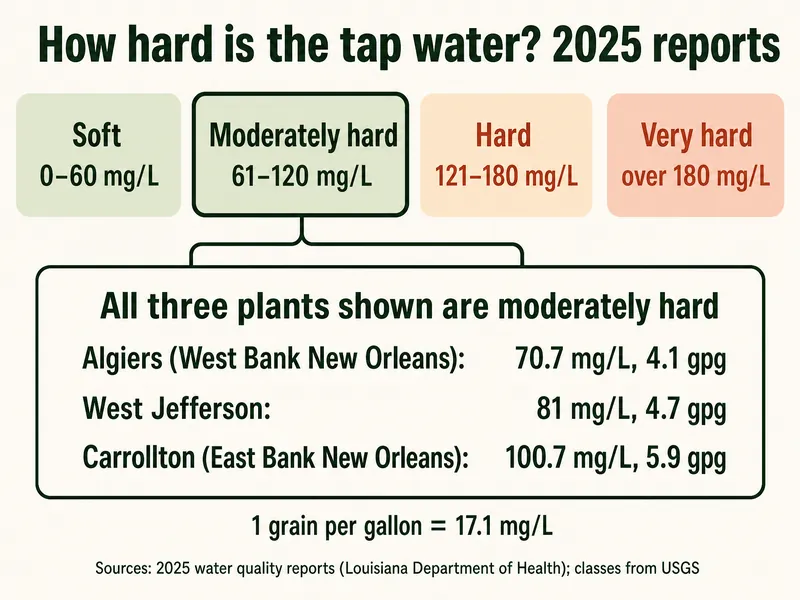
New Orleans water hardness was 100.7 mg/L, roughly 5.9 grains per gallon, on the East Bank in 2025, and 4.1 to 4.8 gpg on the West Bank: moderately hard at every plant with a 2025 figure, so a softener is optional.
Disclosure: SoftPro Water Systems, a store owned by the same team as this site, sells the filters and softeners we link to. Our water pages follow the utilities' 2025 water quality reports and federal and state agency guidance, checked October 2026. Store descriptions are reported as the store's own claims. Ownership disclosure
View at SoftPro Water Systems
On this page
Key takeaways
- In its 2025 report, the East Bank's Carrollton plant listed 100.7 mg/L of total hardness from a January 16, 2025 sample (LDH).
- Algiers Water Works (West Bank New Orleans) reported 70.7 mg/L, about 4.1 gpg, in February 2025.
- West Jefferson's plant came in at 81 mg/L (4.7 gpg) and Gretna's at 81.4 mg/L (4.8 gpg).
- All four fall in the USGS "moderately hard" class of 61–120 mg/L (USGS).
- East Jefferson (Metairie and Kenner) is in the parish's own 2025 report; its figure is not repeated here because the report could not be opened.
- A softener on this water is a comfort choice, not a need; a salt-free conditioner targets scale and does not soften.
How hard is New Orleans water?
New Orleans water is moderately hard. The East Bank plant, Carrollton Water Works, listed total hardness of 100.7 mg/L as calcium carbonate in the 2025 Carrollton report, from a sample taken on January 16, 2025, with a reported range of 99.7 to 100.7 mg/L.
The West Bank of Orleans Parish is served by a different plant. The Algiers Water Works 2025 report lists 70.7 mg/L, sampled February 24, 2025. Both plants draw from the Mississippi River, but they are separate systems with separate results.
Hardness has no federal health limit. It matters for spotting, soap use and scale in water heaters and fixtures, which is why the question usually comes up when people shop for a softener.
| Water system (area) | Hardness as CaCO3 | Grains per gallon | USGS class | Sample date |
|---|---|---|---|---|
| Carrollton Water Works (East Bank New Orleans) | 100.7 mg/L | 5.9 | Moderately hard | Jan 16, 2025 |
| Algiers Water Works (West Bank New Orleans) | 70.7 mg/L | 4.1 | Moderately hard | Feb 24, 2025 |
| West Jefferson Water Works District 2 | 81 mg/L | 4.7 | Moderately hard | Feb 13, 2025 |
| Gretna Waterworks | 81.4 mg/L | 4.8 | Moderately hard | Feb 13, 2025 |
| East Jefferson (Metairie, Kenner) | Not shown here | n/a | n/a | See the parish's 2025 report |
What does 5.9 grains per gallon mean?
Grains per gallon is the unit softener makers use, and 5.9 gpg is the East Bank's 100.7 mg/L converted. Montana State University Extension gives the conversion: 1 grain per gallon equals 17.1 mg/L, so divide mg/L by 17.1 to get gpg.
The USGS Water Science School sorts water into four classes: soft (0 to 60 mg/L), moderately hard (61 to 120), hard (121 to 180) and very hard (over 180). The East Bank figure sits in the upper part of the moderately hard band, and the West Bank figures in its lower part. None of the 2025 reports puts New Orleans or West Jefferson in the hard or very hard classes.
In practice, moderately hard water leaves some white spotting on glasses and shower glass and a slow build of scale in kettles and heaters. It is not the heavy crust that very hard well water can leave.
How hard is Jefferson Parish water?
Jefferson Parish water is also moderately hard on the West Bank. The West Jefferson Water Works District 2 report lists 81 mg/L, about 4.7 gpg, from a February 13, 2025 sample, and the City of Gretna's own plant reported 81.4 mg/L, about 4.8 gpg, on the same date.
East Jefferson, which serves Metairie and Kenner from the river, publishes its hardness in the parish's 2025 consumer confidence report. That document returned an access error every time this site tried to open it, so no East Jefferson number appears here. If you live on the East Bank of Jefferson Parish, read the parish's report directly or ask the water department for the current figure.
Be wary of hardness-by-zip-code tables. They often blend old data, river readings and guesses, and none of the 2025 reports is organized by zip code.
Hardness in the 2025 reports
- 100.7 mg/LTotal hardness, Carrollton Water Works (East Bank New Orleans), January 2025LDH 2025 water quality report
- 70.7 mg/LTotal hardness, Algiers Water Works (West Bank New Orleans), February 2025LDH 2025 water quality report
- 81 mg/LTotal hardness, West Jefferson Water Works District 2, February 2025LDH 2025 water quality report
- 17.1 mg/LEqual to 1 grain per gallon of hardnessMontana State University Extension
- 61–120 mg/LUSGS range for moderately hard waterUSGS Water Science School
Why do hardness numbers differ by plant and by sample?
Each number is a single snapshot from a specific plant on a specific day. Carrollton's 2025 report gives a range from two results, while the other plants list one sample, so the reports describe 2025 rather than every day of the year.
The plants also treat water separately, so their finished water can differ even though they share a river. Read the figure for the plant that serves your address, not a neighbor's, and check next year's report when it comes out.
One more caution: Mississippi River readings published by the USGS measure raw river water, before any treatment. They are not tap water, and they should never be quoted as household hardness. The river water and saltwater guide covers what raw-river data is useful for.
Do you need a softener for New Orleans water?
No, a softener is optional on New Orleans water. At 4.1 to 5.9 gpg the water is moderately hard, and the main gains from softening are comfort ones: less spotting, less scale in fixtures and a slicker feel. On the West Bank, where the numbers are lower, the case is weaker still. The Do I need a water softener? guide walks through who tends to find it worthwhile.
If you want to try softening, the SoftPro ECO City Water Softener (sold by SoftPro Water Systems, a store we own) is listed at $967 for the 32,000-grain softener-only option on the store's page (October 2026). If scale on fixtures is the only concern, the SoftPro FORTRESS Salt-Free Conditioner (sold by SoftPro Water Systems, a store we own) is listed at $229 for its Home model (6 GPM, about 1 to 2 bathrooms, by the store's sizing). A salt-free conditioner is sold for scale reduction; it does not soften water or lower the gpg figure. Hardness is also only one part of tap water; the tap water safety page covers the health-based results.
Optional on city water
SoftPro ECO City Water Softener
New Orleans East Bank tap water measured about 5.9 grains per gallon in the 2025 Carrollton report: moderately hard, so a softener is a choice, not a need. If scale on fixtures and spotting bother you, try a city-water softener sized to your household; check sizes and current prices at SoftPro Water Systems.
View at SoftPro Water SystemsSoftPro Water Systems, a store owned by the same team as this site, sells the filters and softeners we link to. Ownership disclosure
How do you test your own water hardness?
Start with your utility's report, then confirm at the tap if you want a number for your own house. Inexpensive hardness test strips and drop-count kits give a reading in grains per gallon or mg/L; a certified lab gives a more precise one.
Test cold water from a tap that does not run through a softener or filter. If you already have a softener, testing before and after it shows whether it is working. Compare your result with the plant's reported figure: a reading far above it is worth a second test before you buy anything.
How we put this page together
This page uses four 2025 utility reports (Carrollton, Algiers, West Jefferson Water Works District 2 and Gretna) from the Louisiana Department of Health's archive, plus the USGS hardness classes and Montana State University Extension's grains-to-mg/L conversion (dates checked: October 2026). East Jefferson's figure was left out because its report could not be opened. Store prices come from the store's product pages on the day checked. No zip-code estimates, raw-river readings or home test results were used.
Common questions
Is New Orleans water hard or soft?
Moderately hard. The 2025 reports put the East Bank at 100.7 mg/L and the West Bank plants at 70.7 to 81.4 mg/L, all within the USGS moderately hard range of 61 to 120 mg/L.
What is the hardness of Metairie water?
Metairie is served by East Jefferson's plant, and its 2025 figure is published in Jefferson Parish's consumer confidence report. This site could not open that report, so it does not quote a number; the parish water department can confirm it.
Is Algiers water softer than Uptown water?
Yes, in the 2025 reports. Algiers Water Works listed 70.7 mg/L (about 4.1 gpg), while Carrollton, which serves Uptown and the rest of the East Bank, listed 100.7 mg/L.
Does hard water in New Orleans damage water heaters?
Moderately hard water adds scale slowly, so draining sediment as the heater's manual directs is the main defense. The water heater flush guide covers how; there is no sourced figure for how much New Orleans water shortens a heater's life.
What grain capacity softener fits a 5.9 gpg house?
Capacity depends on household water use as well as hardness, so check the maker's sizing for your daily gallons. At 5.9 gpg a smaller unit regenerates less often than it would on hard well water.
Is hard water a health risk?
Hardness has no federal health-based limit; it is a matter of scale, soap and feel. The health-related results in the report are things like disinfectant, lead and disinfection byproducts.
Related guides
More guides: the slab house plumbing guide home page.