
Home & code
How to Prevent Frozen Pipes in the Gulf South
How to prevent frozen pipes in the Gulf South: insulate exposed and attic lines, disconnect hoses, keep the heat on, and when it nears 32°F drip one indoor faucet, the one farthest from the meter.
On this page
Key takeaways
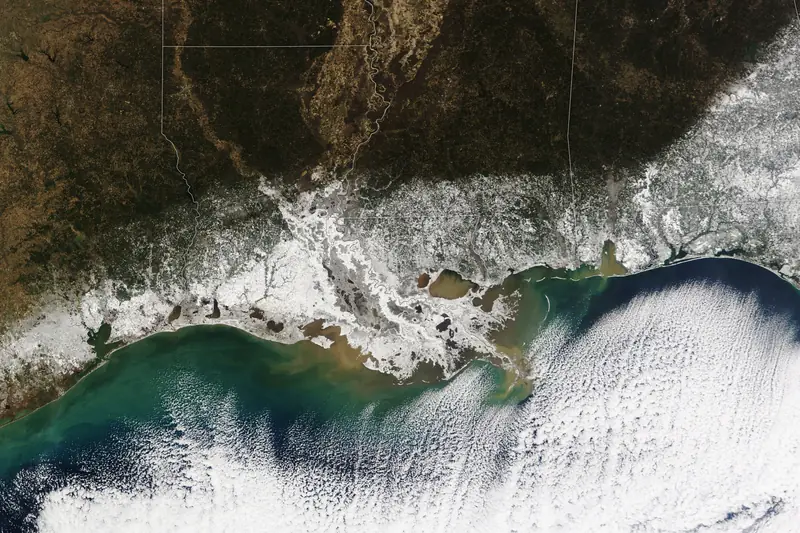
- The 8.0 inches of snow that fell at the New Orleans airport (MSY) on January 21, 2025 set a one-day record, beating 2.7 inches from 1963 (NWS record report via Iowa State Mesonet).
- The airport tied record lows of 22°F on January 22 and 21°F on January 23, 2025; on December 24, 2022 it fell to 25°F.
- When temperatures approach 32°F, the Sewerage and Water Board asks for one indoor faucet, the one farthest from the meter, at a trickle "about as thin as a standard strand of spaghetti" (NOLA Ready).
- Running more faucets lowers pressure across the city and can lead to a precautionary boil water advisory, SWBNO warns.
- University of Illinois Extension advises keeping the heat no lower than 55°F and never thawing a pipe with an open flame (Illinois Extension).
- Louisiana's Broad Form homeowners coverage lists freezing of plumbing as a covered peril (LDI guide); check your own policy.
Why do Gulf South pipes freeze?
Gulf South pipes freeze because houses here are built for heat, not cold: water lines often run through attics, outside walls, crawl spaces and exposed risers, with little insulation. When a rare hard freeze arrives, those lines have nothing between them and the cold air.
Hard freezes are rare, but they do happen. The National Weather Service recorded 8.0 inches of snow at New Orleans International Airport on January 21, 2025, the most on any single day there; the old record was 2.7 inches on December 31, 1963. Spotters reported 10.0 inches in parts of Metairie and New Orleans and 9.0 inches in Kenner (NWS public information statement via Iowa State Mesonet). The next two nights tied the airport's record lows for those dates, at 22°F and then 21°F. On December 24, 2022, the low there was 25°F (NWS climate report).
A freeze also strains the city system. SWBNO's 2025 water quality report says freeze-related water use pushed Carrollton's treatment rates up in January 2025, which led to a turbidity violation; the report adds that customers did not need to boil their water (SWBNO water quality reports).
Which pipes freeze first?
The pipes that freeze first are the ones exposed to moving cold air with no heat nearby: outdoor hose bibs and their supply lines, exposed pipes on raised houses, lines in unheated attics and crawl spaces, and pipes inside exterior walls or under sinks on outside walls. University of Illinois Extension names pipes near outer walls, in crawl spaces and in attics as the most susceptible (Illinois Extension).
| Location | Why it freezes | What helps |
|---|---|---|
| Outdoor hose bibs and exposed risers | Fully exposed to wind and cold | Disconnect hoses; insulate or cover the faucet and riser |
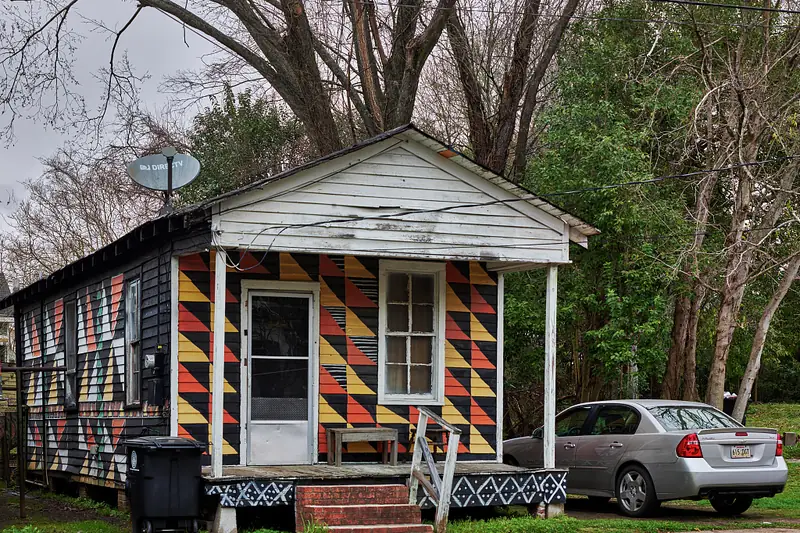
| Pipes under a raised or shotgun house | Cold air moves freely under the floor | Pipe insulation; close off vents or skirting where safe |
| Attic water lines | Unheated space, often after a slab reroute | Insulation over and around the lines |
| Sinks on exterior walls | Thin wall cavity, closed cabinet | Open cabinet doors so room heat reaches the pipes |
| Lines to the water heater in a garage or closet | Unheated space | Insulate exposed hot and cold lines |
Slab houses keep much of their supply piping below the floor, out of the wind. The risk shifts to wherever the pipes come up out of the slab or have been rerouted overhead. If your supply lines were moved into the attic, see water line reroute vs repair.
How do you prevent frozen pipes before a freeze?
To prevent frozen pipes before a freeze, insulate exposed lines, seal drafts where pipes run, disconnect garden hoses, and shut off and drain any outside faucets that have their own shutoff. Illinois Extension lists the same basics: insulate pipes near outer walls and in crawl spaces and attics, use UL-listed heat tape where needed, seal leaks that let cold air in, and drain lines to outside faucets.
A short checklist for the day before:
- Find the main water shutoff and make sure it turns. Everyone in the house should know where it is.
- Wrap exposed pipes and hose bibs with pipe insulation or covers.
- Disconnect and drain garden hoses. SWBNO's freeze guidance asks residents to do this too.
- Close off drafts near pipes, such as gaps around skirting on a raised house.
- If you will be away, keep the heat on, have someone check the house, or shut off and drain the water system.
Freeze facts for New Orleans
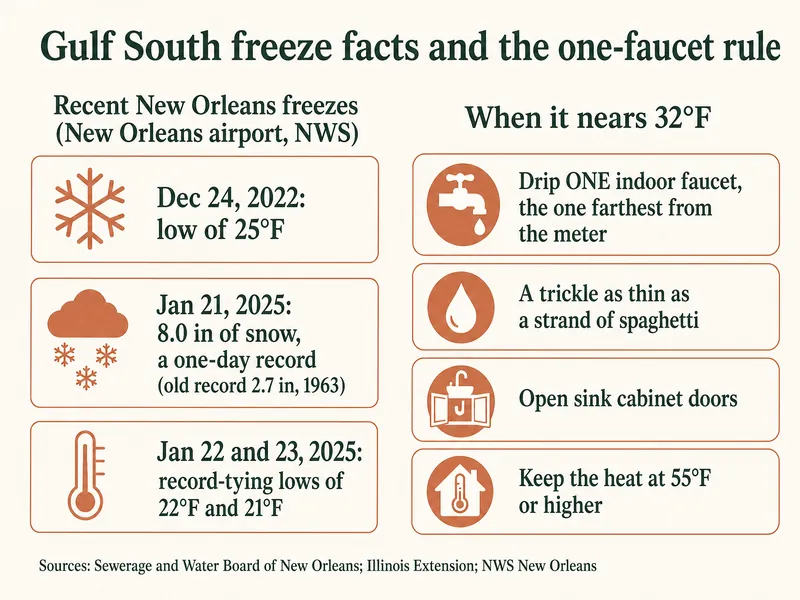
- 8.0 inOne-day snowfall record set at MSY, Jan 21, 2025NWS New Orleans, via Iowa State Mesonet
- 21°FRecord-tying low at the airport on Jan 23, 2025 (22°F on Jan 22)NWS New Orleans, via Iowa State Mesonet
- 1 faucetHow many faucets SWBNO asks households to drip when it nears 32°FSewerage and Water Board, via NOLA Ready
- 55°FLowest thermostat setting Illinois Extension advises during cold weatherUniversity of Illinois Extension
Should you drip faucets during a freeze?
Yes, but drip only one faucet, at a thin trickle. SWBNO's guidance says that when the outdoor temperature approaches 32°F, turn on the indoor faucet farthest from your water meter and run "no more than a trickle", "about as thin as a standard strand of spaghetti" (NOLA Ready, 2021).
The one-faucet rule is a New Orleans-specific point. SWBNO asks residents not to run more than one faucet or any faucet at full blast, because it wastes water and "can also contribute to lower water pressures across the city, risking the potential for a precautionary boil water advisory." It repeated that advice before the January 2024 freeze (NOLA Ready, 2024). Advice from other regions that suggests dripping several faucets does not fit a city system that can lose pressure. If an advisory does follow a freeze, see boil water advisory: what to do.
Open the cabinet doors under sinks so room heat reaches the pipes, and open interior doors so heat moves between rooms, as SWBNO suggests.
What do you do when a pipe is frozen?
When a pipe is frozen, shut off the water to that line or the house, open the faucet it feeds, and warm the pipe gently, starting nearest the faucet. Signs include a faucet that gives only a trickle or nothing at all while others work.
Gentle heat means a hair dryer, warm towels or a space heater kept well clear of anything that can burn. Illinois Extension is direct on the main danger: "Never try to thaw a pipe with an open flame or torch." It also warns about electric shock around standing water. If the frozen section can't be reached or found, a licensed plumber can locate and thaw it.
Keep the faucet open while the pipe thaws, so melting ice and water can flow and pressure doesn't build. Check the line for leaks once water runs again; a split often only shows itself after the ice melts.
What should you do if a pipe bursts?
If a pipe bursts, shut off the water at the main valve right away, turn off electricity to any wet area if it is safe to do so, and then call a licensed plumber and your insurance agent. Illinois Extension's advice is the same order: know how to shut off the water, stop the flow to limit damage, then call a plumber and your insurer.
For the claim, document the damage with photos before cleanup, keep receipts for emergency repairs, and avoid signing repair contracts before talking to the insurer, as the Louisiana Department of Insurance recommends (LDI guide). LDI's guide lists "freezing of" plumbing among the perils in the Broad Form, and Washington's insurance regulator notes that burst frozen pipes are usually covered "as long as you heat your home properly" (Washington OIC). Read more in does homeowners insurance cover slab leaks.
Outdoor assemblies such as irrigation backflow preventers sit fully exposed, so check them after a freeze too; see backflow prevention. Plumbing repairs that replace water piping in New Orleans need a permit; see Louisiana plumbing code, or browse all guides.
How we put this page together
The freeze history here comes from National Weather Service products for New Orleans (record event, climate and public information reports, read through Iowa State's Mesonet archive), the Sewerage and Water Board's freeze guidance published by NOLA Ready in 2021 and 2024, SWBNO's 2025 water quality report, University of Illinois Extension's frozen-pipe advice, the Louisiana Department of Insurance homeowners guide and the Washington insurance regulator's page on water damage. Everything was read in October 2026. Left out: a single temperature at which exposed pipes freeze, February 2021 freeze figures, and counts of past boil advisories, none of which could be confirmed.
Common questions
At what temperature do pipes freeze in New Orleans?
No single verified threshold applies, because wind, insulation and how long the cold lasts all matter. SWBNO's trigger for dripping one faucet is when the outdoor temperature approaches 32°F.
Why does New Orleans say to drip only one faucet?
Many faucets running at once lower water pressure across the city, which can lead to a precautionary boil water advisory. One thin trickle at the faucet farthest from the meter protects the house without straining the system.
Should outdoor faucets be covered or drained?
Both help. Disconnect hoses, and if the outside faucet has its own indoor shutoff, close it and drain the line, as Illinois Extension recommends.
Do pipes in a slab house freeze?
Lines buried under the slab are far less exposed than lines in walls and attics. The weak points are where pipes rise out of the slab, in exterior walls, and in attics after a reroute.
Is it safe to use a space heater to thaw pipes?
A space heater can help if kept well clear of anything flammable and of standing water. Never use an open flame or torch, Illinois Extension warns.
Does homeowners insurance cover a burst frozen pipe?
Often, as a sudden loss, but check your policy. Washington's regulator notes coverage usually depends on having kept the home properly heated.
What should renters do in a freeze?
The same steps apply: one thin drip, open cabinets, keep heat on, and know where the shutoff is. Tell the landlord right away about any frozen or burst pipe.
Related guides
More guides: the Below the Slab home page.