
Sewer & drains
Hydro Jetting: How It Works, Risks and Cost
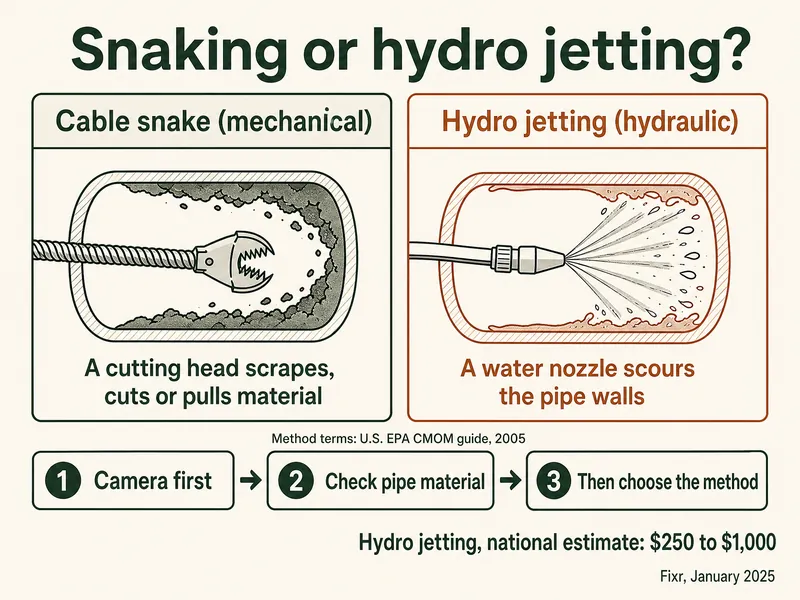
Hydro jetting cleans a sewer line with a high-pressure water nozzle that scours grease, sludge and roots off the pipe wall; Fixr's January 2025 national estimate is $250 to $1,000.
On this page
Key takeaways
- EPA's 2005 sewer-maintenance guide names three cleaning methods: hydraulic (any use of water), mechanical (devices that scrape, cut or pull) and chemical (EPA CMOM guide). Hydro jetting is the hydraulic kind.
- Fixr puts hydro jetting at $250 to $1,000 nationally (January 2025), against $300 to $600 for a camera inspection.
- EPA lists the usual causes of stoppages as structural defects, poor design or construction, buildup (especially grease) and root intrusion. Cleaning fixes only the buildup and roots.
- Roots are reported to cause more than 50 percent of sewer blockages (Randrup, McPherson and Costello, 2001).
- Los Angeles County Public Works says keeping a lateral free of roots and grease is part of the owner's duty, and asks residents not to pour fats, oils and grease down drains.
- EPA notes that iron pipe is more prone to sewer-gas corrosion than clay or plastic, one reason to film old cast iron before cleaning it.
Hydro jetting by the numbers
- $250–$1,000National range for hydro jetting a sewer line, January 2025Fixr
- $300–$600National range for the camera inspection that often comes first, January 2025Fixr
- >50%Share of sewer blockages reported to be caused by tree rootsRandrup, McPherson and Costello, 2001
- 1.0–1.4 ft/sFlow speed below which EPA's guide says grit and solids start to settle in sewersU.S. EPA, CMOM guide (2005)
What is hydro jetting?
Hydro jetting is drain cleaning with water: a hose feeds a nozzle into the sewer line, and jets of water under high pressure push the nozzle forward while scouring the pipe wall behind it. EPA's guide to sewer-system maintenance groups this under hydraulic cleaning, which it defines as any application of water to clean the pipe. The goal is to strip grease, sludge, scale and fine roots from the whole circumference instead of punching one hole through a clog.
A jetter usually goes in through a cleanout, the capped pipe that gives access to the house sewer. In New Orleans the Sewerage and Water Board's customer FAQ puts cleanout upkeep on the homeowner, so a buried or broken cap may have to be dealt with first. A camera run before and after shows what the water removed and what is left.
How does hydro jetting compare with snaking?
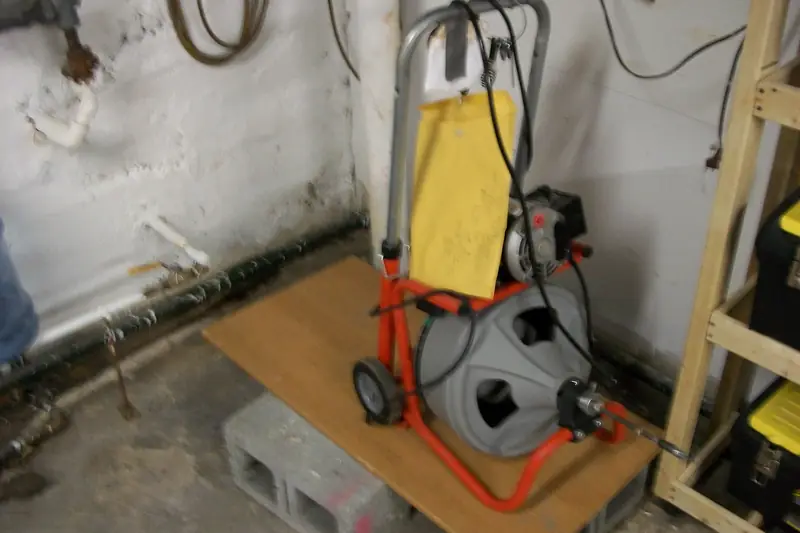
A cable snake drills or cuts through a blockage; hydro jetting washes the pipe wall clean. EPA's guide describes mechanical cleaning as physical devices that scrape, cut or pull material from the sewer, which is what a cable machine with a cutting head does. A snake is quick and cheap for a single clog, and a cutter head is the usual first tool against thick roots. It tends to leave grease and residue on the walls, so a greasy line can close up again.
Jetting reaches the whole pipe wall and flushes the debris downstream, which suits grease-lined kitchen lines and sludge that builds up where flow is slow. EPA's guide notes that when sewage moves slower than about 1.0 to 1.4 feet per second, grit and solids begin to settle; a sag or flat run is where that happens. Jetting does not change the slope, so solids settling in a low spot will return; the sewer line belly guide explains that problem.
| Situation | Snaking (mechanical) | Hydro jetting (hydraulic) | Camera first? |
|---|---|---|---|
| One sudden clog in a sound line | Usually enough | Possible but more than needed | Optional |
| Grease buildup in a kitchen line | Opens a hole, leaves residue | Cleans the full wall | Helpful |
| Roots at joints | Cutting head is the usual first pass | Can flush cut roots and fine growth | Yes, to see the joints |
| Repeat backups | Short-term fix | Longer clean, cause still unknown | Yes |
| Old cast iron with heavy scale | Descaling heads exist | Possible if the wall is sound | Yes, check wall thickness |
| Suspected Orangeburg or broken pipe | Risky | Risky | Yes, before any cleaning |
When is hydro jetting the wrong choice?
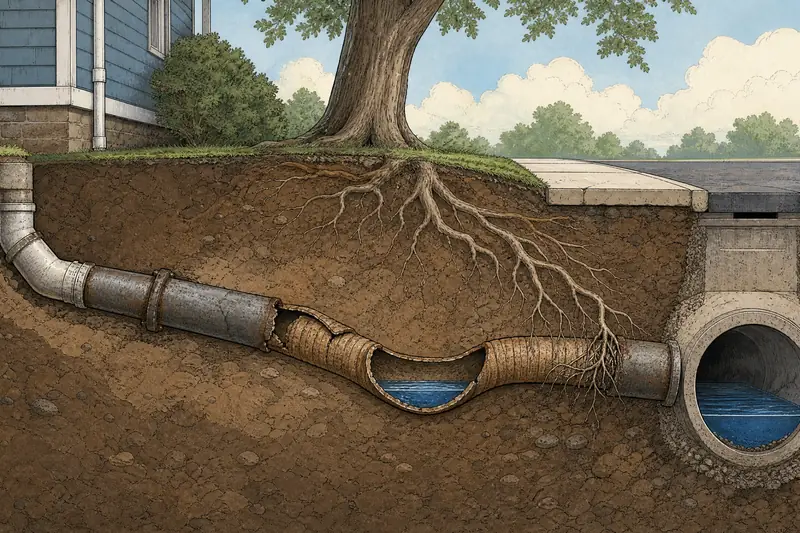
Hydro jetting is the wrong choice when the pipe itself is broken, collapsed or out of line, because cleaning cannot restore structure. EPA lists the usual causes of stoppages as structural defects, poor design, poor construction, buildup of material (especially grease) and root intrusion. Only the last two are cleaning problems; the rest call for repair. If backups return within weeks of a good cleaning, suspect a defect the water cannot reach.
Fragile pipe is the other case. The City of Ann Arbor's Orangeburg page explains that this tar-and-fiber pipe flattens as it deteriorates and fails mostly at the joints. Before any high-pressure cleaning of a house built in the Orangeburg era, ask for a camera run to confirm the material and condition. If the camera shows Orangeburg pipe, cracked sections or missing wall, the money is better spent on a repair plan than on cleaning.
Is hydro jetting safe for old cast iron and clay?
It can be, if the camera first shows a sound wall; the risk depends on the pipe's condition more than its age. EPA's guide notes that vitrified clay and plastic pipes are very resistant to hydrogen sulfide corrosion, while iron, steel and concrete pipes are more susceptible. Old cast iron can therefore be thinner than it looks, with corrosion under the scale. Clay is resistant to that corrosion but it comes in short jointed sections, and its joints are where roots get in.
Ask the contractor what pressure and nozzle they plan to use on that pipe, whether they will start low, and whether they will film the line afterward. On cast iron, ask whether the goal is cleaning or descaling, since removing heavy scale exposes the true wall; the cast iron drain pipe guide covers what thin or channeled pipe looks like.
How much does hydro jetting cost?
Fixr's national estimate for hydro jetting is $250 to $1,000, from its January 2025 page; New Orleans and Jefferson Parish quotes can fall outside that. The price rises with the length of the line, poor access (no cleanout, or entry through a roof vent or a pulled toilet), heavy roots or grease, and after-hours calls. A camera inspection, which Fixr puts at $300 to $600 nationally, is sometimes bundled in and sometimes billed on its own.
Ask what the quote covers: the length cleaned, whether a camera run comes before and after, whether the video is handed over, and what happens if the jetter finds a break. A low jetting price paired with a pitch for immediate replacement deserves a second opinion based on the same video; the sewer line replacement cost guide explains what drives those bigger bids.
How often should a sewer line be jetted?
No single schedule fits every house; jet when a camera shows buildup or regrowth, not by the calendar. EPA's guide shows how wide the range is even for city sewers: lines in a restaurant district may need cleaning every six months, while new plastic pipe with steady slope and little grease may go five years with no problems. A house line falls somewhere in that spread depending on its trees, its grease habits and its slope.
For roots, regrowth is the rule rather than the exception, since cutting or jetting removes what is inside the pipe and leaves the tree. The tree roots in sewer line guide covers longer-term fixes, and the University of Georgia Extension advises against planting aggressive-rooted trees near sewer lines. For grease, the cheapest maintenance is keeping fats, oils and grease out of the sink, which Los Angeles County Public Works lists as an owner's basic duty.
How we put this page together
Sources: EPA's CMOM evaluation guide for sanitary sewer systems (305-B-05-002, 2005) for cleaning methods, stoppage causes, flow speeds, cleaning intervals and pipe corrosion; Ann Arbor's Orangeburg page; Los Angeles County Public Works on owner duties; the New Orleans water board's FAQ on cleanouts; the 2001 Randrup, McPherson and Costello paper on roots; UGA Extension on tree planting; and Fixr's national price ranges, named without links. Checked in October 2026. Not included: jetting pressure figures (no agency source found), any claim that jetting damages a given share of pipes, contractor quotes and forum anecdotes.
Common questions
Can hydro jetting remove tree roots?
It can flush cut roots and strip fine root growth from joints, but thick roots are usually cut first with a mechanical head. Either way the tree remains, so roots tend to come back at the same joints.
Does hydro jetting clean the city's sewer main too?
No. A house jetting job covers the private line up to the main. In New Orleans the public main is the Sewerage and Water Board's system, and backups that come from it are reported to the board.
Is hydro jetting the same as hydro excavation?
No. Hydro jetting cleans the inside of a pipe; hydro excavation uses water and a vacuum to dig soil away from buried pipes or under a slab. Digging methods for slab houses are covered in the tunneling under a slab guide.
Can enzyme or chemical drain cleaners replace jetting?
EPA's guide lists chemical cleaning as a third method that can help control grease and root growth, but it is a maintenance tool, not a fix for a blocked or broken line. Follow the product label and keep chemicals away from Orangeburg pipe, which Ann Arbor says solvents can damage.
Will jetting stop a sewer backup during heavy rain?
Not if the water is coming from the city side. Rain-driven backups are a separate problem handled with backwater valves and insurance endorsements; the sewer backup guide explains both.
Should a camera be run before jetting?
In an older house, yes. A camera shows the pipe material, the condition of the wall and where the blockage sits, which tells the contractor whether jetting is safe and useful.
Is a homeowner allowed to rent a jetter?
Rental units exist, but this guide has not verified Louisiana rules on homeowner plumbing work, and a jetter misused on fragile pipe can make a bad line worse. A licensed plumber can say whether the line can take it.
Related guides

More guides: the slab house plumbing guide home page.