
New Orleans & Jefferson Parish water
Boil Water Advisory: What to Do at Home
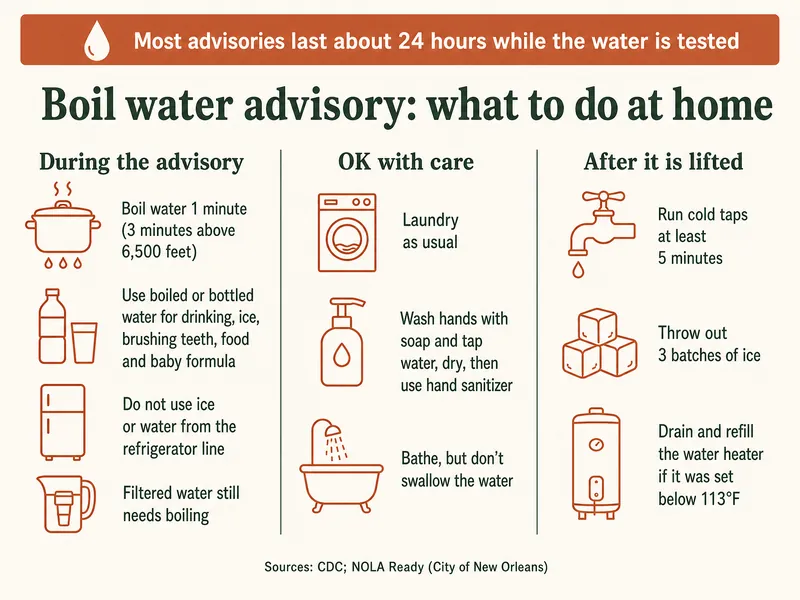
During a boil water advisory, bring tap water to a rolling boil for 1 minute before drinking or cooking with it, skip refrigerator ice, and flush taps, ice makers and sometimes the water heater once it ends.
On this page
Key takeaways
- CDC: bring clear water to a rolling boil for 1 minute, or 3 minutes above 6,500 feet.
- NOLA Ready's factsheet says "Most advisories will last 24 hours," the time it takes to test the water.
- CDC says not to use ice or water from a refrigerator connected to the water line, and to boil tap water even if it is filtered.
- After an advisory, NOLA Ready says to run cold taps for at least 5 minutes, discard 3 batches of ice, and drain and refill the water heater if it was set below 113°F.
- A 2018 New Orleans advisory followed a line break that dropped pressure below 15 psi at two gauges, per NOLA Ready.
- Check ready.nola.gov or your utility for whether an advisory is in effect at your address.
What does a boil water advisory mean?
A boil water advisory means the utility cannot yet confirm that tap water is free of germs, so water used for drinking, cooking, ice and brushing teeth should be boiled or bottled. Most are precautionary: something happened that could have let contamination into the pipes, and the water is being tested. The NOLA Ready boil water factsheet says most advisories last 24 hours, the time it takes to test the water.
An advisory does not usually mean the water is known to be contaminated. When testing comes back clean, the utility and the Louisiana Department of Health lift it. Until then, follow the advisory for every use that puts water in someone's mouth.
Boil water advisory numbers
- 1 minuteRolling boil time for clear water (3 minutes above 6,500 feet)CDC
- 24 hoursHow long most New Orleans advisories last, the time it takes to test the waterNOLA Ready factsheet
- 5 minutesMinimum time to run each cold tap after an advisory is liftedNOLA Ready factsheet
- 113°FWater heater setting below which NOLA Ready says to drain and refill the tank afterwardNOLA Ready factsheet
Why do New Orleans boil water advisories happen?
Most New Orleans advisories follow a drop in water pressure in the distribution system, not a problem at the treatment plant. Water mains are kept under pressure, and a sharp drop opens a window for contamination to get in at leaks and joints, so the utility treats the water as suspect until tests clear it. A main break or unusually heavy demand can cause that drop.
NOLA Ready's notice lifting a January 2018 advisory gives a typical case: a water line broke near Wall Boulevard and Flanders Street, and the rupture "caused water pressure at two gauges to drop below the acceptable 15 psi." The advisory was cancelled two days later, after testing for bacterial contaminants came back negative. Freezes are a known risk too, which is why SWBNO asks residents to drip only one faucet in a freeze; dripping citywide drops pressure. The frozen pipes guide explains that advice.
Not every water-quality notice calls for boiling. SWBNO's 2025 water quality report says the Carrollton plant's January 2025 turbidity violation, linked to freeze-related demand, did not require customers to boil their water. The New Orleans tap water guide covers that report in full.
How long should you boil water?
Boil water for 1 minute at a full rolling boil, says the CDC; above 6,500 feet, make it 3 minutes. Every part of New Orleans and Jefferson Parish sits far below that height, so 1 minute is the rule here. NOLA Ready describes the boil as heating until large bubbles rise from the bottom to the top of the pot.
Let the water cool, then store it in a clean container with a cover. CDC also notes that "boiling does NOT remove chemicals," which matters only for the rare advisory caused by a chemical problem, when the utility will say not to drink the water at all.
What is safe to do during an advisory?
Laundry, handwashing and bathing can carry on with care, but anything you swallow needs boiled or bottled water. NOLA Ready's factsheet lists drinking, making ice, brushing teeth, preparing food and mixing baby formula as uses for bottled or boiled water, and says to give pets bottled or boiled water too.
| Activity | What to do | Source |
|---|---|---|
| Drinking, cooking, brushing teeth, baby formula | Use boiled or bottled water | NOLA Ready factsheet |
| Refrigerator ice and water dispenser | Do not use; make ice with boiled or bottled water | CDC; NOLA Ready |
| Filtered tap water (pitcher or home filter) | Boil it anyway | CDC |
| Dishwasher | Use a 150°F rinse or a sanitize cycle | NOLA Ready factsheet |
| Washing dishes by hand | Wash as usual, then soak 1 minute in 1 teaspoon of unscented bleach per gallon of warm water and air dry | NOLA Ready factsheet |
| Laundry | Safe as usual | NOLA Ready factsheet |
| Bathing | Do not swallow water; consider sponge baths for babies, young children and anyone with an open wound | NOLA Ready factsheet |
| Washing hands | Soap and tap water, dry, then hand sanitizer | NOLA Ready factsheet |
What should you flush after the advisory ends?
Flush the water lines, the ice maker and, in some cases, the water heater. NOLA Ready's list for after an advisory: run all cold water faucets for at least 5 minutes, flush home ice makers by making and throwing out 3 batches of ice, and drain and refill water heaters set below 113°F.
Most tank water heaters run hotter than 113°F; DOE's Energy Saver guidance names 120°F as enough for most households. If yours is set lower, or you are not sure, the water heater flush guide covers draining and refilling a tank safely. Run refrigerator water dispensers to flush their lines too, and replace any filters the maker says to change after contamination.
Where do you check whether an advisory is active?
Check the city's NOLA Ready boil water page or your water utility, not social media posts. In New Orleans, advisories come from the Sewerage and Water Board with the Louisiana Department of Health; NOLA Ready's factsheet also points residents to 311 and local news for updates.
Jefferson Parish runs its own water systems, so Metairie, Kenner and West Bank parish customers should follow Jefferson Parish government notices rather than New Orleans ones. An advisory can cover only part of a system, so check that the notice names your area. This site does not track live advisories.
Can a home filter replace boiling?
No. CDC says to "boil tap water even if it is filtered," including water from a pitcher filter or a home filter. Pressure-loss advisories are about possible germs, and the CDC advice makes no exception for any household filter.
That includes whole-house carbon filters and water softeners, which treat taste, chloramine or hardness. The whole-house water filter guide and the chloramine guide explain what those systems do. During an advisory, follow the utility's instructions and boil or use bottled water, whatever equipment is under the sink.
How we put this page together
This page is based on CDC's boil water advisory and Cryptosporidium guidance, the City of New Orleans NOLA Ready boil water factsheet and boil water page, NOLA Ready's January 2018 notice lifting an advisory, SWBNO's 2025 water quality report and its freeze advice, and DOE Energy Saver's thermostat guidance. Read in October 2026. Not included: any count or frequency of New Orleans boil advisories and any live status, because neither can be kept accurate here, and Jefferson Parish advisory procedures, whose pages could not be loaded.
Common questions
Can you shower during a boil water advisory?
Yes, NOLA Ready says to be careful not to swallow water. It suggests sponge baths for babies, young children and anyone with an open wound.
Is it safe to brush teeth with tap water during an advisory?
No. NOLA Ready lists brushing teeth among the uses that need bottled or boiled water.
Can coffee makers be used during a boil water advisory?
A drip coffee maker does not bring water to a rolling boil for 1 minute, so use boiled or bottled water in it until the advisory is lifted.
What about water for pets?
NOLA Ready says to give pets bottled or boiled water to be safe.
How do you know when an advisory is over?
The utility announces that it has been lifted, usually after tests for bacteria come back negative. Until that notice covers your area, keep boiling.
Does a boil advisory mean the water has germs in it?
Usually not confirmed. Most are precautions after a pressure loss, lifted when tests for bacteria come back negative, as in the January 2018 New Orleans case.
Is boiled water safe to give a baby?
NOLA Ready lists mixing formula among the uses for bottled or boiled water. Let boiled water cool first, and follow your pediatrician's advice on formula.
More on city water
More guides: the Below the Slab home page.