
Sewer & drains
Tree Roots in a Sewer Line: Signs and Fixes
Tree roots in a sewer line are the most common cause of blockages, reported at over half of them; cutting clears the pipe for a while, but only a jointless or relined pipe keeps roots out.
On this page
Key takeaways
- Roots are reported to cause more than 50% of all sewer blockages, according to a review in the Journal of Infrastructure Systems (Randrup, McPherson and Costello, 2001).
- The pipes most at risk are old jointed lines, shallow lines and small-diameter lines: a house sewer line fits all three.
- In a Danish survey, 48% of root intrusions came from trees less than 3 m (about 10 ft) from the pipe, and another 44% from trees 3 to 6 m away.
- Willow, birch and poplar caused the most intrusions in that survey (30%, 25% and 23% of reports).
- Cutting roots fixes the clog, but the same review notes roots often grow back more vigorously after each cut.
- In New Orleans, the Department of Parks and Parkways maintains all City trees, including those between the sidewalk and the street; requests go through 311.
Tree roots in a sewer line are a slow problem that shows up as a sudden one. A drain runs a little slower each month, then a toilet backs up on a Sunday. The cause is usually a single leaky joint that a root found years ago. This page covers how roots get in, how to tell they are there, what each fix does, and what to ask before paying for one.
How do tree roots get into a sewer line?
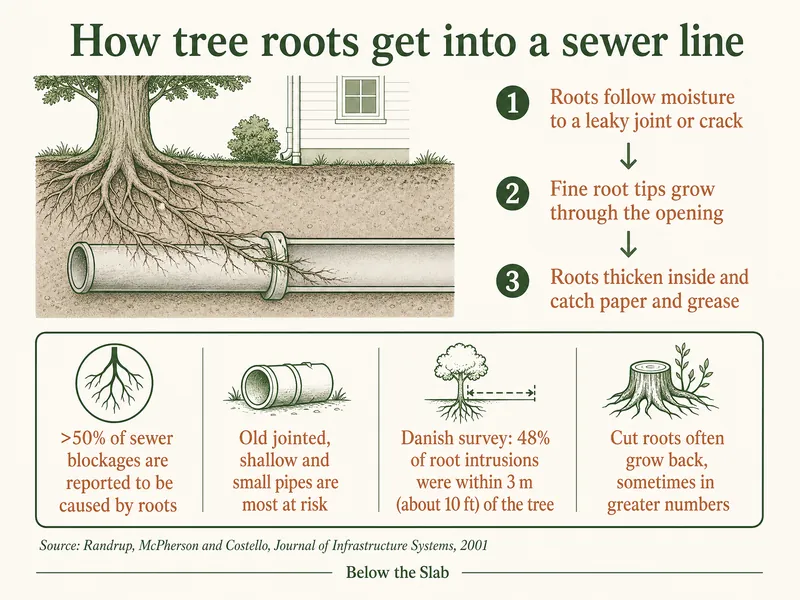
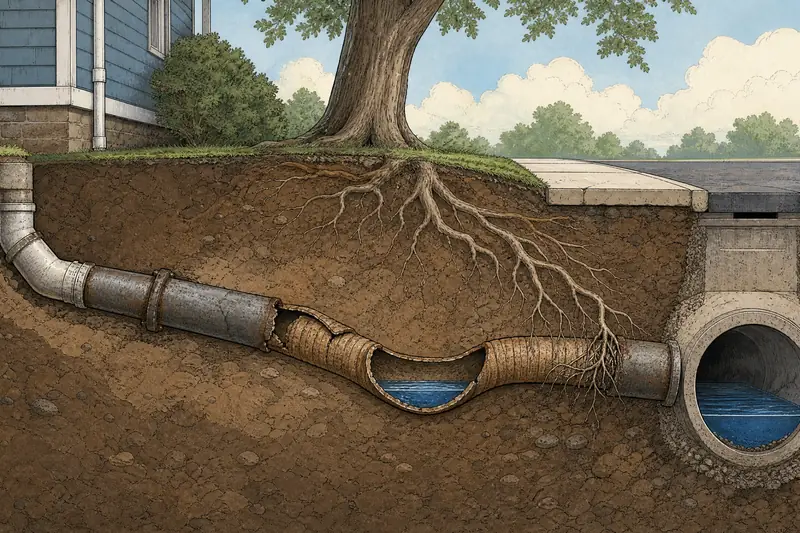
Tree roots get into a sewer line through gaps that already exist: loose joints, cracks and failed seals. A root grows cell by cell from its tip, which lets it push into very small openings, as the 2001 review of root intrusion explains. Once inside, the root finds water and nutrients, thickens, and branches into a mat that catches paper and grease.
The same review cites researchers who found roots enter pipes only where joints can no longer hold pressure, and others who concluded that modern plastic drains are unlikely to suffer. Older lines are another story. Many older clay and concrete lines were joined with packed rope and mortar or similar fill, and those joints became stiff and cracked when the soil settled.
House sewer lines are more exposed than the city mains. The review reports that service connections, the pipes from a house to the main, are shallower and were often less carefully inspected when laid. That matches what Gulf South homeowners deal with: a shallow lateral, an old joint and a live oak or a fast-growing tree in the yard. For a look at older pipe types, see the guides to cast iron drain pipe and Orangeburg pipe.
What are the signs of roots in the sewer?
The usual signs of roots in the sewer are slow drains across the house, gurgling, and backups that return after each cleaning. University of Georgia Extension lists slow drainage, blockages and backups into the house as the results of root intrusion. One slow sink is usually a local clog; every fixture draining slowly at once points to the main line.
A pattern helps. If a drain cleaner pulls root fibers out on the cable, or the line clogs again at about the same distance from the cleanout, roots are the likely cause. The 2001 review notes that in smaller pipes, root removal every year or every other year is common, so a clog that comes back on a yearly rhythm fits.
The only way to confirm roots is to look. A sewer camera inspection shows where the roots enter, how dense the mass is, and whether the pipe behind them is cracked, offset or sagging. Ask for the video and the distance markings, not only a verbal summary.
Can you kill roots in a sewer line?
Roots in a sewer line can be killed or slowed with chemical root treatments, but none of them seals the gap that let the roots in. The 2001 review reports that one sewer engineer recommended following each root cutting with a chemical treatment or with scalding water to slow regrowth. It also notes that herbicides used for root control may threaten the environment, and that Denmark moved to ban herbicide use on public land.
For a homeowner, that means a root treatment is maintenance, not a repair. If a product is used, follow its label exactly and ask the plumber which product goes down the line and why. Never pour anything into a drain on the same day a plumber is running a cable or jetter without telling them.
The review's own conclusion is plain: the most effective root control is to stop roots from entering in the first place, with watertight lines that will not crack or separate.
Cutting, jetting or lining: what works longest?
Lining or replacing the damaged section works longest, because it removes the joint the roots use; cutting and jetting only clear the pipe. The review cites studies finding that roots usually grow back after cutting, often in greater numbers than before. Continuous, jointless pipes, it adds, should be relatively unaffected by root growth.
| Fix | What it does | What it does not do | National cost estimate |
|---|---|---|---|
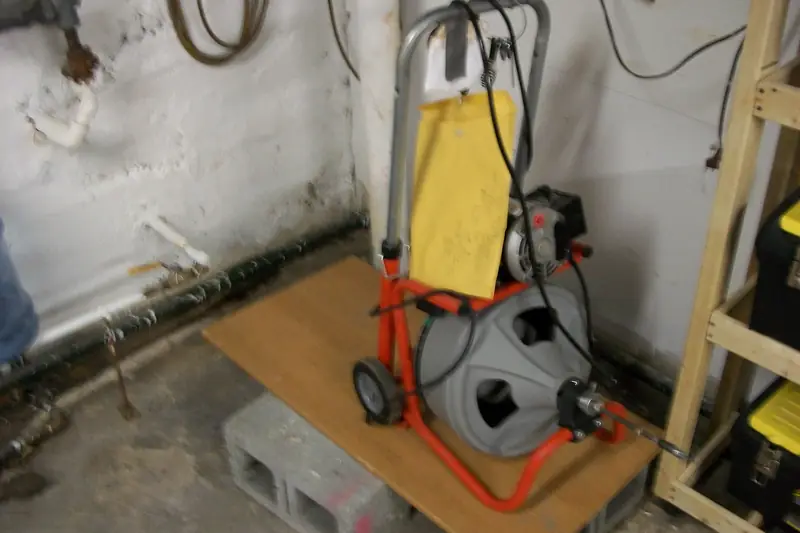
| Mechanical cutting (drum machine) | Cuts roots at the pipe wall and clears the clog | Seal the joint; roots return | Not verified |
| Hydro jetting | Scours roots, grease and scale with high-pressure water | Seal the joint or fix a crack | $250 to $1,000 (Fixr, Jan 2025) |
| Chemical root treatment | Slows regrowth after cleaning | Open a blocked line or seal a gap | Not verified |
| Lining the damaged run | Forms a jointless pipe inside the old one | Fix a sag or a fully collapsed pipe | Not verified |
| Replacing the section | Removes the failed pipe and joints | Come cheap under a slab or driveway | $1,000 to $20,000 for sewer line replacement (Fixr, Jan 2025) |
Fixr's figures are national contractor-survey estimates as of 2025; local quotes vary with depth, length and access. A sensible order is clean, film, then decide. If the camera shows roots at one joint in otherwise sound pipe, cleaning on a schedule may be enough for years. If it shows cracks, offsets or a sag in the line, the root problem is a pipe problem, and the sewer line replacement cost guide covers what drives the price.
Which trees are worst near sewer lines?
Fast-growing, water-seeking trees are the worst near sewer lines, and willow, birch and poplar topped the list in a Danish survey summarized in the 2001 review. Those three made up 30%, 25% and 23% of reported problem species; elm followed at 6%. The review also lists fast-growing species among the main risk factors.
Distance matters more than species. In the same Danish data, 48% of intrusions came from trees under 3 m (about 10 ft) from the sewer and 44% from trees 3 to 6 m (about 10 to 20 ft) away, so researchers treated 6 m as the high-risk zone. University of Georgia Extension gives the practical version: find out where your sewer line runs before planting, and keep trees with aggressive roots away from it.
What the research reports
- >50%Share of sewer blockages reported to be caused by rootsRandrup, McPherson and Costello, J. Infrastructure Systems, 2001
- 48%Root intrusions from trees under 3 m (about 10 ft) from the sewer, Danish surveyRandrup, McPherson and Costello, 2001
- 30%Share of problem reports naming willow, the top species in the Danish surveyRandrup, McPherson and Costello, 2001
- 1 in 6Root removal may cost about one-sixth of replacing pipe damaged by rootsRandrup, McPherson and Costello, 2001
Who pays when a street tree's roots block the line?
Who pays depends on where the blockage is and on local rules, and in most cases the line on private property is the owner's to clear. The Sewerage and Water Board's customer FAQ says homeowners are responsible for maintaining their sewer cleanouts and that water leaks on private property are the owner's responsibility. A clog between the house and the cleanout is almost always a private job.
The tree is a separate question. In New Orleans, the Department of Parks and Parkways maintains all City trees, including those between the sidewalk and the street, and asks for tree service requests through 311. Any work on a City tree needs a Tree Maintenance Work Permit, so a homeowner should not cut or remove a street tree's roots or limbs without one.
If a camera shows the blockage under the street, or the main itself is backing up, report it to the Sewerage and Water Board through its online report form. If you believe city property caused damage, SWBNO's claims page lists what to send, including photos and three repair estimates, and says documents must arrive within five months of the claim. Insurance is a third track: most homeowners policies treat roots and wear as maintenance, so read the insurance guide before filing.
How we put this page together
This page is based on the review "Tree Root Intrusion in Sewer Systems: Review of Extent and Costs" (Randrup, McPherson and Costello, Journal of Infrastructure Systems, March 2001, pages 26-31), University of Georgia Extension's note on roots and sewer lines (April 2023), the City of New Orleans Parks and Parkways tree page, and the Sewerage and Water Board's FAQ and claims pages, all checked in October 2026. Cost ranges are Fixr's national contractor-survey estimates, named and dated, not local quotes. Left out: named root-killer products and doses, per-foot lining or trenchless prices, and contractor blog claims, none of which could be confirmed in a primary source.
Common questions
Do roots grow into PVC sewer pipe?
Rarely, when the joints are sound. The 2001 review cites researchers who concluded modern plastic drains are unlikely to suffer, and a Danish survey found only five root intrusions in sewers laid after 1979. Roots can still enter a PVC line at a poorly made joint or where PVC meets older pipe.
How often do sewer roots need cutting?
In smaller pipes, root removal every year or every other year is common, according to the 2001 review. A camera inspection after cleaning shows whether that schedule is enough or whether the joint needs lining or replacing.
Will cutting a tree down stop roots in the sewer?
Not right away. Roots already in the pipe stay there until they are cut out and break down, and the gap they used stays open. Removing a City tree in New Orleans also needs a permit from Parks and Parkways.
Can roots break a sewer pipe, or only clog it?
Both. The review describes a mulberry planted over a newly filled sewer trench in California whose roots crushed a 100 mm (about 4 in) sewer line within four years. In most house lines, though, roots enter an existing gap and widen it over time.
Is it safe to plant a tree near a sewer line?
Keep fast-growing, water-seeking trees well away. Danish data treated anything within 6 m (about 20 ft) as the high-risk zone. Find where the line runs first, as University of Georgia Extension advises, and choose smaller, less aggressive trees for the space over it.
Does homeowners insurance pay to remove roots from a sewer line?
Usually not, because root intrusion is treated as maintenance and gradual damage. Water damage from a sudden backup may fall under a sewer backup endorsement, if the policy has one; the sewer backup guide covers that.
Should the sewer line be filmed before or after cleaning?
Both, if the budget allows. Filming before shows where the roots enter; filming after cleaning shows the pipe wall, so cracks, offsets and sags are visible.
More on sewer lines
More guides: the slab house plumbing guide home page.