
Slab leaks
Foundation Settlement and What It Does to Pipes
Foundation settlement is the uneven sinking of a house as the soil beneath it compresses or shrinks, and on Gulf South slabs it can bend, crack or flatten the drain and water lines cast under the floor.
On this page
Key takeaways
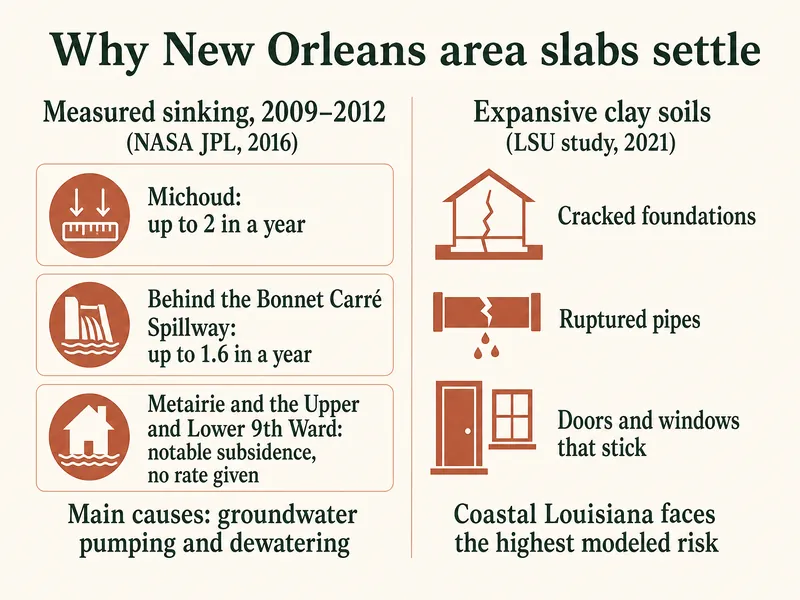
- A NASA-led radar study recorded Michoud sinking by as much as 2 inches yearly, and the area behind the Bonnet Carré Spillway by as much as 1.6 inches yearly, from 2009 to 2012 (NASA JPL, 2016).
- The same study found notable subsidence in Metairie and the Upper and Lower 9th Ward, with no single rate given, and named groundwater pumping and dewatering as the main causes.
- LSU researchers modeling expansive soils found coastal Louisiana faces the highest risk, and list cracked foundations and ruptured pipes among the effects (Mostafiz et al., 2021).
- The USGS says land subsidence is most often caused by human activities, mainly the removal of groundwater (USGS Water Science School).
- Most Louisiana homeowners policies exclude earth movement, according to the Louisiana Department of Insurance.
- Having the drains checked before and after leveling is a common way to catch pipes that leveling itself has moved.
What is foundation settlement?
Foundation settlement is downward movement of a house's foundation caused by changes in the soil below it, and it becomes a problem when one part of the house sinks more than another. Uniform settlement, where the whole house drops evenly, is usually harmless. Differential settlement, where one corner or the middle sinks faster, bends the structure and anything rigid built into it.
On a slab-on-grade house, that includes the plumbing. Drain lines, and in many houses the water supply lines, are cast into or buried under the concrete. When the slab moves, the pipes move with it, and pipe joints are often the weakest point.
Settlement is different from heave, where swelling soil pushes part of a slab up. Both happen in Louisiana, and both stress the pipes underneath.
Why do Gulf South foundations settle?
Gulf South foundations settle because many sit on soft, young, water-rich soils over a delta that is itself sinking. Two forces work together: regional subsidence, the slow sinking of the land, and local soil behavior, such as clays shrinking in dry spells and swelling when wet.
The regional picture comes from a NASA-led study using airborne radar from June 2009 to July 2012. It measured sinking of up to 2 inches (50 mm) a year around Michoud and up to 1.6 inches (40 mm) a year behind the Bonnet Carré Spillway, and noted "notable subsidence" in Metairie and the Upper and Lower 9th Ward without giving a single rate. The main contributors were "groundwater pumping and dewatering", the pumping that lowers the water table to keep ground dry (NASA JPL). The USGS describes the same pattern nationally: subsidence is "most often caused by human activities, mainly from the removal of groundwater", and drainage of organic soils is another cause (USGS).
Local soil behavior adds a second layer. LSU researchers who mapped expansive-soil risk across the state found that coastal parishes face the highest risk, and their model put the average annual statewide property loss from expansive soils at about $66 million in 2010 dollars (Mostafiz et al., Frontiers in Built Environment, 2021). That figure is a model estimate, not a count of claims.
Settlement by the numbers
- 2 in a yearMaximum sinking measured around Michoud, 2009–2012NASA JPL
- 1.6 in a yearMaximum sinking measured behind the Bonnet Carré Spillway, 2009–2012NASA JPL
- $66.2 millionModeled average annual statewide property loss from expansive soils, 2010 dollarsLSU, Frontiers in Built Environment (2021)
How does settlement break drain lines?
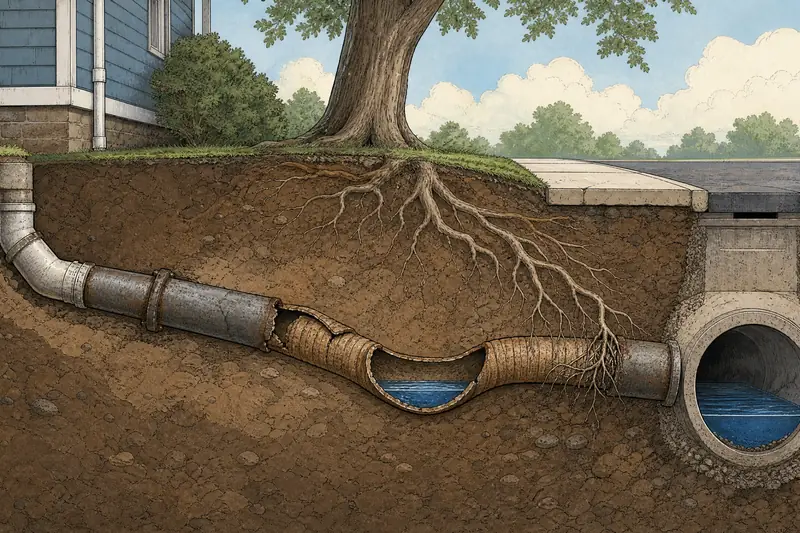
Settlement breaks drain lines by changing their shape: a section that sinks more than its neighbors creates a low spot, a joint pulls apart, or a rigid pipe cracks where it is held by the slab on one side and moves with the soil on the other. Drains are especially sensitive because they work by gravity and need a steady downhill slope.
The common failure patterns are:
- Bellies. A sag in the line holds water and solids, causing slow drains and repeat clogs. See sewer line belly.
- Separated joints. Older cast-iron and clay joints can open up and let water escape or roots and soil in. See cast iron drain pipe.
- Cracks and breaks. A pipe that cannot flex snaps, often where it passes through the slab or a grade beam.
- Supply line stress. Pressurized water lines in the slab can also crack, which shows up as a classic slab leak. See slab leak signs.
The LSU study names the same chain of damage in plain terms: uneven settling and shifting on expansive soils can cause "cracks in foundations, walls, streets, driveways, and sidewalks; ruptured pipes; and windows and doors that do not open and close properly" (Mostafiz et al., 2021).
What are the signs of settlement and plumbing damage?
The signs of settlement and plumbing damage tend to show up together: cracks in walls and floors, doors that stick, and drains that slow down or back up for no obvious reason. Any one of them alone can have another cause, so it is the combination that deserves attention.
| Sign | What it can point to | Who can check it |
|---|---|---|
| Diagonal cracks at door and window corners | Differential movement of the slab | Structural engineer or foundation contractor |
| Doors or windows that stick or won't latch | Frame racked by settlement | Structural engineer |
| Cracked or tented floor tile | Slab movement or heave | Structural engineer |
| Slow drains or repeat clogs in one area | Belly or offset joint in a drain under the slab | Licensed plumber with a sewer camera |
| Sewer odor indoors or damp spots near a drain | Separated or cracked drain joint | Licensed plumber |
| Water meter moving with every tap off | Leak in a supply line, possibly in the slab | Licensed plumber, leak detection |
A water meter test is the simplest home check for supply lines: turn off every tap and water-using appliance and watch the meter's leak indicator. For drains, a sewer camera inspection shows bellies, offsets and cracks directly.
Does house leveling fix the pipes?
No, house leveling does not fix the pipes, and it can move them again. Leveling, whether by piers, pilings or slab jacking, lifts and supports the foundation, but pipes that were already cracked or sagging stay damaged, and lifting the slab can open joints that were holding.
That is why the plumbing deserves its own plan. A drain that had a belly may come out of leveling straighter, worse, or broken at a new point. A supply line that was stressed may start leaking once the slab is lifted. Foundation repair contracts generally cover the structure, not the pipes, so ask in writing what happens if the plumbing is damaged during the lift.
Insurance adds another reason to plan ahead. The Louisiana Department of Insurance lists earth movement among the losses most homeowners policies do not cover, so damage traced to settlement may fall to the owner (LDI guide). For how policies treat leaks, see does homeowners insurance cover slab leaks.
Should you test the plumbing before or after foundation repair?
Test the plumbing both before and after foundation repair: before, to find damage that settlement already caused and to set a baseline, and after, to catch anything the lift moved. A before-and-after record also helps sort out who is responsible if a pipe fails.
A typical sequence looks like this:
- Before leveling: a drain test or sewer camera inspection of the lines under the slab, and a pressure check of the water supply.
- Repairs first where needed: a broken drain may be fixed before the lift, or planned as part of the same job.
- After leveling: a repeat test of the drains and supply, compared with the first results.
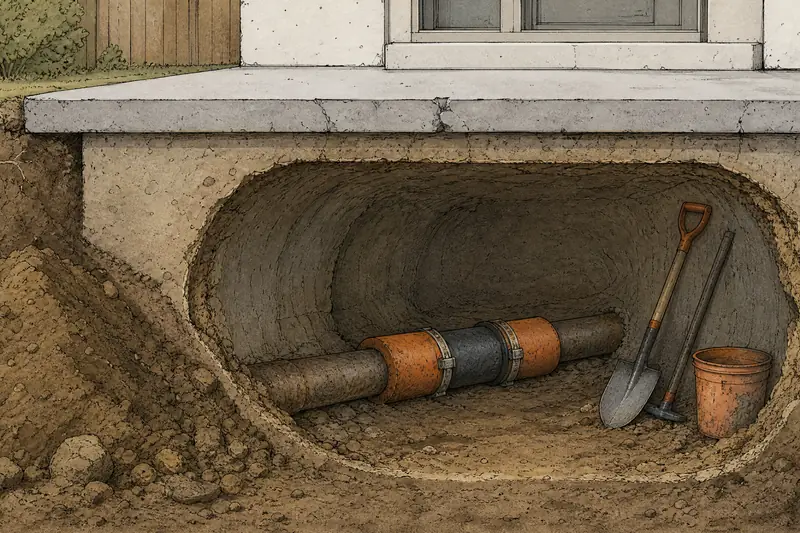
In New Orleans, replacing water piping or fixtures needs a plumbing permit from the Sewerage and Water Board, applied for by a master plumber licensed in Orleans Parish (City of New Orleans permit brochure). If pipes have to be reached under the slab, see tunneling under a slab; for the bigger picture, the slab leak guide or all guides.
How we put this page together
Sources for this page: NASA JPL's 2016 report on its UAVSAR subsidence study of the New Orleans area, the USGS Water Science School page on land subsidence, the LSU-led expansive-soil risk study (Frontiers in Built Environment, 2021), the Louisiana Department of Insurance's homeowners guide, and New Orleans' building permit guidelines. All were read in October 2026. Left out: a subsidence rate for Metairie (the study gives none), foundation repair prices, and soil statements from sources that could not be loaded.
Common questions
Is a crack in a slab floor always a plumbing problem?
No. Many slabs have shrinkage cracks that are cosmetic. A crack that widens, changes level across its edges, or appears with slow drains or a running meter is worth having checked.
What is causing the land around New Orleans to sink?
The NASA JPL study named groundwater pumping and dewatering, the pumping that lowers the water table, as the primary contributors. The study says natural geologic processes play a part as well. For the drain side of soil problems, see tree roots in sewer line.
Does foundation settlement make a slab leak more likely?
Movement stresses pipes cast in or under the slab, and the LSU study lists ruptured pipes among the effects of uneven settling on expansive soils. Settlement is one of several causes of slab leaks.
Who should inspect first, a plumber or a foundation engineer?
For structural signs such as wall cracks and sticking doors, a structural engineer can assess the foundation without a stake in selling the repair. For drain symptoms, a plumber's camera inspection comes first. Many owners do both before leveling.
Is Metairie sinking faster than New Orleans?
The NASA JPL study reported notable subsidence in Metairie but gave no single rate, so this page doesn't compare them. Rates varied a great deal from place to place.
Does homeowners insurance pay for pipes broken by settlement?
Often not: LDI's guide lists earth movement among common exclusions. How an insurer handles the water that escaped is a separate question worth putting to them in writing.
Related guides
More guides: the slab house plumbing guide home page.