
Sewer & drains
Sewer Camera Inspection: What the Camera Shows
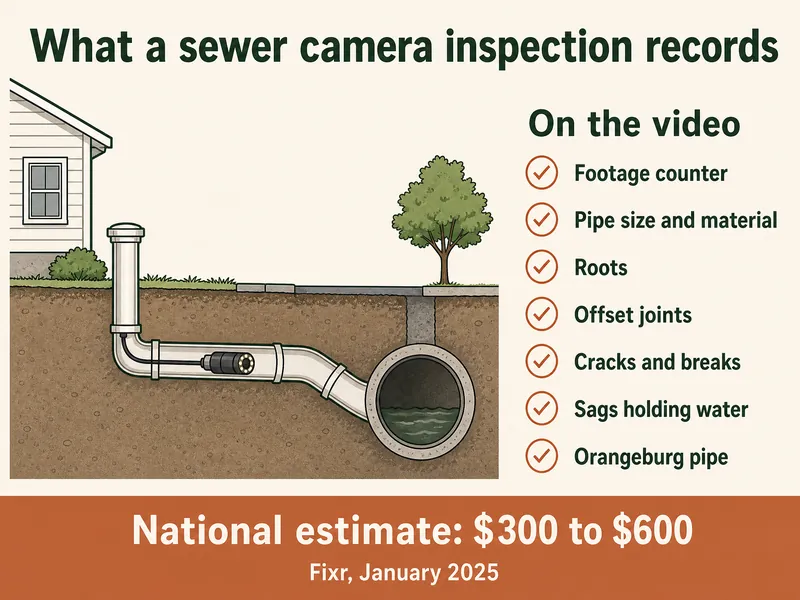
A sewer camera inspection pushes a lighted camera on a cable through the drain line and records roots, cracks, offset joints and sags, with a footage counter showing where each one sits.
On this page
Key takeaways
- EPA's 2005 sewer-maintenance guide describes closed-circuit television (CCTV) inspection as a lighted camera, pushed or self-propelled, that leaves a permanent video record of the pipe (EPA CMOM guide).
- Fixr's national estimate for a sewer camera inspection is $300 to $600 (January 2025); it is not a local price.
- The City of Morro Bay, California lists four key defects for private sewer video: break-in connections, Orangeburg pipe, offset joints with bad gaskets, and cracked or broken pipe (Morro Bay video standard).
- The same standard caps camera speed at 30 feet per minute and asks for a footage counter accurate within 3 percent.
- A 2001 review in the Journal of Infrastructure Systems reports that roots cause more than 50 percent of sewer blockages (Randrup, McPherson and Costello).
- In New Orleans, homeowners are responsible for maintaining their sewer cleanouts, the usual way a camera gets in (SWBNO FAQ).
Camera inspection in numbers
- $300–$600National range for a sewer camera inspection, January 2025Fixr
- 30 ft/minTop camera speed in Morro Bay's private sewer video standardCity of Morro Bay
- 5 secondsMinimum pause at each break, root intrusion or misaligned joint in the same standardCity of Morro Bay
- >50%Share of sewer blockages reported to be caused by rootsRandrup, McPherson and Costello, 2001
What is a sewer camera inspection?
A sewer camera inspection is a video survey of the pipe that carries a house's waste to the public sewer, recorded from the inside. EPA's guide to sewer-system maintenance describes CCTV inspection as a closed-circuit camera with a light that is self-propelled or pulled down the pipe, recording the interior as it moves. Its main benefit, EPA says, is a permanent visual record that can be reviewed later. For a house line the camera usually rides on a stiff push cable fed in through a cleanout.
Access is the first practical question. In New Orleans the Sewerage and Water Board's customer FAQ says homeowners are responsible for maintaining their sewer cleanouts, so a buried or missing cleanout cap is the owner's to deal with. Morro Bay's standard notes that where a line has no access point, a new cleanout may have to be installed before it can be filmed. Some city lining programs, such as the one described in the City of Columbus lining brochure, send the camera up from the public main instead.
When should you get a sewer scope?
Get a sewer scope when drains keep backing up, before paying for a big repair, and before buying an older house. The City of Ann Arbor's Orangeburg page notes that a failing house sewer may run very slowly or back up through a fixture or floor drain; repeat clogs in the lowest drains are the classic prompt. A camera is also worth running before hydro jetting, so the cleaner knows what the pipe is made of and whether it is intact.
A camera run after a repair or cleaning is useful too. It shows whether roots were cut back to the pipe wall, whether a new section lines up with the old one, and whether a liner went in without wrinkles. Ask for both videos, before and after, and keep them with the house papers.
What can a sewer camera find?
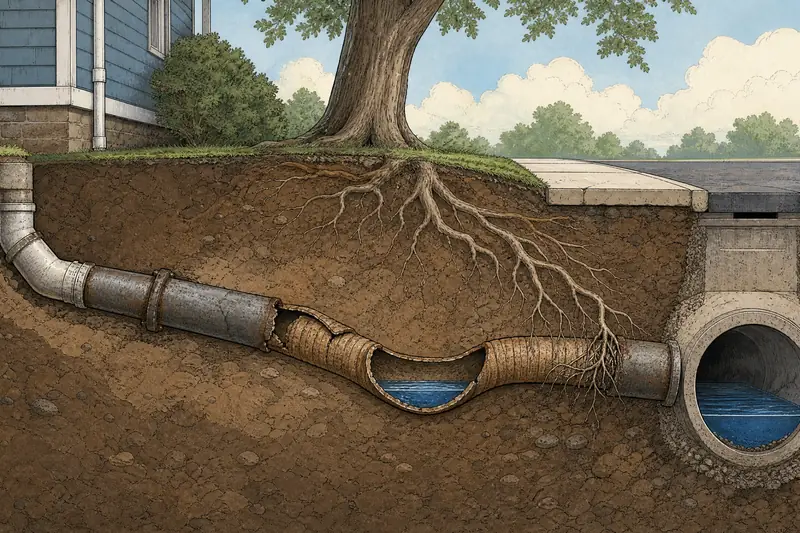
A sewer camera can find roots, cracks, breaks, offset or separated joints, sags, grease and scale buildup, and the pipe material itself. Morro Bay's standard lists four key defect types for private sewer lines: break-in connections to the main instead of a factory fitting, Orangeburg pipe (asphalt-impregnated paper), offset joints and bad gaskets, and cracked or broken piping. Ann Arbor adds that a video scan may help identify Orangeburg, which matters because that pipe flattens as it ages; the Orangeburg pipe guide explains how to spot it.
Roots deserve their own line in any report. A 2001 review by Randrup, McPherson and Costello in the Journal of Infrastructure Systems reports that roots cause more than half of all sewer blockages, with old jointed pipe at higher risk. The tree roots in sewer line guide covers what to do about them.
A camera has limits. It sees only the inside surface, so it cannot show the soil around the pipe or the size of a void. Standing water in a sag hides the pipe floor, and EPA's guide says a line should be cleaned before inspection where needed, so the camera has clearance and the picture is clear.
How do you read a sewer inspection report?
Read the report against the video, defect by defect, using the footage counter to place each one. Morro Bay's standard is a useful checklist even outside California: the video should open with the date, address, pipe size and material, show a running footage counter accurate within 3 percent, and record the full length of the lateral to the junction with the main. The camera should move no faster than 30 feet per minute and pause at least 5 seconds at each break, root intrusion or misaligned joint.
| Finding | What it looks like on screen | What it usually leads to |
|---|---|---|
| Roots at a joint | Hair-like or thick root masses at a pipe seam | Cutting or jetting, then a recheck; repeated intrusion points to repair |
| Offset joint | A step or ledge where two pipe sections meet | Watch if minor; spot repair if it catches waste or lets roots in |
| Crack or break | A line or missing piece in the wall, sometimes soil visible | Spot repair or replacement of that section |
| Sag or belly | Water pooled in a stretch with the camera partly submerged | Monitoring, or relaying the pipe to grade |
| Orangeburg pipe | Dark fiber wall, often squeezed out of round | Planning a replacement |
| Scale in cast iron | Rough, flaky buildup narrowing the pipe | Descaling, lining or replacement depending on wall condition |
Ask the camera operator to name the pipe material at each change, to locate the defects from the surface if a repair is likely, and to give the video file, not just stills. If the report recommends replacement, the footage numbers let a second plumber price the same defects; the guide to sewer line replacement cost lists what moves those bids.
Should you scope before buying a house?
Yes, a sewer scope is worth ordering before buying an older house, because a general home inspection usually does not include filming the buried line. EPA's guide notes that some sewer utilities require an inspection of the private lateral before a property is sold, which shows how often problems hide there. A house built in the Orangeburg era, roughly the early 1950s to early 1970s according to Ann Arbor, or a lot with large trees near the sewer path, is a stronger case for a scope.
Repair costs on the buried line usually fall to the owner. Louisiana's insurance department says homeowners policies generally exclude water that backs up through sewers or drains, and a buyer who learns of a cracked line after closing has little room to negotiate. Book the scope during the inspection period, ask the seller where the cleanout is, and have the operator film all the way to the street.
What does a camera inspection cost?
Fixr's national estimate for a sewer camera inspection is $300 to $600, from its January 2025 page; quotes in New Orleans and Jefferson Parish may differ. Price usually rises when there is no usable cleanout, when the line must be cleaned first, or when the operator also locates defects from the surface for a repair crew. Ask whether the price includes the video file, a written report with footage numbers, and locating.
Some contractors bundle a camera run with cleaning or with a repair bid. That can be convenient, but the company that films the line is also the one quoting the fix, so a second opinion on a large job is reasonable.
How we put this page together
This page draws on EPA's January 2005 CMOM evaluation guide (document 305-B-05-002), Morro Bay's video requirements for private laterals, Ann Arbor's page on Orangeburg sewer piping, Columbus' lining brochure for homeowners, the New Orleans water board's customer FAQ, the 2001 Randrup, McPherson and Costello review on tree roots and sewers, Louisiana's homeowners insurance guide, and Fixr's national cost range (named without a link). Everything was read in October 2026. Not included: home-inspector pricing, any claim about how often scopes find defects (no source found), and forum stories.
Common questions
Is a sewer scope part of a standard home inspection?
Usually not; it is ordered as an add-on. Ask the inspector whether a camera run is included and whether it reaches the city main or stops at the property line.
Can the camera go in through a toilet?
Sometimes, after the toilet is pulled, but a cleanout is the normal entry point. Morro Bay's standard says a new cleanout may be required where a line has no access point.
Can a sewer camera show a leak under a slab?
It can show a crack, break or open joint in the drain under the floor, but not how much water has escaped into the soil. A suspected supply-line leak needs different tools, covered in the slab leak detection guide.
How long is a typical house sewer camera run?
Long enough to film the whole line from the cleanout to the main. At Morro Bay's limit of 30 feet per minute plus pauses at each defect, a short line takes minutes of video; setup and cleaning take longer.
Can a camera tell what the pipe is made of?
Usually. Cast iron, clay, plastic and Orangeburg each look different on video, and Ann Arbor names a video scan as one way to identify Orangeburg. Ask the operator to state the material on the recording.
Should roots be cut before or after the camera?
Often both: a first pass to see the problem, cleaning, and a second pass to check the pipe wall behind the roots. EPA's guide notes that cleaning helps prepare a sewer for inspection.
Who keeps the video?
Whoever paid for it should get the file. Keep it with the house records; it gives a baseline for the next inspection and a reference if an insurer or buyer asks.
Related guides

More guides: the Below the Slab home page.