
Slab leaks
Tunneling Under a Slab: How Hydro Tunneling Works
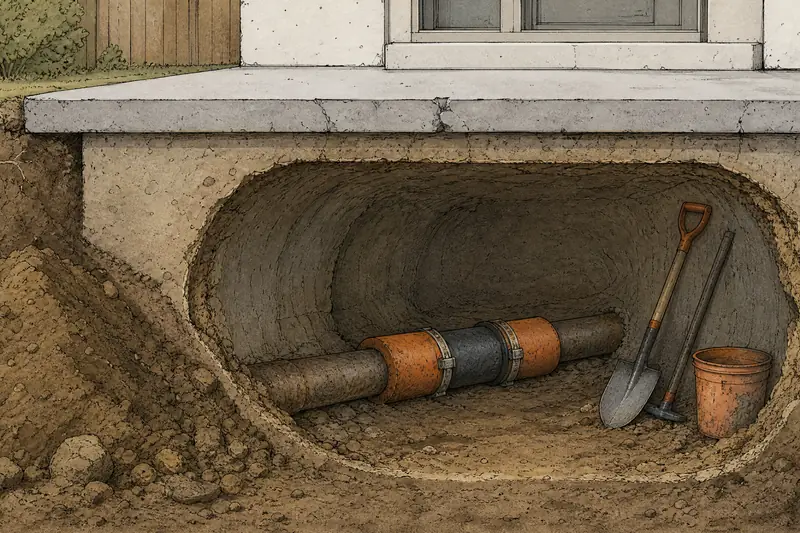
Tunneling under a slab means digging from outside the house to reach a broken pipe, so the floors inside stay intact; it trades a dug-up yard and careful backfill for no jackhammering indoors.
On this page
Key takeaways
- A tunnel starts as an access pit beside the foundation and runs under the slab to the leak, so no floor covering is torn up.
- Fixr's national estimate for tunneling is $900 to $2,000 for the whole job (updated May 2025); local quotes vary.
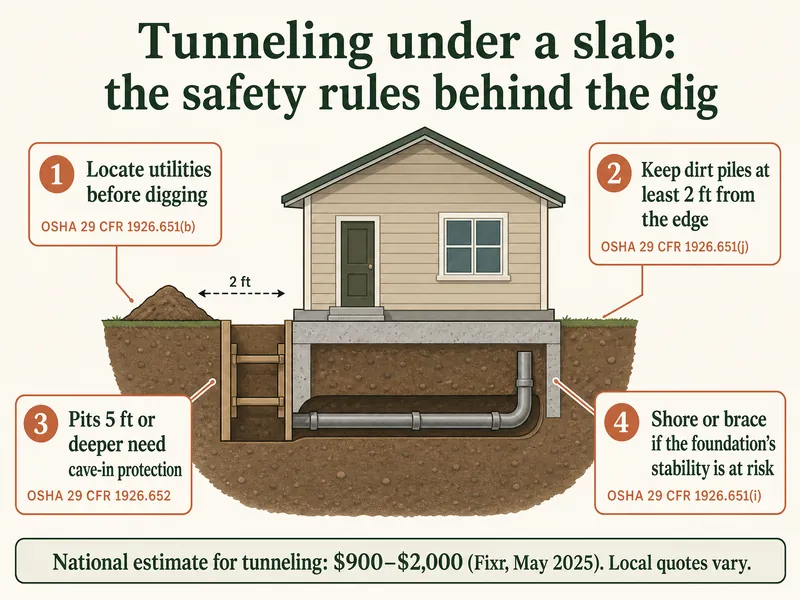
- Federal excavation rules require cave-in protection for workers in excavations 5 feet deep or more (OSHA, 29 CFR 1926.652).
- Buried utilities must be located before the digging starts, and spoil must sit at least 2 feet from the edge (29 CFR 1926.651).
- In New Orleans, replacing water piping needs a plumbing permit, applied for by a master plumber licensed in Orleans Parish (City of New Orleans permit brochure).
- Poor backfill under a slab is the main risk afterward, so ask how the tunnel will be filled and compacted before work starts.
What is tunneling under a slab?
Tunneling under a slab is a way to reach pipes buried below a concrete floor by digging underneath it from the outside, instead of cutting through the floor from above. A crew opens an access pit next to the foundation, then digs sideways under the slab until it reaches the leaking water line or the cracked drain.
The method is common on slab-on-grade houses, the type built across much of the Gulf South. Once the pipe is exposed, a licensed plumber repairs or replaces the damaged section, tests it, and the tunnel is filled back in. The floor inside, and whatever sits on it, is left alone.
If you have not confirmed a leak yet, start with slab leak signs and how slab leak detection works. Tunneling is a repair route, not a diagnosis.
How does hydro tunneling work?
Hydro tunneling uses pressurized water to loosen the soil under the slab and a vacuum or pump to pull the slurry out, so the tunnel is cut without shovels doing most of the work. It is one of two common methods; the other is digging by hand with short-handled tools from the access pit.
The basic sequence is the same either way:
- The leak is located first, usually with pressure tests and acoustic or thermal equipment, so the tunnel can aim at a known spot.
- Buried utilities near the access pit are marked. Federal rules require that the estimated location of sewer, water, gas and electric lines be determined before an excavation is opened (29 CFR 1926.651(b)).
- The access pit is dug beside the foundation, and the tunnel is advanced under the slab toward the pipe.
- The pipe is repaired or replaced and pressure-tested before anything is covered.
- The tunnel and pit are backfilled and compacted, and the yard is restored.
On the soft, wet clays and silts common around New Orleans, water-based digging can move soil quickly. The ground is not static either: a 2016 NASA JPL subsidence study found sinking of up to 2 inches a year near Norco and in Michoud, driven mainly by groundwater pumping and dewatering. That is also why the backfill step matters so much: soil that was washed out has to be replaced with material that will carry the slab.
When does tunneling beat breaking the floor?
Tunneling usually beats breaking the floor when the leak sits under finished flooring, cabinets or a bathroom that would be costly to tear out and rebuild. It also suits jobs where the household needs to stay in the house during the work, because the noise, dust and debris stay outside.
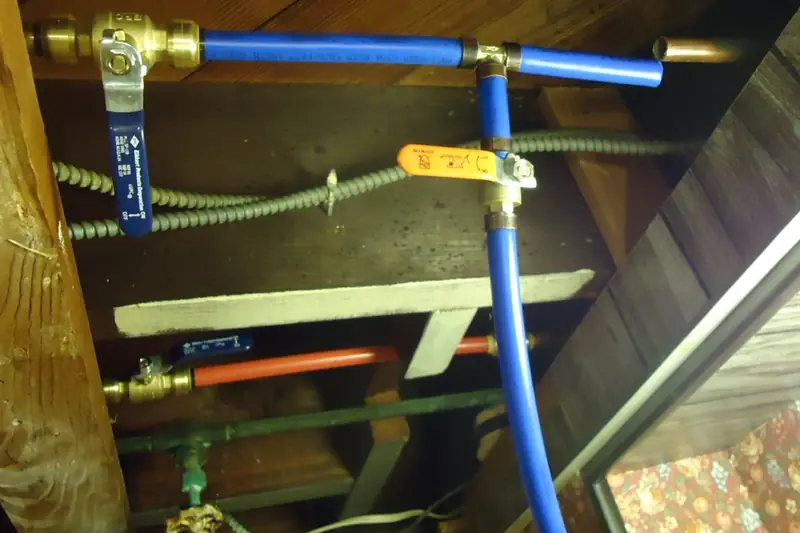
Breaking the slab from above can be the simpler choice when the leak is close to an outside wall, under an easily replaced floor, or under a garage. A third option is to stop repairing the buried line at all and run a new one overhead, which is covered in water line reroute vs repair.
| Approach | What it involves | Main cost drivers |
|---|---|---|
| Tunneling under the slab | Access pit outside, tunnel to the pipe, repair, backfill | Tunnel length and depth, soil type, backfill and compaction, yard restoration |
| Breaking the slab from above | Cut the floor over the leak, repair, pour new concrete | Floor covering removed and replaced, cabinets or fixtures moved, concrete patch |
| Rerouting the water line | New pipe through the attic or walls; old line abandoned | Length of new pipe, number of fixtures, drywall patching, permit |
Ask the contractor to explain why one route fits your house. For a broader cost view, see slab leak repair cost.
How is the tunnel backfilled and compacted?
A tunnel is backfilled by placing soil or a specified fill back into the void in layers and compacting each layer, so the slab is supported again from below. Some contractors use the dug-out soil; others bring in sand, select fill or a flowable fill, depending on the soil and the engineering behind the job.
Backfill is the step homeowners can least see and most need to ask about. Questions worth putting in writing:
- What material will fill the tunnel, and why that material for this soil?
- How will it be compacted, and will compaction be checked?
- Will the void directly under the slab be filled completely, including the crown of the tunnel?
- Who is responsible if the floor settles over the tunnel later?
Gulf South soils add a reason to be careful. Researchers at LSU modeling expansive soils across the state found the coastal parishes face the highest risk, and noted that uneven settling on such soils can cause cracked foundations and ruptured pipes (Mostafiz et al., Frontiers in Built Environment, 2021). More on that in foundation settlement and plumbing.
What does tunneling under a slab cost?
Fixr's national estimate for tunneling under a house is $900 to $2,000 for the whole job (Fixr cost guide, updated May 1, 2025). That is a national estimate, as of 2026, and local quotes vary. This site has no reliable per-foot figure for tunneling and does not publish one.
The things that move a tunneling quote are easy to list even without numbers: how far the leak is from the nearest outside wall, how deep the pipe sits, how wet and soft the soil is, how much backfill has to be imported, what has to be removed and replaced in the yard, and the permit. In New Orleans, a plumbing permit is needed "if you plan to remove or replace any water piping," and the application must come from a master plumber licensed in Orleans Parish; the Sewerage and Water Board issues these permits (City of New Orleans).
Tunneling by the numbers
- $900–$2,000National estimate for tunneling under a house, whole job (May 2025)Fixr cost guide
- 5 ftDepth at which excavations generally need a cave-in protective systemOSHA, 29 CFR 1926.652
- 2 ftMinimum distance for spoil and equipment from the edge of an excavationOSHA, 29 CFR 1926.651(j)
- 4 ftTrench depth at which a ladder, ramp or stairway must be within 25 ft of travelOSHA, 29 CFR 1926.651(c)
Insurance can change the math. Policies differ on whether they pay the cost of reaching a covered leak, often called tear-out; see does homeowners insurance cover slab leaks.
What can go wrong after tunneling?
The most common problem after tunneling is settlement: if the backfill was not compacted well, the soil under the slab can sink and leave a void, and the floor above can crack or dip. Other risks are damage to the foundation edge at the access pit, a repair joint that fails because it was not tested, and a yard that settles where the pit was.
Federal rules recognize the foundation risk. Where digging threatens the stability of an adjoining building, support such as shoring, bracing or underpinning is required, and excavating below a foundation's footing is not allowed without such support or an engineer's approval (29 CFR 1926.651(i)). Those rules protect workers, but they also tell you what a careful crew should be doing next to your house.
Before the tunnel is closed, ask to see the repaired pipe and the pressure test. After the job, watch for new cracks in tile, doors that start to stick, or a soft spot in the yard, and report them to the contractor in writing.
Who should do the tunneling, and what should you ask?
A licensed plumber should do or supervise the pipe repair, and in Orleans Parish the plumbing permit has to be requested by a licensed master plumber. The State Plumbing Board of Louisiana describes a journeyman plumber as qualified to install, repair and maintain plumbing systems under the supervision of a licensed Louisiana master plumber. Many plumbers bring in a tunneling crew for the dig itself, so ask who is digging, who is repairing, and who answers for the backfill.
Useful questions before signing: Has the leak been pinpointed, and how? How long and how deep will the tunnel be? Who pulls the permit? What is the backfill material and compaction plan? What is covered if the floor settles later? For the bigger picture on slab houses, start at the slab leak guide or browse all guides.
How we put this page together
This page is based on the federal excavation rules in 29 CFR 1926.651 and 1926.652 (read on eCFR), the City of New Orleans building permit brochure, and the LSU expansive-soil risk study published in Frontiers in Built Environment (2021). The cost range is Fixr's national estimate (updated May 1, 2025), named but not linked. Sources were checked in October 2026. Left out: per-foot tunneling prices, contractor quotes, and any figure that could not be traced to a named source.
Common questions
How long does it take to tunnel under a slab?
It depends on how far the leak is from the outside wall and on the soil. A short tunnel to a leak near the edge of the house is a smaller job than one that runs to the middle of the slab. Ask the contractor for a schedule that covers digging, repair, testing and backfill separately.
Do you have to leave the house during tunneling?
Usually not, because the work happens outside and under the slab. Water may be shut off for part of the repair. Ask how long the supply will be off and whether any indoor access is needed.
Is hydro tunneling better than hand digging?
Neither is better in every case. Water-based digging can be faster in soft soils, while hand digging adds no water to the ground under the slab. Ask why the contractor prefers one method for your soil.
Can tunneling damage the foundation?
It can if the dig undermines the footing or the backfill is poor. Federal rules require support such as shoring or underpinning where an excavation threatens an adjoining building. Ask how the foundation edge will be protected.
Does tunneling need a permit in New Orleans?
The plumbing repair does: the city says a permit is needed to remove or replace water piping, and the application must come from a master plumber licensed in Orleans Parish. Jefferson Parish rules were not verified for this page, so check with the parish.
What is a fair price to tunnel under a house?
Fixr's national estimate is $900 to $2,000 for the whole job (May 2025), but local quotes vary. Compare quotes on tunnel length, backfill method and yard restoration, not only the total.
Can a tunnel be reused if the pipe leaks again?
Once backfilled, the tunnel is gone and a new dig would be needed. Repeated leaks on the same line are one reason homeowners consider a reroute instead of another tunnel.
Related guides
More guides: the slab house plumbing guide home page.