
Sewer & drains
Sewer Line Replacement Cost, Including Under a Slab
Sewer line replacement cost spans roughly $1,000 to $20,000 in Fixr's January 2025 national estimate; for New Orleans-area homes, length, depth, method and any slab in the way decide where a job lands.
On this page
- How much does sewer line replacement cost?
- What drives the cost of a sewer line?
- How much does it cost to replace a sewer line under a slab?
- Trenchless or open trench: which costs less?
- Who pays for the line to the city main?
- When is a repair enough instead of replacement?
- Does homeowners insurance help pay for a new sewer line?
- Common questions
Key takeaways
- Fixr's national estimate for replacing a sewer line, updated January 31, 2025, runs from $1,000 to $20,000. It is a contractor-survey range, not a New Orleans price.
- In New Orleans, Louisiana law (R.S. 33:4090, as amended by Act 227 of 2020) makes the owner pay for everything from the property line to the house.
- For lots of record that existed before 1954, the same law has the Sewerage and Water Board install one sewer connection from the main to the property line at its own expense.
- A licensed master plumber registered with the Sewerage and Water Board files the permit for drain work in New Orleans (SWBNO plumbing information).
- EPA's 2005 guide to sewer-system maintenance names two structural fixes, replacing the pipe or lining it, done by digging or by trenchless methods (EPA CMOM guide).
- The City of Columbus, Ohio gives a newly lined lateral a life expectancy of 50 years in its homeowner brochure.
What the numbers say
- $1,000–$20,000National range for sewer line replacement, updated January 31, 2025Fixr
- $300–$600National range for the camera inspection that should come first, January 2025Fixr
- 50 yearsLife expectancy Columbus, Ohio states for a newly lined sewer lateralCity of Columbus
- 1954Lots of record older than this get one board-paid sewer connection from main to property line in New OrleansLa. R.S. 33:4090 (Act 227 of 2020), via SWBNO
How much does sewer line replacement cost?
Sewer line replacement cost has no single local price, but Fixr's national estimate, updated January 31, 2025, runs from $1,000 to $20,000. That is a range drawn from contractor pricing across the country, so a bid in New Orleans or Jefferson Parish can land anywhere inside it, or outside it. The low end fits a short repair of one broken section under open lawn. The high end fits a long or deep run, a line under the house, or a job with a driveway or sidewalk to rebuild.
Treat any figure quoted before a camera inspection as a guess. A licensed plumber who has run a camera through the line (the sewer camera inspection guide explains what the video shows) can say how many feet are bad, how deep the pipe sits and which method fits. Ask for at least two written bids that state the length replaced, the method, the new pipe material and who pulls the permit.
What drives the cost of a sewer line?
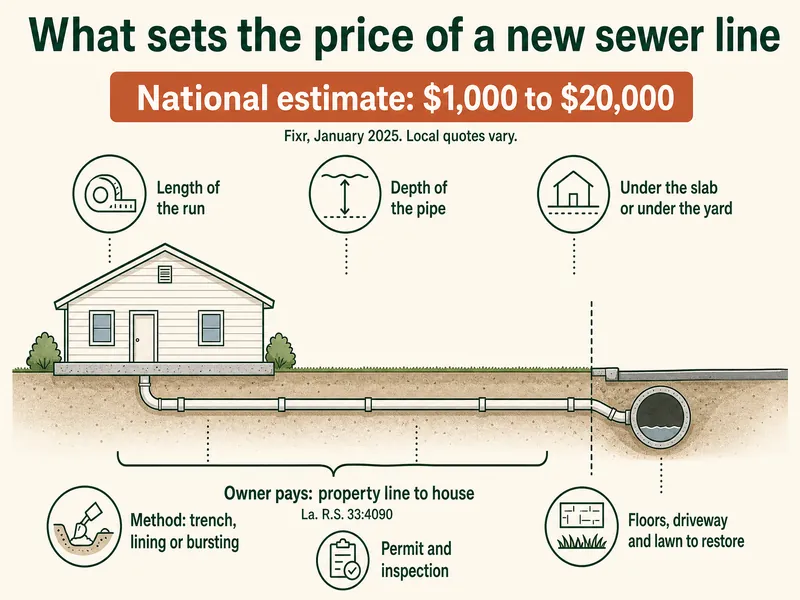
Six things move a sewer bid most: length, depth, access, method, the permit and what has to be put back afterward. Length and depth set how much digging or lining the job needs. Access covers whether the pipe runs under open lawn, a driveway, a patio, a big tree or the house itself. Restoration is the line item owners forget: sod, concrete, flooring and cabinets that come out must go back in.
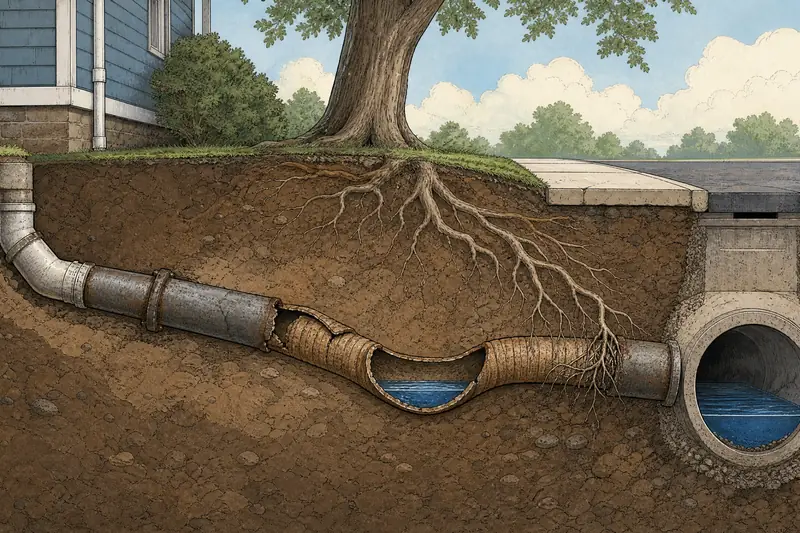
The pipe's own condition matters too. EPA's guide for evaluating sewer systems says the choice of rehabilitation method depends on pipe size, type, location, sewer flow, surface conditions and other physical factors. A line with roots at a few joints is a different job from one that is flattening along its length, as Orangeburg pipe does, or one with a low spot that holds water (a sewer line belly).
| Factor | Why it moves the price | Question for the contractor |
|---|---|---|
| Length | More feet of pipe to dig, line or burst | How many feet are being replaced, by the footage counter on the video? |
| Depth | Deeper trenches mean more digging, shoring and backfill | How deep is the pipe at the house and at the property line? |
| Under a slab | Concrete is cut, or the pipe is reached by tunnel, then floors are restored | Is the work inside the house, outside, or both? |
| Method | Open trench, lining and bursting need different access and equipment | Why this method for this pipe and this yard? |
| Permit and inspection | New Orleans plumbing permits run through the Sewerage and Water Board | Who files the permit, and is the fee in the price? |
| Restoration | Lawn, driveway, flooring and fixtures come out and go back | What restoration is included, and what is left to the owner? |
How much does it cost to replace a sewer line under a slab?
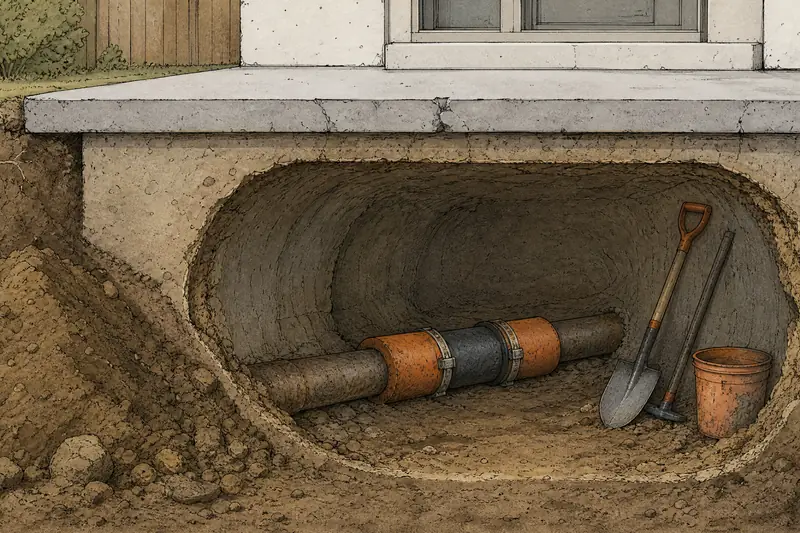
No verified figure exists for replacing a sewer line under a concrete slab, so this guide gives none; the price turns on how the crew reaches the pipe. In a slab house the building drain runs through the soil under the floor before it leaves the house, so a break there means cutting the slab from inside or tunneling to it from outside. Cutting the floor adds concrete, flooring and sometimes cabinet work. Tunneling keeps the floor intact but means digging and later backfilling a tunnel; the tunneling under a slab guide covers how that works.
For scale, Fixr (May 2025) prices a whole tunneling job nationally at $900 to $2,000. That covers getting to the pipe, not the new pipe itself. Ask each contractor to split the bid into access, pipe work and restoration, so bids can be compared line by line instead of as one lump sum.
Trenchless or open trench: which costs less?
Neither method is always cheaper; it depends on what sits above the pipe and what shape the pipe is in. EPA's guide describes two routes for structural repair: dig up and replace or line one or two segments (point repairs), or use trenchless methods that work through existing access points or a few small pits. Open trench means digging along the whole run. It is often simplest under open lawn, and the City of Ann Arbor calls trenching the standard way to replace Orangeburg pipe.
Trenchless options include cured-in-place lining and pipe bursting. In a lining job a resin-filled liner is pulled through the old pipe and cured into a new pipe inside it; the City of Columbus describes filling the liner with hot water so it hardens, and asks residents to stop using water for about four hours. Pipe bursting pulls a new pipe through while breaking the old one outward, and Ann Arbor lists it as an emerging alternative. Columbus also notes that a lateral too damaged for the liner to be pushed through has to be dug up and replaced. Trenchless work tends to save the most where digging would destroy a driveway, a mature tree or a finished floor.
Who pays for the line to the city main?
In New Orleans the owner pays for everything from the property line to the house, and the stretch from the main to the property line depends on the lot. R.S. 33:4090, as amended by Act 227 of 2020 and linked from the Sewerage and Water Board's connection page, says the owner bears all costs for initial connections from the main to the property line. The exception is a lot of record that existed before 1954: the board installs one sewer connection and one water connection to the property line at its own expense. The law also says the board pays to repair a main-to-property-line connection that its own work disrupts.
The statute speaks of initial connections, so for a repair to an existing line between the property line and the main, ask the board's House Connections department before work begins. Its connection page says work on public property needs a contractor licensed in Louisiana as a Municipal and Public Works contractor, and the board inspects work on both sides of the property line. The board's customer FAQ adds that homeowners are responsible for maintaining their sewer cleanouts. Other places draw the line differently: Los Angeles County Public Works makes owners responsible for the entire length of the lateral. Jefferson Parish's rules were not checked for this guide, so ask the parish before work starts.
When is a repair enough instead of replacement?
A spot repair is often enough when the camera shows one bad section in otherwise sound pipe. EPA's guide notes that excavated repairs are usually limited to one or two pipe segments, and that non-structural repairs seal leaking joints in pipe that is otherwise sound. Roots at a joint or two, one cracked hub or a single offset joint can fit that pattern.
Replacement makes more sense when damage repeats along the run: pipe that is flattening, many root-filled joints, long sags, or a material known to fail, such as Orangeburg. Cast iron that is scaling or cracking in several places is another case; the cast iron drain pipe guide covers its warning signs. Ask the plumber to mark each defect by its footage on the video, so a second contractor can check the repair-or-replace call.
Does homeowners insurance help pay for a new sewer line?
Usually not for a line that has simply worn out, though policy wording decides. Louisiana's insurance department, in its homeowners insurance consumer guide, says most policies exclude water that backs up through sewers or drains and earth movement, and that extra coverage can sometimes be bought for excluded items. The NAIC's consumer guide says a homeowners policy "isn't a maintenance contract" and lists sewer and drain backup as an endorsement. Ask the insurer in writing before work starts; the sewer backup guide covers backup endorsements and backwater valves.
How we put this page together
This page is based on Louisiana R.S. 33:4090 as amended by Act 227 of 2020 (linked from the Sewerage and Water Board's connection page), the board's plumbing information and customer FAQ pages, New Orleans' permit brochure for building work, EPA's Guide for Evaluating CMOM Programs at Sanitary Sewer Collection Systems (EPA 305-B-05-002, 2005), the City of Columbus lateral lining brochure, the City of Ann Arbor's Orangeburg page, the homeowners insurance guides from Louisiana's insurance department and the NAIC, and Fixr's national cost ranges (named without links). All were read in October 2026. Not included: per-foot, trenchless and under-slab cost figures (none could be verified), Jefferson Parish permit rules, contractor quotes and forum anecdotes.
Common questions
Is a permit needed to replace a sewer line in New Orleans?
Yes. New Orleans' permit brochure for building work says plumbing permits are issued by the Sewerage and Water Board, not the Department of Safety and Permits, and that only an Orleans Parish licensed master plumber may apply. The board's plumbing page adds that work covered up before inspection must be uncovered for it.
Does the Sewerage and Water Board fix sewer pipes on private property?
No. Under R.S. 33:4090, pipe from the property line to the house is installed and maintained at the owner's cost. The board does pay to repair a connection between the main and the property line when its own work disrupts it.
Can a sewer line be replaced without digging up the yard?
Often, if the old pipe is open enough. Lining needs a path for the liner, and pipe bursting needs a pit at each end; both avoid a full-length trench. A collapsed or badly offset pipe may still need digging at the damaged spot.
How long does a cured-in-place liner last?
The City of Columbus, Ohio states a life expectancy of 50 years for a newly lined lateral, and says the homeowner remains responsible for its upkeep afterward. That is one city's figure for its own program, not a promise from any contractor, so ask what warranty a bid includes.
Should the line be cleaned before the camera inspection?
Usually. EPA's sewer-system guide says cleaning should be considered before inspection so the camera has clearance and the results are clear. A line full of grease or roots can hide cracks and joints on the video.
What should a written sewer replacement bid include?
The footage being replaced, the method, the new pipe material, depth, who files the permit, restoration included and excluded, and a warranty. Ask for a copy of the camera video before and after the work.
Is a sewer line under a slab the same pipe as the main sewer line?
No. The pipe under the floor is the building drain, which collects every fixture in the house; outside the foundation it becomes the building sewer, or lateral, running to the city main. A break under the slab and a break in the yard are reached in very different ways, which is why bids should say where the defect sits.
Related guides
More guides: the slab house plumbing guide home page.