
Slab leaks
Slab Leak Detection: How a Hidden Leak Is Found
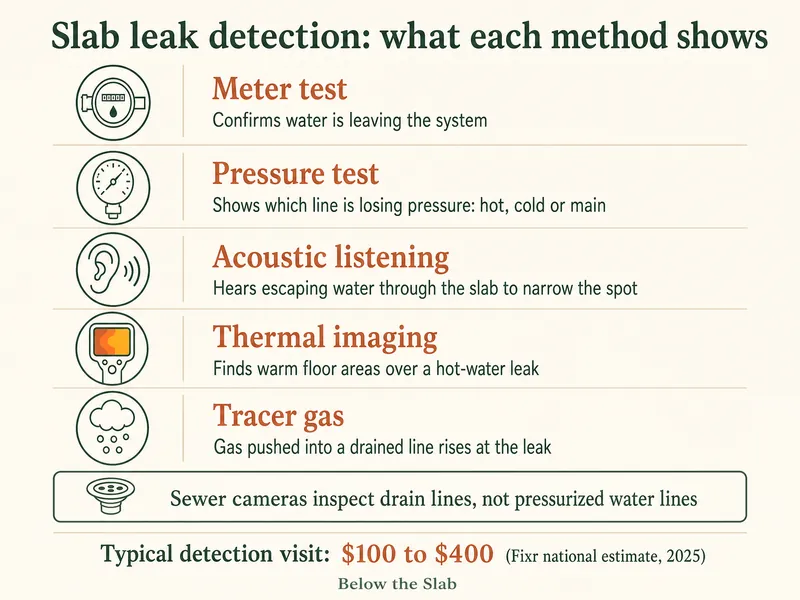
Slab leak detection narrows a hidden leak in steps: a meter test confirms it, a pressure test names the line, and acoustic, thermal or tracer-gas tools mark the spot before any concrete is cut.
On this page
Key takeaways
- Detection starts with the meter: EPA WaterSense's test compares readings taken two hours apart with no water use.
- Closing the house valve separates the yard line from the house; a still-moving flow indicator means the leak lies between the meter and the valve (City of Dayton).
- Pressure tests identify which line is losing water (hot, cold or the main), and listening, thermal and tracer-gas tools then locate the spot along it.
- Cameras inspect drain and sewer lines; they cannot see inside pressurized copper or PEX supply lines.
- Fixr's national estimate (May 2025) for a detection visit is $100 to $400; repair is billed separately.
- A New Orleans permit is required to remove or replace water piping once the leak is found (City of New Orleans).
How does slab leak detection work?
Slab leak detection works by elimination: each test rules out part of the plumbing until only one stretch of one pipe is left. A typical visit moves from the whole house down to a marked spot on the floor.
The usual order is:
- Confirm a leak. Check the water meter with everything off.
- Rule out the yard. Close the house shutoff and see whether the meter stops.
- Name the line. Pressure-test the hot, cold and main lines separately.
- Trace the route. Use a pipe locator or the house's layout to map where the leaking line runs under the slab.
- Pinpoint the leak. Listen, scan for heat or use tracer gas along that route.
- Mark and report. Mark the spot on the floor and write down the method and the line.
The first two steps can be done by any owner. EPA WaterSense describes reading the meter before and after a two-hour period with no water use; if the reading changes, there is probably a leak (EPA WaterSense, Fix a Leak Week). The City of Dayton's water department explains the next step: shut the house valve, open a faucet to make sure the water is off, and check the meter's flow indicator. The slab leak signs page walks through both checks and the false alarms to rule out first.
What does a pressure test show?
A pressure test shows which supply line is leaking, not where along it. That is still the most useful single fact in slab leak detection, because a house's hot and cold systems often run under different rooms.
The plumber isolates each line, usually by closing the main valve and the water heater's cold inlet, then attaches a gauge and pressurizes the section. A line that holds pressure is sound. A line whose gauge falls is leaking. Testing the hot side, the cold side and the main service separately narrows the search from the whole house to one system.
Drain lines are tested differently. A plumber can plug a drain and fill it with water, then watch whether the level drops, or run a camera through it. A pressure test on supply lines tells nothing about drains, and the reverse is also true.
How do acoustic and thermal leak detection compare?
Acoustic and thermal detection are the two most common ways to pinpoint a supply leak once the line is known, and they work on different clues: sound for acoustic, heat for thermal.
Acoustic detection listens for the hiss or rush of water escaping a pressurized pipe. The plumber uses a ground microphone or listening device and moves it along the pipe's route; the sound is loudest above the leak. It works on hot and cold lines, but it depends on a quiet house and good contact with the floor. Thick padding, soft soil around the leak and a large washout can all dull the sound.
Thermal imaging uses an infrared camera to show surface temperature. Hot water leaking under a slab warms the concrete above it, and the camera shows that as a bright patch that often follows the pipe toward the leak. It only works for hot-water leaks, and it can be misled by sunlight, appliances or radiant heat. The camera sees surface temperature only, not the pipe itself.
| Method | What it finds | Works on | Main limits |
|---|---|---|---|
| Water meter test | Whether water is leaving the system | Supply lines | Says nothing about where the leak is |
| Pressure test | Which supply line is leaking | Hot, cold and main lines | Does not locate the leak along the line |
| Acoustic listening | The loudest point of escaping water | Pressurized supply lines | Background noise, padding, soft soil |
| Thermal imaging | Warm areas on the floor | Hot-water lines only | Other heat sources; surface only |
| Tracer gas | Gas rising through the slab at the leak | Drained supply lines | Takes longer; needs the line emptied |
| Camera inspection | Breaks, sags and roots inside the pipe | Drain and sewer lines | Cannot enter pressurized supply lines |
When is a camera or tracer gas used?
A camera is used for drain and sewer lines, and tracer gas is used for supply leaks that sound and heat cannot find.
Cameras go into a drain through a cleanout or a pulled toilet. They show cracks, separated joints, sags that hold water, root intrusion and collapsed sections, and a locator on the camera head lets the plumber mark its position on the floor above. Because drain leaks never move the water meter, a camera is the main tool for them. The sewer camera inspection page covers what the footage can show, and the cast iron drain pipe page describes common failures in older drains.
Tracer gas is used when a supply leak is too small or too quiet to hear, or when a pipe is plastic. The line is drained and filled with a harmless gas mixture under light pressure; the gas escapes at the leak, works up through cracks and joints, and a sensitive detector picks it up at the surface. It can find small leaks, but it takes longer and adds cost.
Some plumbers also use ground-penetrating radar or pipe locators to map where lines run before cutting, so they avoid steel reinforcement and other pipes in the slab.
How accurate is slab leak detection?
Slab leak detection is usually accurate enough to open a small area rather than a whole room, but no method is exact every time, and no public source gives an accuracy rate. Results depend on the method, the pipe material, the soil and the operator.
A few things make results more reliable. Using two methods that agree, such as acoustic and thermal on a hot line, gives more confidence than one. A clear map of the pipe route makes the listening or scanning more precise. And a written report showing the line, the method and the marked spot gives a basis for asking questions if the first opening misses.
Water can also travel. A leak may surface, or warm the floor, a few feet from the actual break, because water follows the pipe trench or a gap under the slab. Experienced plumbers allow for that before marking the floor.
If the house has had several leaks on the same line, a detection visit may lead to a different question: whether to repair one spot or replace the line. The water line reroute page explains that choice.
What does leak detection cost?
Leak detection costs $100 to $400 in Fixr's national cost guide, updated May 2025. That covers finding the leak, not fixing it, and local prices vary with the house, the methods used and whether the visit includes a written report.
Repair is a separate bill, which the same Fixr guide estimates at between $1,000 and $4,000 (around $2,500 on average). Each repair method is priced out on the repair cost page. Ask before the visit whether the detection fee is credited toward any repair, and get the location and method in writing either way.
Some of this may be covered; the policy wording decides. The state insurance department's consumer guide to homeowners insurance treats a sudden plumbing discharge as a broad-form peril while excluding earth movement, and the NAIC consumer guide reminds owners that a homeowners policy "isn't a maintenance contract". Call the insurer before the floor is opened; the insurance and slab leaks page lists the questions to ask.
In New Orleans, the repair that follows needs a permit if water piping is removed or replaced, and the city's guidelines leave the application to a master plumber who holds an Orleans Parish license (City of New Orleans). Plumbing licenses statewide are issued by the State Plumbing Board of Louisiana.
Detection numbers from named sources
- 2 hoursMeter test window with no water in useEPA WaterSense
- $100-$400National estimate for leak detection, May 2025Fixr cost guide
- $1,000-$4,000Repair after the leak is found, national range (Fixr, May 2025)Fixr cost guide
- 9,300+ galWater lost each year to the average household's leaksEPA WaterSense
How we put this page together
Sources for this page: the leak guidance on EPA WaterSense's Fix a Leak Week page (last updated in March 2026), meter and shutoff steps from Dayton, Ohio's water department, the Louisiana Department of Insurance and NAIC homeowners guides, the City of New Orleans permit brochure and the license categories published by the State Plumbing Board of Louisiana, checked in October 2026. Detection methods are described in general terms; no government or university source was found that publishes accuracy rates for residential slab leak detection, so none is given. Prices are Fixr's national estimates, named and unlinked. Left out: equipment-maker marketing claims and contractor success rates.
Common questions
Can a slab leak be found without breaking the floor?
Yes. Meter, pressure, acoustic, thermal and tracer-gas tests are all done from the surface. The floor is only opened to repair the leak, and a good detection visit keeps that opening small.
Can thermal imaging find a cold-water slab leak?
Usually not. A cold-water leak does not warm the concrete, so the infrared camera has nothing to show. Acoustic listening or tracer gas is used for cold lines.
Does leak detection work on PEX pipe under a slab?
It can, but plastic pipe carries sound less well than copper, so acoustic listening may be harder. Pressure tests work the same on any supply pipe, and tracer gas is often used when listening is inconclusive.
How long does a slab leak detection visit take?
It depends on the house and how quickly the line is isolated. A clear leak on a known line can be found in one visit; a small or quiet one may need tracer gas and more time. Ask for an estimate of time and fee before the work starts.
Can a homeowner rent leak detection equipment?
Basic tools such as a pressure gauge are easy to find, and the meter test needs none. Acoustic and tracer-gas equipment takes practice to read, and a wrong mark means opening the floor in the wrong place, so most owners hire this step out.
Will the leak be marked on the floor?
It should be. Ask for the spot to be marked with tape or a marker and for a written note of the line, the method and any uncertainty. That record helps with repair quotes and insurance claims.
What happens if the floor is opened and the leak is not there?
Water can travel along the pipe trench, so the first opening may need to be extended. Ask before the work whether the detection company will return to re-check, and what that costs.
Related guides

More guides: the slab house plumbing guide home page.