
Water heaters
Tankless Water Heater Cost: Install, Savings, Payback
Tankless water heater cost runs about $1,000 to $4,000 installed in Fixr's January 2026 national estimate, and the gas line, venting and household hot water use decide whether it pays back.
On this page
Key takeaways
- Fixr's national guide (updated January 27, 2026) puts an installed tankless water heater at $1,000 to $4,000, against $900 to $3,000 for a gas tank. Local quotes vary.
- DOE's Energy Saver advice rates tankless heaters are 24% to 34% more efficient than storage tanks in homes using 41 gallons of hot water a day or less, and 8% to 14% more efficient at around 86 gallons a day.
- DOE gives tankless heaters more than 20 years of life, against 10 to 15 for a storage tank.
- Rheem's tankless manual for its 160,000 to 199,900 Btu/h models calls for a gas supply line of at least 3/4-inch pipe and approved Category III stainless steel venting.
- DOE's 2024 rule for gas tankless heaters was withdrawn in 2025 (DOE consumer water heaters page); only storage heaters face the May 6, 2029 standard.
- Water heating makes up about 18% of home energy use, by DOE's Energy Saver estimate.
How much does a tankless water heater cost?
An installed tankless water heater costs about $1,000 to $4,000, according to Fixr's national cost guide updated January 27, 2026. That is a national estimate as of 2026; local quotes vary. The same guide puts gas tank heaters at $900 to $3,000 installed, so the tankless premium shows up mostly in the upper end of the range.
The spread comes from the house more than the heater. Replacing an existing tankless unit with a similar one is at the low end. Converting from a tank, which can mean a bigger gas line, a new vent through the wall or roof, an electrical outlet and new water connections, pushes the job toward the top. The water heater replacement cost guide compares all the heater types side by side.
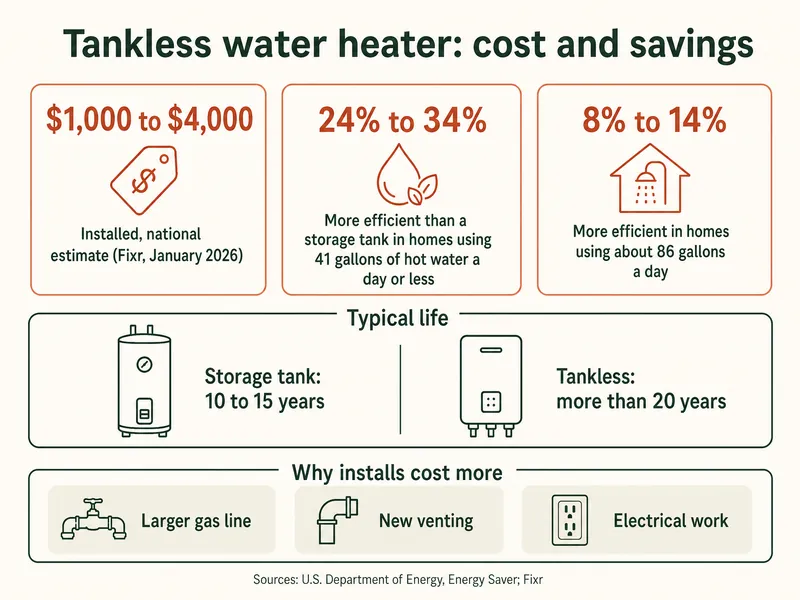
Tankless numbers to know
- $1,000–$4,000Installed cost of a tankless water heater, national estimateFixr, January 2026
- 24–34%Efficiency gain over a storage tank in homes using 41 gallons or less of hot water a dayU.S. Department of Energy, Energy Saver
- 20+ yearsExpected life of a tankless unitU.S. Department of Energy, Energy Saver
- 199,900 Btu/hLargest gas input among the Rheem noncondensing tankless models in its manualRheem tankless use and care manual
Why does tankless installation cost more?
Tankless installation costs more because a gas tankless heater fires at a high gas input while hot water runs, and it needs its own venting. Rheem's manual covers noncondensing models rated at 160,000, 180,000 and 199,900 Btu/h. It says the gas supply line "should be a minimum of 3/4-in." black steel pipe or another approved material, sized to the code tables for the length of run.
Many older houses have a smaller gas line feeding the old tank, so the line may need upsizing. Venting is the second cost: the Rheem manual allows only the maker-approved Category III stainless steel vent material for these models. The unit also needs electrical power for its controls, and Rheem recommends 3/4-inch or larger water inlet and outlet pipes for full flow.
| Factor | Gas storage tank | Gas tankless |
|---|---|---|
| Installed cost (Fixr, Jan 2026) | $900–$3,000 | $1,000–$4,000 |
| Typical life (DOE Energy Saver) | 10–15 years | More than 20 years |
| Efficiency gain at 41 gal/day or less (DOE) | Baseline | 24–34% |
| Efficiency gain at about 86 gal/day (DOE) | Baseline | 8–14% |
| Main upkeep | Flush the tank, check the anode, test the T&P valve | Descale the heat exchanger, clean the inlet filter |
| Federal 2029 standard | Applies to new units from May 6, 2029 | Rule withdrawn in 2025 |
How much energy does a tankless heater save?
A tankless heater saves the most energy in homes that use little hot water. DOE's Energy Saver guidance says demand (tankless) heaters are 24% to 34% more efficient than conventional storage tanks for homes using 41 gallons or less of hot water a day, and 8% to 14% more efficient for homes using around 86 gallons a day. The gain comes from not keeping a tank of water hot around the clock.
Federal rules are moving on the tank side only: DOE's final rule in the Federal Register of May 6, 2024 requires compliance with new consumer water heater standards on and after May 6, 2029, and the separate gas-tankless rule was later withdrawn.
Those percentages apply to water heating, not the whole utility bill. DOE estimates water heating at about 18% of home energy use, so a percentage saving on that slice is a smaller share of the total. This site does not print ENERGY STAR dollar savings figures, because none could be verified on the program's current pages.
How long does a tankless heater take to pay back?
The payback period is the extra installed cost divided by the yearly energy savings, and it varies too much from house to house for a single number. Take the difference between a tankless quote and a tank quote for the same house. Then estimate the yearly saving from your own water-heating cost and DOE's efficiency range for your household's hot water use.
A large family using a lot of hot water sits at the low end of DOE's savings range, and a couple using little sits at the high end, but the couple's total hot water bill is smaller. Longer life helps the case: DOE's more-than-20-year figure for tankless against 10 to 15 years for a tank means one tankless unit may outlast a tank and part of its replacement. Ask contractors to price both options on the same visit so the comparison is fair.
What maintenance does a tankless heater need?
A tankless heater needs its heat exchanger descaled and its inlet water filter cleaned. Rheem's maintenance guidance says a vinegar or descaling solution flush dissolves deposits and suggests flushing or descaling about every six months in hard-water areas, yearly otherwise. Rheem's manual asks owners to clean the water filter monthly and recommends isolation valves to make flushing easier.
Rheem's warranty sets water-quality limits, including total hardness up to 200 mg/L, and excludes damage "caused by lime, mineral build-up, or scale." Carrollton Water Works (East Bank New Orleans) reported 100.7 mg/L hardness in its 2025 report, inside that limit. The same report lists aluminum at 0.27 mg/L in one sample, above the top of Rheem's 0.05 to 0.2 mg/L range; owners in that area may want to ask the installer how the maker treats that. The New Orleans water hardness guide and the water heater flush guide have more.
When is a tank water heater the better buy?
A tank is often the better buy when the upfront budget is tight, when converting would need a new gas line and vent, or when the household uses a lot of hot water and so sits at the low end of DOE's savings range. In those cases a tank's lower installed cost may never be recovered by a tankless unit's savings.
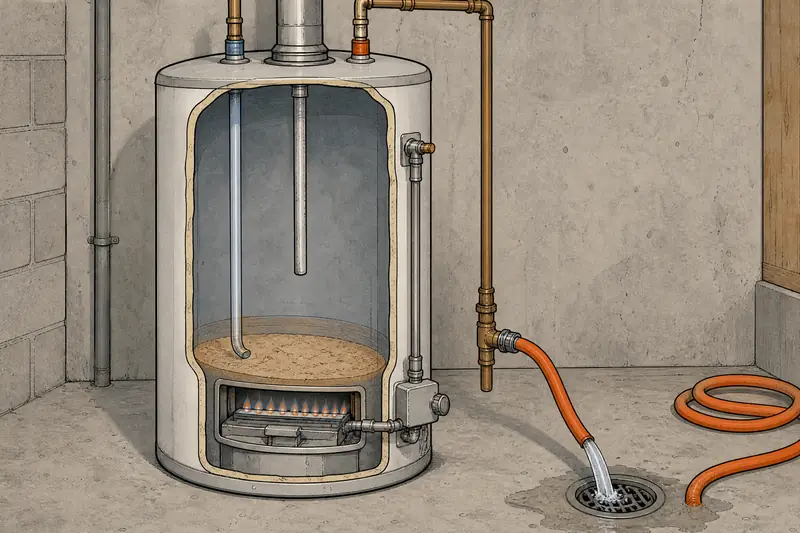
Tanks are not maintenance-free either. The A. O. Smith residential gas manual says its heaters should be drained and flushed every 6 months to remove sediment.
Space and the existing setup matter too. If the house already has a gas tank with a good vent in a closet, a like-for-like swap is the simplest job. If the old tank is in the way, or the house needs the floor space, a wall-hung tankless unit has an advantage that is not about energy. The water heater lifespan guide helps judge how much life the current tank has left.
How we put this page together
Sources behind this page: DOE's Energy Saver article on tankless or demand-type heaters (now offline at energy.gov, so it was read from a January 2026 archive copy), DOE's consumer water heaters rulemaking page, the Rheem noncondensing tankless manual and Rheem's maintenance article, plus LDH's posted copy of the Carrollton plant's 2025 water quality report. Prices are Fixr's national ranges, last updated by Fixr in January 2026; Fixr is named in the text without a link. Reviewed October 2026. Omitted on purpose: local installer prices, tax credit amounts and ENERGY STAR savings claims, since none could be confirmed.
Common questions
Is an electric tankless heater cheaper to install than gas?
It avoids a gas line and vent, but it needs an electrical supply sized to the unit, which the electrician has to confirm. This page gives no electric tankless price because no verified figure was found.
Can a tankless heater use the old tank's gas line?
Only if the line is large enough for the new heater's input. Rheem's manual calls for at least 3/4-inch pipe and sizing by the gas code tables for the length of run.
Does a tankless heater need a new vent?
Usually. Rheem's noncondensing models must use only the maker-approved Category III stainless steel vent material, so plan on new venting rather than the old tank's flue.
Will a tankless heater run out of hot water?
It heats water as it flows, so it does not run out the way a tank does, but it can only heat so many gallons a minute. Ask the contractor to size it for the number of fixtures running at once.
Does New Orleans water need a softener before a tankless heater?
Not by Rheem's hardness limit: Carrollton's 100.7 mg/L in 2025 is under the 200 mg/L in Rheem's chart. Regular descaling is still the maker's advice in hard-water areas.
Do tankless heaters face new federal efficiency rules?
No. DOE's December 2024 rule for gas tankless heaters was withdrawn in May 2025. The May 6, 2029 standard applies only to consumer storage heaters.
Is a tankless heater worth it for a small household?
Small households sit in the 24% to 34% band of DOE's efficiency range, but their total hot water spending is lower, so the payback can still be long. Compare quotes for both options before deciding.
Water heater reading

More guides: the Below the Slab home page.