
Sewer & drains
Sewer Line Belly: Why Sags Form and the Fixes
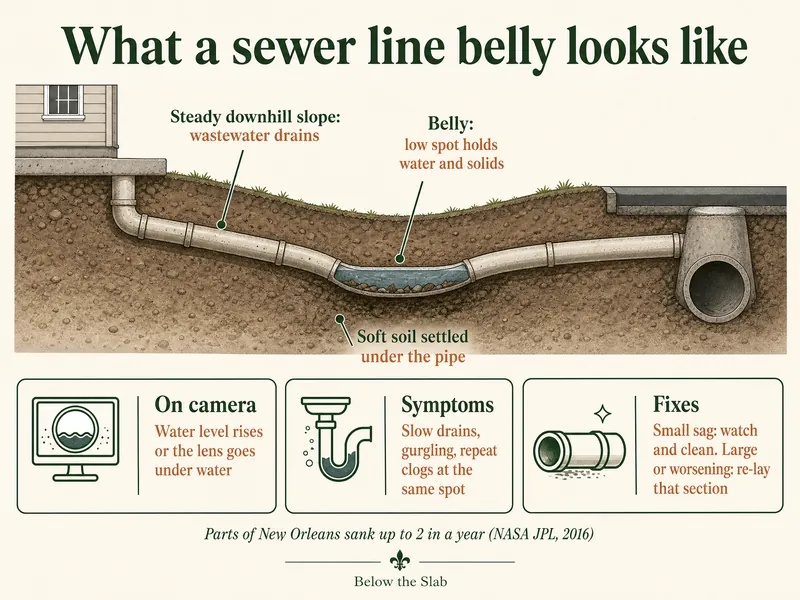
A sewer line belly is a low spot where the pipe has sunk, so water and solids sit in it instead of draining; small ones can be watched, while deep or growing ones need that section re-laid.
On this page
Key takeaways
- A belly is a sag in a sewer line that breaks its steady downhill slope, so wastewater pools in the low spot and solids settle there.
- Ground in the New Orleans area is sinking: NASA's Jet Propulsion Laboratory measured up to 2 inches a year in Michoud and up to 1.6 inches a year behind the Bonnet Carré Spillway.
- An LSU model put average annual property losses from expansive soils in Louisiana at about $66.2 million (2010 dollars).
- On a sewer camera, a sag shows as rising water or a lens that goes under water, as Los Angeles County's sewer inspection reports describe.
- Fixr's national estimate for a sewer camera inspection is $300 to $600 (January 2025); local quotes vary.
- Cleaning clears a belly for a while; only re-laying the section on a firm, sloped bed removes it.
A sewer line belly rarely announces itself. The house drains, just not quite as well as it used to, and the same clog keeps coming back. On soft Gulf South soils, where ground settles and swells, sags are a common finding when a line is filmed. This page explains what a belly is, why it forms, how to judge one and what the fixes involve.
What is a sewer line belly?
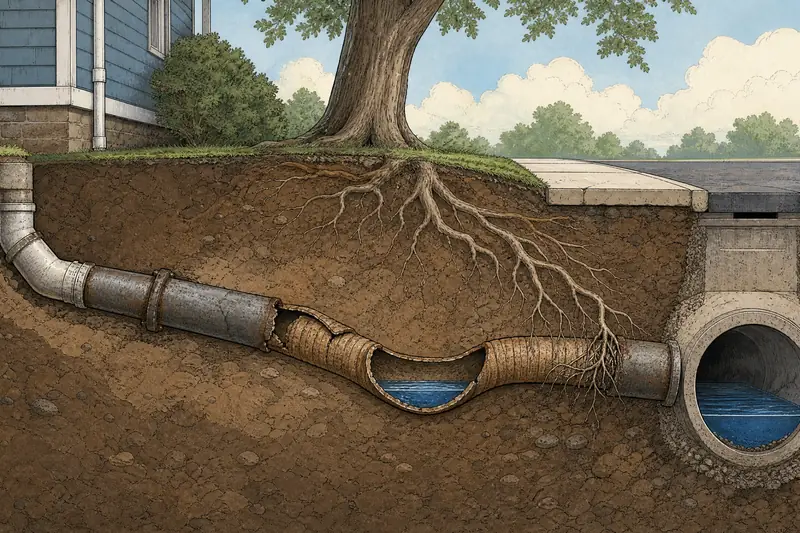
A sewer line belly is a section of pipe that has dropped below the line's intended slope, creating a dip that holds water. A house sewer line, or lateral, works by gravity: it has to fall steadily from the house to the city main. Where one stretch sinks, wastewater runs downhill into the low spot and stops.
The standing water is not the main problem; what settles in it is. Paper, grease and grit drop out of the slow water and build up in the dip. Over months, that deposit narrows the pipe, and a clog forms at the same place again and again.
A belly is different from a break. The pipe can be whole and still sag, and a camera may show clean, intact walls with a pool of water in the middle. That is why a belly is often missed until a line is filmed, and why it tends to sit alongside other faults such as tree roots at a joint that opened when the pipe moved.
Why do sewer lines belly in settling soil?
Sewer lines belly because the soil under them moves, and the pipe follows the ground down. In much of the Gulf South that movement comes from two sources: settling of soft, wet soils and the shrinking and swelling of clay. NASA's Jet Propulsion Laboratory found notable subsidence across the New Orleans area, with rates up to 2 inches a year in Michoud, and named groundwater pumping and dewatering as main causes.
Clay adds its own movement. An LSU-led study of expansive soils in Louisiana modeled average annual statewide property losses of $66,231,136 (2010 dollars) and repeated a USDA estimate that roughly half of US households stand on expansive soils (the American Society of Civil Engineers, cited in the same paper, puts the share of affected homes nearer a quarter). When clay dries it shrinks; when it wets it swells. A buried pipe resting on that soil is lifted and dropped with it.
How the pipe was laid matters as much as the soil. A 2001 review of sewer damage notes that on shrinkable clay, pipes may move, but cites engineers who rank pipe design, materials and workmanship as more important than the clay itself. It also describes older rigid joints that became stiff and cracked when the soil settled. A line laid on poorly packed fill, or across a trench that was never compacted, is the classic starting point for a belly. The guide to foundation settlement and plumbing covers how the same ground movement affects the slab itself.
How is a belly found and measured?
A belly is found with a sewer camera, which shows water standing in the pipe at a measured distance from the cleanout. Los Angeles County's sewer district, in its camera inspection reports, reads sags from recorded water levels, water marks and notes that the camera went under water. Those reports treat a public sewer pipe as at capacity when water fills 50% of its diameter, and say a high reading can come from heavy flow, a temporary stoppage or a sag in the line.
For a house line, ask the operator three things: where the belly starts and ends, how deep the water gets compared with the pipe diameter, and whether debris is sitting in it. A sewer camera inspection with a locator can also mark the spot on the surface and estimate its depth, which matters if the dip runs under the slab.
| Finding | What it looks like on video | What it usually means |
|---|---|---|
| Belly (sag) | Water pooled over a stretch of intact pipe; lens may go under water | The pipe sank; slope is lost in that section |
| Root intrusion | Hair-like or matted roots at a joint | A joint opened; roots are feeding on the leak |
| Offset joint | One pipe end sitting higher or lower than the next | Ground movement shifted the joint |
| Crack or collapse | Visible split, missing pipe wall or soil in the line | Structural failure; repair is not optional |
| Grease or scale buildup | Rough, narrowed walls along a length of pipe | A cleaning problem, not a slope problem |
Film after cleaning if possible. A line full of debris can hide the shape of the dip, and a clean pipe shows how much of the problem is the sag itself.
Does every sewer belly need repair?
No; a small, stable belly that drains between uses can often be watched and cleaned on a schedule instead of dug up. No code table this guide could confirm sets a size at which a residential belly must be repaired, so the decision rests on what the camera shows and how the line behaves.
Signs that favor watching: shallow water that never reaches the top third of the pipe, no debris collecting, and no backups between cleanings. Signs that favor repair: water filling half the pipe or more, solids sitting in the dip, repeat clogs at the same distance, a belly that is deeper on a second video than on the first, or a crack or offset joint inside it.
Ask for a second film a year later if the first one is borderline. A belly that is growing is the soil still moving, and it will not stop on its own. Hydro jetting can scour a dip clean, as the hydro jetting guide explains, but it does nothing for the slope.
How is a belly under a slab fixed?
A belly under a slab is fixed by reaching the sagging section, removing it, rebuilding a firm bed at the right slope and laying new pipe. There are two ways in: cutting and breaking the slab over the spot, or digging a tunnel from outside the house. The guide to tunneling under a slab compares the two; Fixr's national estimate puts a complete tunnel at $900 to $2,000 (May 2025), before any pipe work.
Outside the house, the same section is usually dug from the yard. Lining, which helps with roots and cracks, does not fix a belly on its own: a liner follows the shape of the old pipe, sag included. Fixr's national range for replacing a sewer line is $1,000 to $20,000 (January 2025); the drivers, covered in the replacement cost guide, are depth, length, slab or driveway over the pipe, and access.
In New Orleans, a plumbing permit comes from the Sewerage and Water Board rather than the city's permits office, and the City's permit brochure says only an Orleans Parish licensed master plumber may apply for one. The Louisiana plumbing code guide covers who to ask elsewhere.
Soil and sewer figures
- 2 in/yrHighest subsidence rate measured in Michoud, New OrleansNASA Jet Propulsion Laboratory, 2016
- $66.2MYearly statewide loss to shrink-swell clay, LSU-led model, 2010 dollarsMostafiz and others, Frontiers in Built Environment (2021)
- 50%Share of pipe diameter full of water at which LA County treats a public sewer as at capacityLos Angeles County Public Works
- $300-$600National estimate for a sewer camera inspection, January 2025Fixr
Can you stop a belly from coming back?
A belly can be kept from coming back mainly by how the new section is bedded: on firm, compacted material at a steady slope, not on loose fill. The 2001 review's point about pipes applies here too: design, materials and workmanship matter more than the soil type. Ask the contractor what bedding material will go under the pipe, how it will be compacted, and how the slope will be checked before backfill.
Ask, too, whether the new pipe will be filmed before the trench or tunnel is closed. A short video of the finished run, with water flowing through it, is the simplest proof that the slope is right. Keep it with the house records.
Beyond that, control what you can. Keep gutters and downspouts discharging away from the line, since repeated soaking and drying of clay moves it. Keep large trees away from the sewer route. And if the house shows other signs of settlement, such as new cracks or sticking doors, have the sewer line filmed as part of the check.
How we put this page together
Sources for this page: the NASA JPL subsidence map of New Orleans (2016), the LSU-led study of expansive-soil losses (2021), a 2001 engineering review of sewer pipe damage, Los Angeles County's sewer camera reports, and New Orleans' building permit guidelines. Each was reread in October 2026. Prices come from Fixr's nationwide surveys and are labeled with their dates. Not included: any numeric depth at which a house-line belly must be repaired, prices per foot, trenchless pricing, and claims from plumbing company blogs, because no primary source for them turned up.
Common questions
Can a sewer belly cause a backup into the house?
Yes. Solids that settle in the dip narrow the pipe until a clog forms, and wastewater then backs up to the lowest drain in the house. A slab house often sees it first in a shower or tub.
Can a new sewer line develop a belly?
It can if it was laid on loose fill or across a trench that was not compacted, because the pipe settles as the soil does. Firm bedding and a filmed slope check before backfill are the best protection.
Does hydro jetting fix a sewer belly?
No. Jetting clears the grease and debris that collect in the dip, which can restore flow for a while. The sag itself stays, so the buildup returns.
Is a belly in a cast iron line worse than in PVC?
The sag behaves the same way in both. Older cast iron joints are rigid, so a sinking section is more likely to crack or open at a joint, which adds a second fault to the first.
How deep can water in a belly get before it matters?
No code table this guide could confirm sets a limit for house lines. As a working guide, water filling half the pipe or more, debris in the dip, or repeat clogs point toward repair; LA County uses 50% of the diameter as its capacity mark for public sewers.
Does homeowners insurance cover a sagging sewer line?
Usually not. Louisiana's insurance department says homeowners policies exclude earth movement, and sewer backup water damage needs its own endorsement; the sewer backup guide covers what that endorsement does.
Related sewer guides

More guides: the slab house plumbing guide home page.